Profile
Ken Griffey Jr.
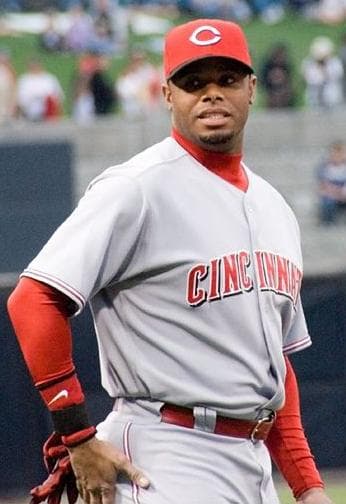
Ken Griffey Jr. in Cincinnati Reds uniform.
Photo credit: Unknown photographer via Wikimedia Commons
Ken Griffey Jr. had the most beautiful swing anyone had seen in a generation, a left-handed stroke so smooth that hitting looked easy and joyful both. He hit 630 home runs, won 10 Gold Gloves in center field, and wore his cap backward with a smile that helped pull baseball back from the brink after the 1994 strike. Injuries cost him a real run at the all-time home run record, and he stayed clean while the men who chased it did not. The BBWAA elected him to the Hall of Fame in 2016 with a record 99.32 percent of the vote.
The Son of a Big Red Machine
Griffey was born on November 21, 1969, in Donora, Pennsylvania, the same small mill town that produced Stan Musial, born exactly 49 years earlier to the day. His father Ken Griffey Sr. starred in the outfield for Cincinnati's Big Red Machine, and the boy grew up in major league clubhouses, learning the game from the men who played it best. The talent was obvious early, so obvious that the Seattle Mariners made him the first pick in the entire 1987 draft. Stardom waited, but so did trouble.
The Hardest Year
The pressure nearly broke him before it lifted him. In January 1988, at 17, Griffey swallowed 277 aspirin tablets in a suicide attempt and spent time in a hospital before he recovered. He spoke about it openly in later years, refusing to bury it. "It seemed like everyone was yelling at me in baseball," he said, "then I came home and everyone was yelling at me there." He came through the darkness and reached the majors the next spring, and the joy that became his trademark was hard-won, not given.
Back-to-Back with His Father
Griffey debuted on April 3, 1989, at 19, and doubled in his first at-bat, and the smile and the swing did the rest. The most tender moment of his early years came on September 14, 1990, when the Mariners signed his father to play beside him and the two hit back-to-back home runs in the same inning, the first father and son ever to go deep in succession. "It's about time," the elder Griffey told his boy. They were the first father-son pair to play together as teammates, and for 51 games an entire family lived out a dream the sport had never staged.
The Catch and the Swing
For a decade in Seattle, Griffey was the best all-around player in the game. He won 10 straight Gold Gloves in center field, running down balls in the alleys and climbing the wall to steal home runs, and at the plate the swing produced power without effort. The backward cap and the easy grin made him the face of the sport, and when the 1994 strike soured fans on the game, his joy was part of what brought them back. He led the American League in home runs four times in the 1990s and put up 438 by the end of his age-30 season, more than Hank Aaron had at the same age, with the all-time record squarely in his sights.
The Run That Saved Baseball in Seattle
The defining moment came in October 1995, when the Mariners faced the Yankees in a division series that kept the franchise in Seattle. Griffey homered five times in the five games, a record-tying barrage, and the series came down to the bottom of the eleventh inning of Game 5. With Griffey on first base, Edgar Martínez doubled down the left-field line, and Griffey never stopped running, sliding home with the winning run as the dugout buried him. The play is remembered simply as the Double, the hit that won a new ballpark and saved baseball in the Pacific Northwest. In 1997 he won the American League MVP in a unanimous vote, hitting .304 with 56 home runs and 147 runs batted in.
Home to Cincinnati and the Injuries
In February 2000 Griffey forced a trade to the Cincinnati Reds, the team of his childhood, and went home. "I'm finally home," he said. "This is my hometown. I grew up here." The homecoming turned cruel. Hamstrings and knees and a shoulder gave out one after another, and the player who had averaged 150 games a year in Seattle could barely stay on the field, costing him any real chance at Aaron's record. He still reached his 500th home run on Father's Day in 2004 and finished with 630, fifth-most in history when he retired, the count of what the injuries left intact.
The Clean One
Through the years when McGwire and Sosa and Bonds rewrote the record book on chemistry, Griffey did it the old way, and everyone knew it. No suspicion ever touched him, and he became the natural alternative to the inflated sluggers around him, the great clean star of a dirty era. He made 13 All-Star teams, won seven Silver Sluggers, and took his place on baseball's All-Century Team in 1999. When the writers voted him into the Hall of Fame in 2016, 437 of 440 named him, 99.32 percent, the highest share anyone had ever received. He went in wearing the Mariners cap, turned backward on the plaque, the only way to picture The Kid.