Profile
Marvin Miller
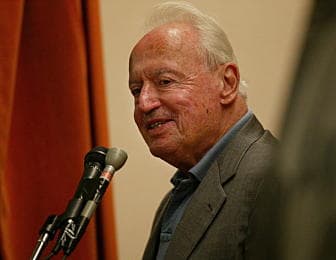
Marvin Miller portrait.
Photo credit: Unknown photographer via Wikipedia
Marvin Miller never played an inning, and he changed baseball more than almost anyone who did. He took a players' union that the owners treated as a formality and built it into the most powerful labor organization in American sports, winning the collective bargaining, the arbitration, and finally the free agency that remade the economics of the game. The owners who resented him kept him out of Cooperstown for as long as they could, and he died before they relented. The Modern Baseball Era Committee elected him to the Hall of Fame in 2020, eight years after his death.
The Labor Man
Miller was born on April 14, 1917, and grew up in Brooklyn in a working-class Jewish family, the son of a garment-trade salesman and a public-school teacher who belonged to her union. He learned the labor movement early, walking a picket line as a young man, and after an economics degree at New York University he spent his career representing workers, most prominently as the chief economist for the United Steelworkers. He was a negotiator by trade, patient and rigorous, and he understood the power that organized workers held when they acted together. In 1966 the baseball players came looking for someone to run their union, and they found exactly the wrong man for the owners.
A Union Worth the Name
What Miller inherited in 1966 was a union in name only. The minimum salary had sat near 6,000 dollars for two decades, the players had no real voice, and the men who ran the game treated the association as a courtesy. "They had been so beaten down that they really didn't understand their value in the game," Miller said, and his first job was to teach them otherwise. He organized them, educated them, and in 1968 won the first collective bargaining agreement in professional sports, raising the minimum salary and establishing that the players could bargain as a bloc. The toothless group had grown teeth.
Arbitration and the First Strike
Miller pressed his advantage methodically. He won independent grievance arbitration in 1970, putting a neutral party between the players and the commissioner, and salary arbitration in 1973, giving players a way to fight for their pay. When the owners balked in 1972, he led the players into the first strike in the sport's history, a 13-day walkout that cost 86 games and ended with the owners blinking. He had shown that the union would not be bluffed, and that the players would hold together when it counted, and the lesson reshaped every negotiation that followed.
Breaking the Reserve Clause
The great prize was the reserve clause, the rule that bound a player to one team for life, and Miller attacked it on two fronts. He backed Curt Flood's lawsuit against the system, a case the Supreme Court rejected in 1972 but that put the injustice on the record. Then he found a cleaner path, having the pitchers Andy Messersmith and Dave McNally play a full season unsigned and argue that the clause renewed for only one year, not forever. The arbitrator Peter Seitz agreed on December 23, 1975, striking down the reserve clause and creating free agency, the single most consequential ruling in the business of the sport.
The Money Revolution
The numbers measure what he did. The average player salary stood around 19,000 dollars when Miller arrived in 1966 and had climbed past 240,000 by the time he retired in 1982, on its way to the millions that free agency would eventually bring. He had transferred a fortune from the owners to the players and built the machinery, the bargaining and the arbitration and the open market, that kept the money flowing long after he left. No labor leader in American sports accomplished more, and the players who came after him lived in the world he had made.
The Enemy of the Owners
The achievement made Miller the most hated man in the owners' boardrooms, and the resentment followed him toward Cooperstown. The veterans committees that judged executives were stacked with management men, and they passed him over again and again, at least seven times, once by a single vote, while lesser figures from the owners' side went in. Red Barber had called him one of the two or three most important people in baseball history, alongside Babe Ruth and Jackie Robinson, and Hank Aaron said the players should break down the doors to get him elected. Miller, disgusted, finally asked to be left off the ballot. "I find myself unwilling to contemplate one more rigged Veterans Committee," he wrote, "whose members are handpicked to reach a particular outcome."
Cooperstown at Last
He did not live to see it. Miller died on November 27, 2012, at 95, still outside the Hall that had spurned him, and the recognition came only afterward. The Modern Baseball Era Committee elected him in December 2019, and he was inducted with the Class of 2020, his old adversaries finally outnumbered on the panel that judged him. He went in alongside Ted Simmons, the catcher who had played an unsigned season in the fight Miller led, a fitting pairing for the man who taught the players what they were worth. The union leader who never wore a uniform had earned a plaque among the players he set free.