Profile
Mike Piazza
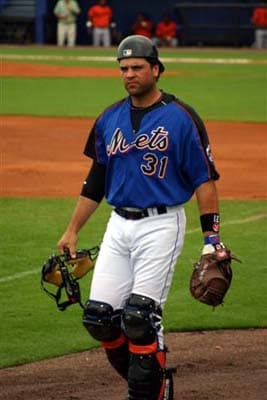
Mike Piazza during spring training in 2004.
Photo credit: Unknown photographer via Wikimedia Commons
Mike Piazza was the 1,390th player taken in his draft, a courtesy pick to a family friend, and he became the greatest hitting catcher the game has ever seen. He hit 427 home runs, 396 of them behind the plate, more than any catcher in history, and he batted .308 across 16 years that began as an afterthought and ended in Cooperstown. He gave New York its most needed home run on a night the city could barely stand, and he climbed the longest road to the Hall any great hitter has walked. The BBWAA elected him in 2016.
The Last Pick That Mattered
Piazza was born on September 4, 1968, in Norristown, Pennsylvania, the son of a self-made businessman named Vince, who happened to be a lifelong friend of Tommy Lasorda. That friendship is the only reason Piazza got a chance. As a favor to Lasorda, the Los Angeles Dodgers used a 62nd-round pick on him in 1988, the 1,390th selection of 1,395, and signed him for a small bonus only because Lasorda insisted he learn to catch. A teenage Mike had once taken hitting tips in his own backyard from Ted Williams, who signed a copy of his book, "As good as you look now, I'll be asking you for tickets." The prophecy looked absurd at the time. It turned out short.
Rookie of the Year
Catching was the bargain that bought him a career, the one position thin enough to give an unheralded slugger a path, and Piazza worked his way up the system on the strength of a bat no one could ignore. He reached Los Angeles for good in 1993 and won the National League Rookie of the Year in a unanimous vote, batting .318 with 35 home runs and 112 runs batted in, the most home runs any rookie catcher had ever hit. The Dodgers had found a franchise hitter in the last place anyone looks, and for five years he was the best catcher in baseball, an All-Star every season and a perennial contender for Most Valuable Player.
Traded Twice in a Week
The Dodgers let him get away in a stunning sequence in May 1998. Contract talks had stalled, and Los Angeles shipped him to the Florida Marlins in a seven-player deal, and a week later the Marlins flipped him to the New York Mets, so that he changed teams twice in eight days. New York gave him the home he wanted. After the season the Mets signed him to a seven-year contract worth 91 million dollars, the richest deal in baseball at the time, and Piazza became the centerpiece of a franchise and a New York icon. He carried the Mets to the 2000 National League pennant, where they lost a Subway Series to the Yankees in five games.
Clemens and the Broken Bat
That fall produced the strangest feud of his career, against the Yankees pitcher Roger Clemens. In July 2000, Clemens hit Piazza in the head with a fastball and gave him a concussion, and the bad blood carried into October. In Game 2 of the World Series, Piazza shattered his bat on a foul ball, and Clemens fielded the jagged barrel and flung it toward Piazza as he ran up the first-base line, an act no one has fully explained since. The benches emptied, the moment became one of the indelible images of the Series, and the rivalry gave the two cities a grudge they nursed for years.
The Home Run New York Needed
Piazza's largest moment was not about baseball at all. On September 21, 2001, the Mets hosted the first professional sporting event in New York after the September 11 attacks, a raw and grieving night at Shea Stadium with the Atlanta Braves leading 2-1 in the eighth inning. With a man on base, Piazza drove a pitch from Steve Karsay deep to left-center for a go-ahead home run, and a wounded city found something to cheer. "The hardest thing I've ever had to do as an athlete was play that game," he said. "We had to win that game." They did, and the swing outlived the score.
The Catcher They Doubted
The book on Piazza always carried a caveat, that he could not throw, that base-stealers ran on him at will, and the caught-stealing numbers gave the critics ammunition. The fuller picture is kinder, because he blocked balls in the dirt, called good games, and earned a rating from a later pitch-tracking study as one of the best framers ever to crouch behind the plate, and the pitchers he caught kept posting low earned run averages. He finished with a .308 average, 427 home runs, and 12 All-Star selections, and the bat settled any argument about the glove. No catcher in the history of the game hit the ball as he did.
The Long Road to Cooperstown
Piazza finished with the Mets through 2005, then a season in San Diego and a final year in Oakland before he retired in 2008. The Hall of Fame made him wait. Whispers of steroids followed him with no positive test and no evidence behind them, and his vote total climbed slowly, from 57.8 percent in his first year to election in 2016 with 83 percent on his fourth try. He went in wearing a Mets cap, the second player so honored after Tom Seaver, and the Mets retired his number 31. The last pick who mattered had become the standard every hitting catcher is measured against.