Profile
Rabbit Maranville
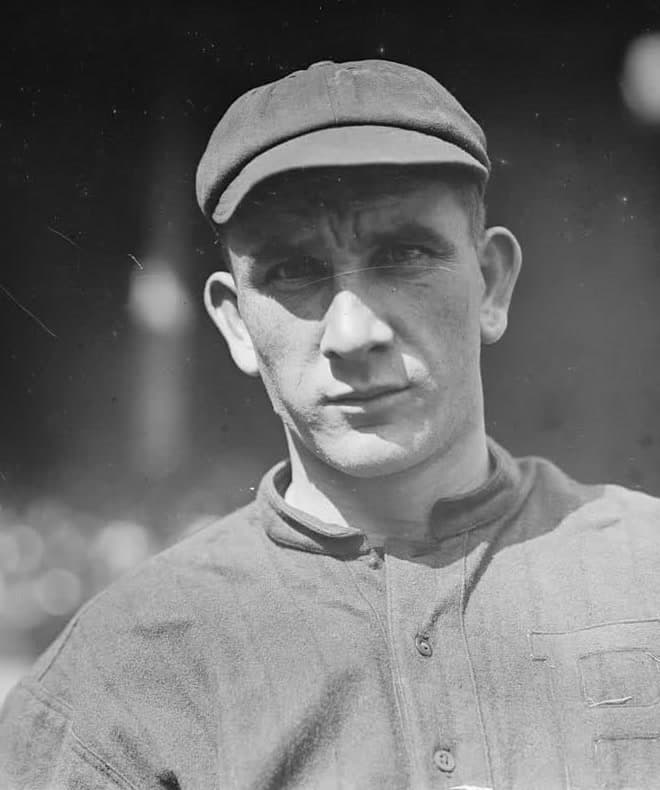
Rabbit Maranville portrait, Boston NL.
Photo credit: Bain News Service via Wikimedia Commons (Public domain)
Walter James Vincent Maranville stood 5-foot-5 and weighed 155 pounds, played 23 major league seasons at shortstop, and spent much of that time proving he belonged through defensive brilliance and sheer force of personality. He was the starting shortstop on the 1914 Miracle Braves, the most improbable World Series champion in baseball history, and he was still playing in the major leagues at age 43 more than two decades later. Between those two points he collected 2,605 hits, drank heavily enough to lose a managerial job, quit drinking entirely, and turned himself into one of the most beloved and exasperating figures of his era. The BBWAA elected him to the Hall of Fame posthumously in 1954.
Springfield
Maranville was born on November 11, 1891, in Springfield, Massachusetts. He was small as a child, small as a teenager, and small as a professional ballplayer, and his nickname came from his quick, darting movements in the field and on the basepaths. He played for minor league teams in New England before breaking into the major leagues with the Boston Braves in 1912. He became the starting shortstop in 1913 and immediately established himself as one of the best defensive players in the National League, covering ground that larger shortstops could not reach and throwing from angles that seemed improbable for a man of his size.
His trademark was the vest-pocket catch, in which he caught pop flies at his waist rather than overhead. The technique looked reckless and entertained crowds everywhere the Braves played. Coaches discouraged it. Maranville kept doing it for his entire career, and it became as much a part of his identity as his speed or his glove work. He understood that he was a performer as well as a player, and the vest-pocket catch gave audiences something to remember beyond the routine plays that filled most defensive innings.
The Miracle Braves
The 1914 Braves sat in last place on July 4 and looked like one of the worst teams in baseball. Over the final two and a half months they went on one of the greatest sustained runs in major league history, winning at a pace that carried them from the cellar to the National League pennant by ten and a half games. They entered the World Series against Connie Mack's Philadelphia Athletics, who had won three of the previous four pennants and were heavy favorites. The Braves swept the Series in four games, one of the most stunning upsets in postseason history.
Maranville was the defensive anchor throughout the Series. He played every inning at shortstop, handled his chances cleanly, and hit .308 against a pitching staff that had dominated the American League for years. The Miracle Braves were a team without a single dominant star, and their championship depended on the collective performance of players like Maranville who played above their heads at exactly the right moment. Maranville's performance in October 1914 became the signature achievement of his career, the event that defined his reputation for the rest of his life.
The Long Career
Maranville played for the Braves, Pittsburgh Pirates, Chicago Cubs, Brooklyn Robins, and St. Louis Cardinals across his 23 seasons. He hit .258 for his career with almost no power, finishing with just 28 home runs in more than 10,000 plate appearances. His defense kept him employed in every lineup he joined. He led National League shortstops in putouts and assists multiple times and set records for games played at the position that stood for decades.
His off-field behavior was legendary and not always in ways he would have chosen. He poured ice water on sleeping teammates during road trips. He climbed out of hotel windows on upper floors. He drank with a determination that matched his approach to fielding ground balls, and the habit eventually cost him a job. The Cubs named him player-manager in 1925, but he was fired after 53 games, undone by drinking that undermined whatever authority the position required. He had been a beloved teammate for years, but managing demanded a different kind of respect, and alcohol made it impossible to maintain.
He later quit drinking entirely, a decision he credited with extending his career into his forties. The transformation was genuine and complete. He played productive baseball for the Cardinals' 1928 pennant-winning team and continued performing at a level that kept him in the major leagues until 1935, when he was 43 years old. Few players of any era have lasted as long, and almost none who stood 5-foot-5 and relied on defense rather than the bat.
Death
Maranville broke his leg during spring training in 1934 and played only sparingly after that, appearing in his final game during the 1935 season with the Braves. He suffered a heart attack on the evening of January 5, 1954, at his home in Woodside, Queens, and died shortly after midnight on January 6 at age 62. The BBWAA elected him to the Hall of Fame posthumously later that month, the vote announced just weeks after his death.