Profile
Roberto Alomar
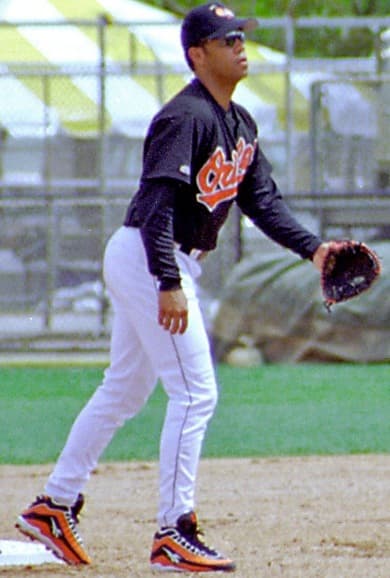
Roberto Alomar portrait.
Photo credit: Unknown photographer via Wikimedia Commons
Roberto Alomar played second base with a grace that stood out even in a family full of major leaguers, and for a dozen years he was the best in the game at his position, a switch-hitter who could turn a game with his glove, his legs, and his bat in the same inning. He won 10 Gold Gloves, a record for a second baseman, made 12 straight All-Star teams, and won back-to-back World Series with the Toronto Blue Jays. His career also held the ugliest moment of his public life, the night he spat in an umpire's face, and a fall from grace decades later that put him on baseball's permanently ineligible list. The BBWAA elected him to the Hall of Fame in 2011.
A Son of Puerto Rican Baseball
Alomar was born on February 5, 1968, in Ponce, Puerto Rico, into the game. His father, Sandy Alomar Sr., played 15 years in the major leagues as an infielder, and his older brother, Sandy Alomar Jr., became a six-time All-Star catcher, the two of them the first brothers picked for the same All-Star Game since the Perrys in 1970. Roberto grew up around big league clubhouses, learned to grip a pitch from Nolan Ryan as a small boy, and signed with the San Diego Padres, reaching the majors at 20 in 1988, a slick switch-hitting second baseman who already moved like a veteran.
The Greatest Glove at Second
Alomar fielded his position the way few ever have, with acrobatic range, soft hands, and a flair that turned routine outs into theater. He ranged deep into the hole and far up the middle, and he made plays bare-handed that scouts could not remember anyone trying before him. "He's acrobatic, flamboyant, he's got his style," said Dave Winfield, who played beside him in Toronto. He won 10 Gold Gloves, a record for a second baseman, three of them turning double plays with the shortstop Omar Vizquel in Cleveland. "It would be worth the price of a ticket," the Indians general manager John Hart said, "just to watch Omar and Robbie turn a double play."
The Home Run Off Eckersley
The defining moment of Alomar's career came in October 1992, in Game 4 of the American League Championship Series at Oakland. With the Blue Jays trailing in the ninth inning and the late-afternoon shadows making the ball hard to see, he hit a game-tying, two-run home run off Dennis Eckersley, the best closer in baseball that year, and swung the series Toronto's way. "As soon as I made contact, I knew it was out of there," Alomar said. "This was the greatest game of my career." He was named the series MVP, and the Blue Jays went on to win the first of two straight World Series, the first championships ever won by a team based outside the United States. He hit .480 in the 1993 Series, the best player on a champion both years.
The Spitting Incident
On September 27, 1996, Alomar argued a called third strike with umpire John Hirschbeck, and when Hirschbeck ejected him, Alomar spat in his face and then made an ugly remark about the umpire's family. The act drew a five-game suspension, deferred to the next season so he could play in the 1996 playoffs, and a wave of public disgust. What he did next was harder to predict, an apology, a $50,000 donation to research into adrenoleukodystrophy, the disease that had killed one of Hirschbeck's young sons, and a handshake with the umpire at home plate the next spring. The real peace came later, in 1999, after both had moved on, when they talked it through and became friends. "If he and I can forgive and forget," Hirschbeck said, "why not everyone else?"
The Peak Years
Alomar was a complete player at his height, a .300 hitter with power and speed who could beat a team any way the game allowed. "He has the ability to hit a home run, or work the count and hit a double down the opposite line," Tony Gwynn said. "He's probably the best all-around player in the game." His finest seasons came in Cleveland from 1999 through 2001, when he hit .323 with career highs of 24 home runs, 120 runs batted in, and 138 runs scored, and finished third in the MVP vote. He retired with a .300 average, 2,724 hits, and 474 stolen bases, the best second baseman of his generation.
The Sudden Fall
Traded to the New York Mets after the 2001 season as a star, Alomar hit .266 the next year and never got his game back, his 12-year run of All-Star selections ending all at once. "Sometimes you put too much pressure on yourself in New York," he said, "and maybe I did that." He bounced through the White Sox and the Diamondbacks and was finished by 2005, his decline as steep as his peak had been high.
The First Blue Jay in Cooperstown
The writers elected Alomar to the Hall of Fame in 2011, in his second year on the ballot, with 90 percent of the vote, and he became the first player ever inducted wearing a Toronto Blue Jays cap. He opened his speech in Spanish and honored his father and brother, who had raised him in the game. By any measure of the position, he belonged among the greatest second basemen who ever played.
The Permanent Ban
A decade later the game cut him off. In April 2021 Major League Baseball placed Alomar on its permanently ineligible list after an independent investigation into a sexual misconduct allegation, reported that year, concerning conduct in 2014. "I have concluded that Mr. Alomar violated MLB's policies," the commissioner Rob Manfred said. The Blue Jays took down his banner and returned his number to circulation. The Hall of Fame, a private institution, kept his plaque on the wall. "His plaque will remain on display," the chairman Jane Forbes Clark said, "in recognition of his accomplishments in the game." Alomar is the only man both enshrined in Cooperstown and barred from the sport.