Profile
Ted Simmons
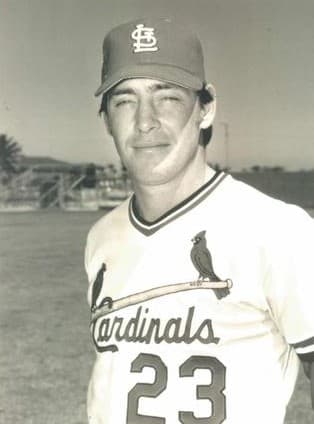
Ted Simmons in St. Louis Cardinals uniform.
Photo credit: Unknown photographer via Wikimedia Commons
Ted Simmons hit better than almost any catcher of his time and finished with more hits than any catcher who had ever played, and then the writers dropped him from the ballot after a single year. He was a switch-hitting force behind the plate, a thinking man with long hair and strong opinions who once dared to challenge the reserve clause before free agency existed. It took the game nearly three decades to correct the snub, and a committee finally did. The Modern Baseball Era Committee elected him to the Hall of Fame in 2020.
Simba
Simmons was born on August 9, 1949, in Highland Park, Michigan, and grew up outside Detroit, a gifted athlete who could have played college football. He chose baseball, and the St. Louis Cardinals made him a first-round pick in 1967, the 10th selection overall, a switch-hitting catcher with a quick bat. The long brown hair that spilled out of his cap earned him the nickname Simba, and the personality matched the look, a free-thinker who collected antiques, served on an art museum board, and spoke his mind in a clubhouse culture that preferred its players quiet. He was different, and he did not mind being.
The Man Who Played Without a Contract
In 1972 Simmons did something almost no player had dared. He refused the Cardinals' contract offer and played the early months of the season unsigned, a direct test of the reserve clause that bound a player to his team in perpetuity, the kind of stand that could have made him a martyr. He downplayed the crusade even as he waged it. "I'm not a crusader," he said. "I don't even have a lawyer. All I want is more money." He signed a two-year deal that July before the question reached a courtroom, but the act itself fed the argument that broke the reserve clause three years later, a forerunner of the revolution to come.
The Best-Hitting Catcher Nobody Watched
For a decade in St. Louis, Simmons hit like few catchers ever had, and almost no one outside Missouri noticed. He played in the long shadow of Johnny Bench and later Carlton Fisk, the glamour catchers of the era, while he quietly batted .300 seven times and drove in runs from both sides of the plate. He hit .332 in 1975, one of the finest offensive seasons any catcher has managed, and he kept producing year after year without the spotlight the other two enjoyed. The bat was the equal of anyone's at the position, and the recognition never quite matched it.
Harvey's Wallbangers
The Cardinals traded Simmons to Milwaukee after the 1980 season, and he found the October stage that St. Louis had never reached with him. The 1982 Brewers, a slugging bunch nicknamed Harvey's Wallbangers for their manager Harvey Kuenn, won the American League pennant and reached the World Series, where they ran into the Cardinals, of all teams. St. Louis won it in seven games, beating the catcher they had given up on, a bitter irony that capped his only trip to the Series. He finished his career with a stint in Atlanta, a respected veteran to the end.
The Numbers
The totals tell the story the fame never did. Simmons retired with a .285 average, 2,472 hits, 248 home runs, and 1,389 runs batted in, the most hits by any catcher in the history of the game at the time he walked away. He made eight All-Star teams and caught nearly 1,800 games, durable and productive across 21 seasons, the kind of career that usually ends in Cooperstown without a wait. The defensive metrics were less kind to him, and the lack of a signature trophy hurt, but the offensive record stood above every catcher who came before.
The Front Office
When his playing days ended, Simmons stayed in the game on the other side, building one of the more substantial post-playing careers among his peers. He ran the Pittsburgh Pirates as general manager and watched them win a division title in his first season, until a heart attack forced him out of the job in 1993. He spent the decades that followed scouting and advising, helping build contenders in Cleveland, San Diego, and Seattle, the thinking player who turned into a respected baseball mind. The intelligence that had made him an outlier as a young catcher served him well in the executive ranks.
The Long-Overdue Call
The Hall of Fame nearly forgot him entirely. The writers gave Simmons just 3.7 percent of the vote in 1994, dropping him from the ballot after a single year, an astonishing dismissal of a player with his record. He waited a generation for a second look, came within one vote of election in an earlier committee round, and finally got in when the Modern Baseball Era Committee chose him in December 2019. "There's never too long a time to wait if you finally make the leap," he said, "and today I finally did." He went in with a Cardinals cap, alongside Marvin Miller, the union leader whose fight he had joined as a young man playing out an unsigned season.