Profile
Tim Raines
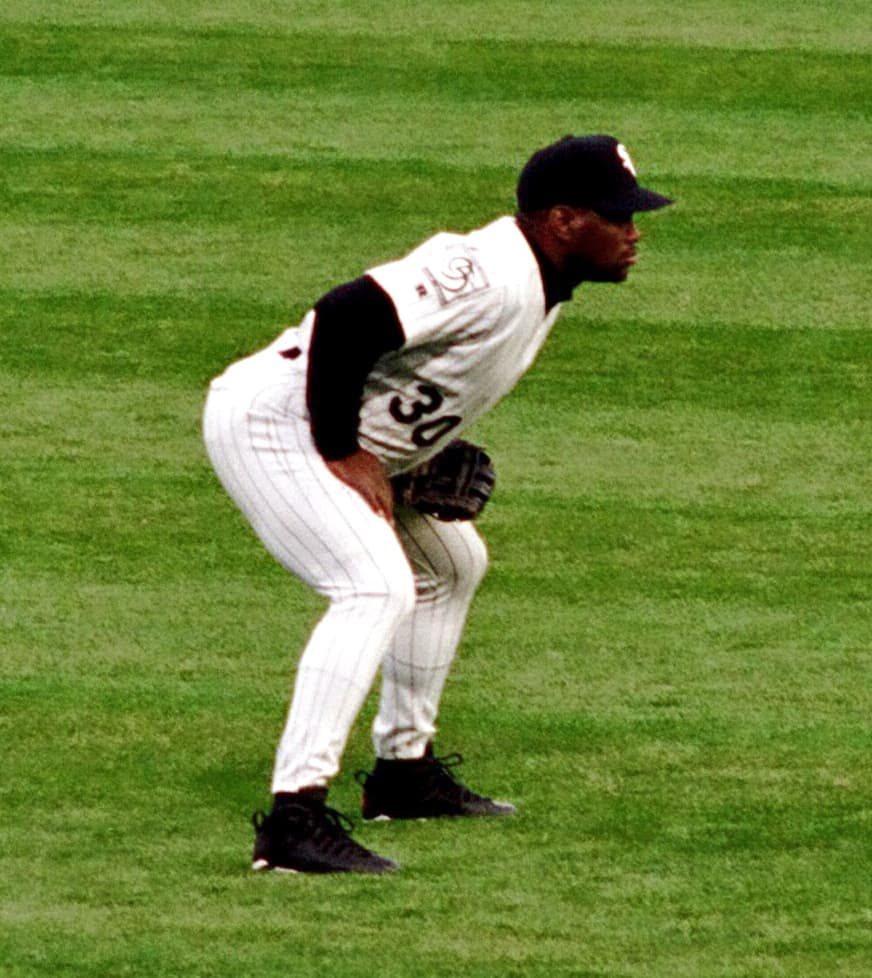
Tim Raines in Chicago White Sox uniform, 1995.
Photo credit: Unknown photographer via Wikimedia Commons
Tim Raines stole bases better than anyone who ever played, and for most of his career almost nobody noticed. He swiped 808 of them at a success rate no high-volume base-stealer has matched, got on base at a .385 clip, and scored more runs than a lot of men already in Cooperstown. He had the misfortune of arriving alongside Rickey Henderson, the one leadoff man of his era who stood above him, and the bad luck cost him recognition for decades. The BBWAA elected him to the Hall of Fame in 2017, in his final year on the ballot.
Rock
Raines was born on September 16, 1959, in Sanford, Florida, and the Montreal Expos drafted him in the fifth round in 1977. He was built low and thick with muscle, so lean that a teammate started calling him Rock, and the name fit the way he ran the bases, all power and acceleration. By 1981 he was a full-time Expo and an instant terror, stealing 71 bases in a strike-shortened season and finishing second in the Rookie of the Year vote. He led the National League in steals each of his first four full seasons, swiping 78, then 90, then 75, and he ran with a precision that set him apart.
The Best Base-Stealer There Was
The raw total of 808 stolen bases ranks fifth in history, but the number that defines Raines is the rate. He succeeded on 84.7 percent of his attempts, the best mark of anyone who ever stole 400 or more, better even than Henderson, which means he gave away fewer outs on the bases than any great runner in the game. He stole 70 or more in six straight seasons and was caught so rarely that the risk almost vanished. Stealing a base helps a team only if the runner is safe often enough to justify the out, and no one cleared that bar as consistently as Raines did.
More Than a Runner
The speed got the attention, but Raines reached base like a star and hit like one too. He won the National League batting title in 1986 at .334, finished with a .294 average and 2,605 hits, and drew 1,330 walks against fewer than a thousand strikeouts, the patience of a hitter who understood his value lived in getting on. He scored 1,571 runs and posted a .385 on-base percentage, and he stands as the only player in history with at least 100 triples, 150 home runs, and 600 stolen bases. He made seven straight All-Star teams from 1981 through 1987 and took the 1987 game's Most Valuable Player award with a 13th-inning triple.
The Vial in His Pocket
The early 1980s nearly swallowed him. Raines developed a cocaine addiction that ran so deep he carried the drug in his uniform pocket and slid headfirst to keep from breaking the vial, and he later admitted to using it before games and between innings. He entered rehabilitation after the 1982 season and testified at the Pittsburgh drug trials in 1985, naming his habit in open court. He credited his teammate Andre Dawson with helping him straighten out, and he named a son after the man who pulled him back. The addiction could have ended everything, and instead it became the low point he climbed out of.
Collusion and the Grand Return
After the 1986 season Raines became a free agent and found that no team would bid, the owners quietly colluding to hold salaries down, and the rules kept him from re-signing with Montreal until May. He came back on May 1, 1987, sat out a few weeks of conditioning, and returned to the lineup on May 2 against the Mets, where he answered the insult with the loudest game of his life. He went 4 for 5 with a triple on the first pitch he saw all year, stole a base, and won it in the 10th inning with a grand slam off Jesse Orosco. The owners had frozen him out, and he made them watch what they had tried to bury.
Two Rings in the Bronx
The Expos traded Raines to the Chicago White Sox after the 1990 season, and he led the American League with 51 steals in his first year there. He moved on to the Yankees in 1996 as an aging role player, and he found the October stage that Montreal's lean years had denied him, winning World Series titles in 1996 and 1998. He played the part with a joy that filled the clubhouse, a veteran happy to do less and win more. Along the way doctors diagnosed him with lupus, and he fought the disease and kept playing, even sharing a 2001 Orioles lineup with his son Tim Raines Jr.
The Last Ballot
Raines retired with a case that the traditional numbers undersold, and the writers took a long time to see it. He debuted at 24.3 percent in 2008, far below the bar, and climbed slowly as a generation of analysts argued that on-base skill and base-stealing efficiency were worth more than the counting stats showed. In 2017, his 10th and final year of eligibility, he reached 86 percent and got in, joining the short list of players elected on their last try. He went in wearing an Expos cap, the face of a franchise that no longer existed, finally counted among the greatest leadoff men the game has produced.