Profile
Todd Helton
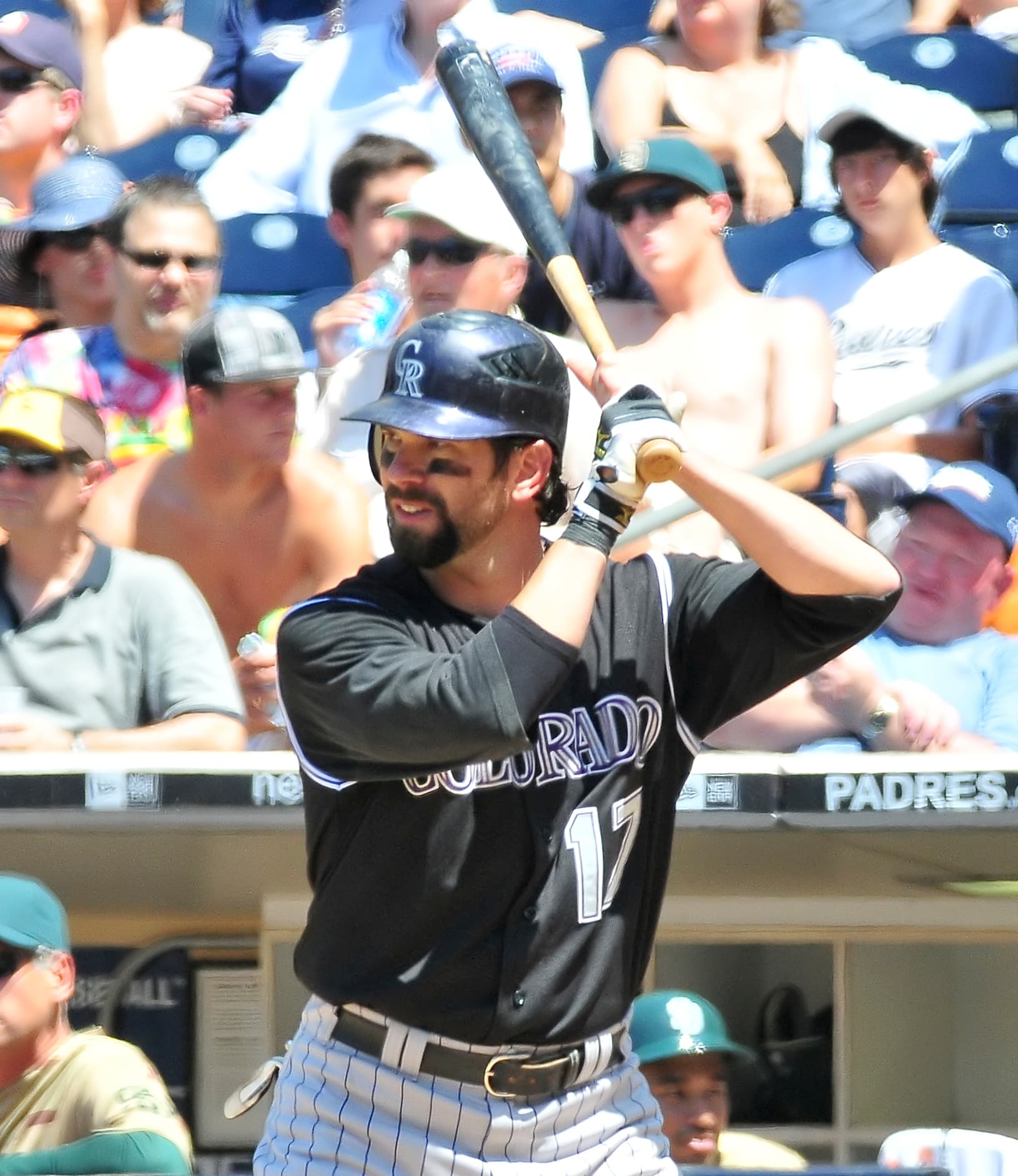
Todd Helton portrait.
Photo credit: Unknown photographer via Wikimedia Commons
Todd Helton played all 17 of his seasons for the Colorado Rockies and hit better than almost anyone of his time, a .316 career average and an on-base percentage above .400 that put him among the elite offensive players of his era. He nearly won a Triple Crown in 2000 with one of the great seasons anyone has had, fielded first base with three Gold Gloves, and became the face of a franchise. The thin air of Coors Field cast a long shadow over his case, and the voters took years to look past it. The BBWAA elected him to the Hall of Fame in 2024.
The Quarterback
Helton was born on August 20, 1973, in Knoxville, Tennessee, the son of a former minor league catcher, and he went to the University of Tennessee as a two-sport star, a baseball standout and a quarterback. He worked his way up the football depth chart and became the starter in 1994 after the man ahead of him blew out a knee, holding the job until he hurt his own knee a few games later. The freshman who replaced him was Peyton Manning, who never gave the job back, and Helton turned his full attention to baseball, where his future plainly was. He won the national college player of the year award in 1995 and left for the pros.
The Toddfather
The Colorado Rockies drafted Helton eighth overall in 1995, and he reached the majors for good in 1997, the start of a career he would spend entirely in one uniform. He became the cornerstone of the franchise, a sweet-swinging left-handed hitter and a slick defender at first base, and the fans called him the Toddfather. He never played for another team across 17 seasons, a loyalty that ran both ways, and he grew into the most important player the Rockies have ever had. The one-team career gave Colorado a star to build around and an identity it had lacked.
The Season of a Lifetime
In 2000 Helton put together a season that belongs among the best of the modern game. He led the major leagues with a .372 average and 147 runs batted in, hit 42 home runs and 59 doubles, and led his league in hits, doubles, on-base percentage, and slugging, falling just short of a Triple Crown. He reached base nearly half the time he came to the plate and piled up 103 extra-base hits, a total few hitters have ever matched, and he finished second in the Most Valuable Player vote only because Jeff Kent had a huge year too. It was the peak of a career full of high years, the season that defined what he could do.
The Complete Hitter
Helton hit at an elite level for a decade, and the totals reflect it. He finished with a .316 average, 2,519 hits, 369 home runs, and 592 doubles, along with a .414 on-base percentage that ranks among the best of his generation, the mark of a hitter who almost never gave away an at-bat. He drove in a hundred runs five times, made five All-Star teams, and won four Silver Sluggers as the best-hitting first baseman in his league. He paired the bat with a glove good enough for three Gold Gloves, a complete player whose patience and contact set him apart in a power-mad era.
The Coors Question
The argument against Helton was the ballpark, the same one that dogged his teammate Larry Walker. Coors Field, a mile above sea level, turned the Rockies' home games into hitting carnivals, and Helton's gaudy numbers invited the suspicion that the altitude had built them. The park effect was real, and his home statistics dwarfed his road ones, but the case held up better than the critics allowed, because the measures that adjust for the thin air still rated him a strong Hall of Fame hitter. He had been a great player in any context, the mountains amplifying a talent that did not depend on them.
Rocktober
His defining team moment came in 2007. The Rockies caught fire in the final weeks, winning 21 of their last 22 games to surge into the playoffs and then sweeping their way to the only World Series in franchise history, a run the city called Rocktober. Helton, the longtime captain who had endured the lean years, finally reached the October stage he had waited a decade for, hitting .333 in the Series even as the Boston Red Sox swept Colorado for the title. The championship eluded him, but the pennant did not, and the franchise icon got his moment on the biggest stage.
Cooperstown
The Hall of Fame made Helton wait while it argued about Coors. He debuted at 16.5 percent in 2019, the ballpark skepticism holding him down, and then climbed steadily as the voters reconsidered, missing by 11 votes in 2023 before getting in the next year with 79.7 percent. He went into the Hall in his sixth year on the ballot, in a class with Adrián Beltré and Joe Mauer, and he wore a Rockies cap, the only team he ever played for. Colorado had retired his number 17 a decade earlier, the first number the franchise ever retired, and the Toddfather took his place among the immortals.