Profile
Chief Bender
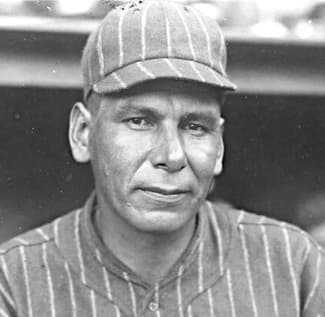
Chief Bender portrait, 1925.
Photo credit: Bain News Service via Wikimedia Commons (Public domain)
Charles Albert Bender pitched for sixteen major league seasons, won 212 games, posted a 2.46 career ERA, and established himself as the pitcher Connie Mack trusted most when everything was on the line. He was Ojibwe, a graduate of the Carlisle Indian Industrial School, and one of the first Native American players to reach the highest levels of professional baseball. He endured racial abuse from crowds and opponents throughout his career and answered it with performance that left little room for argument. The Veterans Committee elected him to the Hall of Fame in 1953.
Crow Wing County to Carlisle
Bender was born on May 5, 1884, in Crow Wing County, Minnesota, near the town of Brainerd. His father was German American and his mother was Ojibwe, and his family had connections to the White Earth Reservation. At about age seven, he was sent away from his family to a government-run boarding school, part of the federal assimilation program that removed thousands of Native American children from their communities and placed them in institutions designed to erase their languages, cultures, and identities.
He enrolled at the Carlisle Indian Industrial School in Pennsylvania in 1896, when he was twelve years old. Carlisle was the most prominent of the federal Indian boarding schools, and its athletic program, which would later produce Jim Thorpe, gave Bender his first organized exposure to competitive sports. He played baseball and football at Carlisle and developed into a pitcher with enough talent to attract the attention of professional scouts. Bender graduated from Carlisle in 1902 and played semi-professional ball in Harrisburg before Mack signed him for the Philadelphia Athletics. He debuted in April 1903 at age eighteen.
The nickname "Chief" was imposed on him by sportswriters and fans, as it was on virtually every Native American athlete of the era. Bender tolerated the name in public settings and answered to it throughout his career, but he preferred to be called Albert or Charlie by people who knew him. The nickname was not a term of respect. It was a reduction of his identity to a racial category, applied casually by a press corps that saw nothing wrong with it.
The Money Pitcher
Bender won 17 games as a rookie in 1903 and showed the combination of control, composure, and competitive will that would define his career. He threw a fastball with good movement, a sharp curve, and what contemporaries described as one of the earliest effective sliders in the game. His control was exceptional. He walked only 712 batters across 3,017 career innings, and his ability to locate pitches under pressure made him Mack's preferred choice for the games that carried the most weight.
Mack called Bender "my money pitcher" and meant it literally. When the Athletics needed to win a specific game, whether in the regular season or the postseason, Mack gave the ball to Bender. His World Series record demonstrated why. In the 1905 Series against Christy Mathewson's New York Giants, Bender threw a complete-game shutout to win Game 2, the only game the Athletics won in a Series that Mathewson dominated with three shutouts of his own.
The Athletics built one of the great dynasties of the Dead-Ball Era in the years that followed, winning the American League pennant in 1910, 1911, 1913, and 1914. Bender was central to each run. He pitched alongside Eddie Plank and Jack Coombs in a rotation that gave the Athletics three reliable starters, and behind a lineup that featured Eddie Collins, Home Run Baker, and other future Hall of Famers.
In the 1911 World Series against the Giants, Bender won two games and posted a 1.04 ERA across his starts. He threw a complete-game four-hitter to clinch the championship. In the 1913 Series, again against the Giants, he went 2-0 in two starts. Across his World Series career, he won six games for the Athletics, delivering in exactly the situations Mack had identified as his strength.
He threw a no-hitter against the Cleveland Naps on May 12, 1910, one of the signature individual performances of his career. His final career record stood at 212 wins and 127 losses with a 2.46 ERA and 1,711 strikeouts.
Racial Hostility
Opposing fans and players subjected Bender to war whoops, mock tomahawk chants, and racial slurs throughout his career. The abuse was loudest on the road, where crowds treated his heritage as a target rather than a fact. Teammates who watched him absorb the hostility game after game described a man who channeled it into competitive intensity rather than letting it erode his focus.
By some accounts, Bender made a habit of tipping his cap to the most hostile sections of the crowd after winning a game, a gesture that conveyed both dignity and contempt. When asked about the abuse later in life, he said he had used it as fuel. The composure required to pitch in that environment, to perform at the highest level while absorbing treatment that would have driven many players from the field, was as remarkable as any statistical line in his record.
Federal League and After
When the Federal League launched as a rival major league in 1914, Bender left the Athletics after the World Series loss to the Boston Braves. He joined the Baltimore Terrapins for the 1915 season, a move driven by money at a time when Mack was already dismantling his championship roster for financial reasons. The Federal League folded after the 1915 season, and Bender returned to the established leagues, pitching for the Philadelphia Phillies in 1916 and 1917 before retiring from the major leagues.
He continued pitching in the minor leagues for several years and later managed in the lower minors. He coached for the Athletics under Mack, returning to the organization where he had spent his best years. During World War I, he worked at the Hog Island shipyard in Philadelphia, contributing to the war effort alongside thousands of other workers building transport ships.
Bender spent his later years in Philadelphia, far from the reservation where he had been born and the boarding school where he had been shaped. He died on May 22, 1954, in Philadelphia, at age 70, one year after his election to the Hall of Fame.