Profile
Craig Biggio
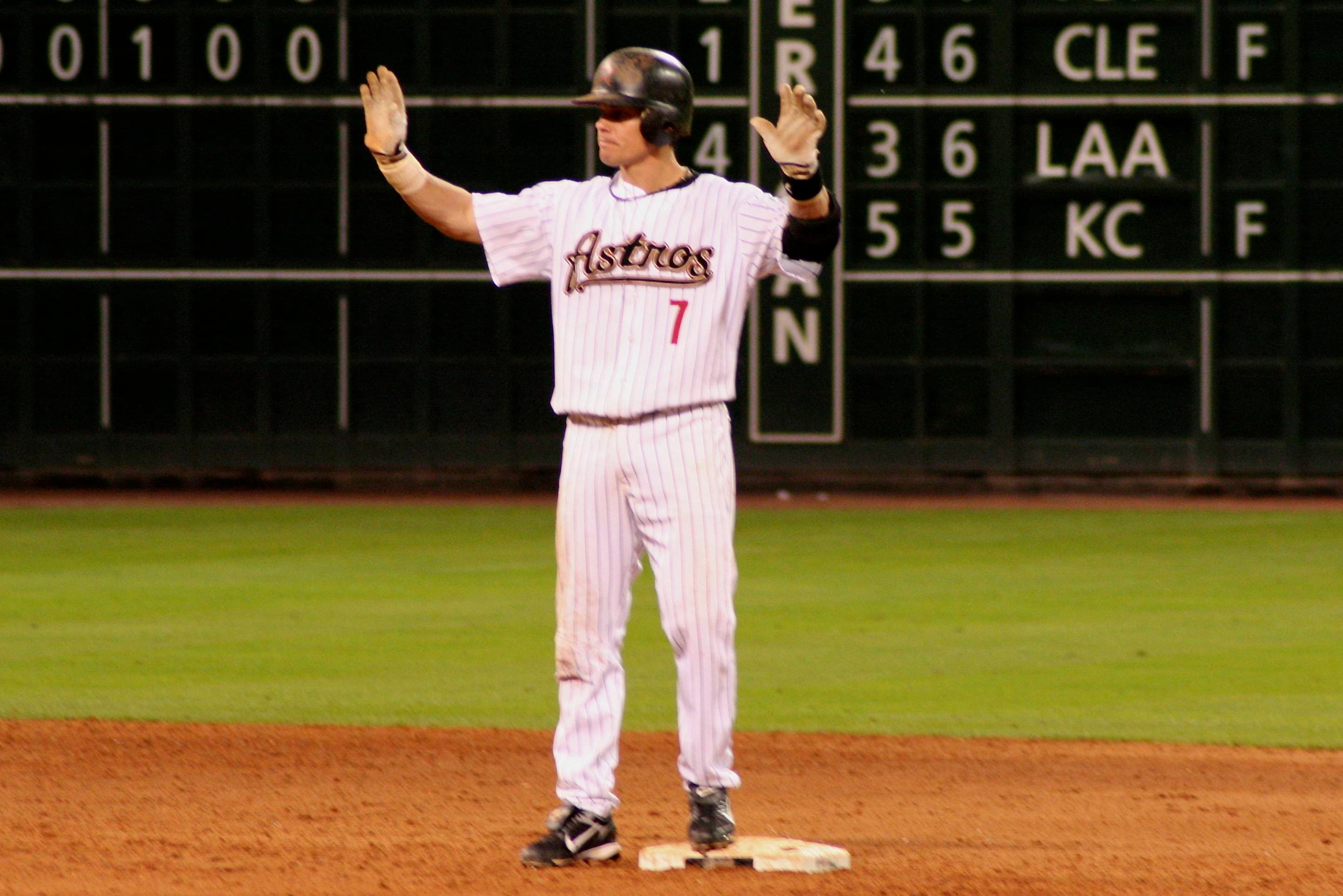
Craig Biggio in Houston Astros uniform.
Photo credit: Unknown photographer via Wikimedia Commons
Craig Biggio played 20 years for one team, changed positions three times to keep his bat in the lineup, and got his uniform dirtier than anyone in the game. He collected 3,060 hits and 668 doubles, scored 1,844 runs, and stood so close to the plate that he was hit by more pitches than any player of the last century. He is the only man ever named an All-Star as both a catcher and a second baseman, the rare star who valued the team's need over his own comfort. The BBWAA elected him to the Hall of Fame in 2015.
A Long Island Catcher
Biggio was born on December 14, 1965, in Smithtown, New York, and grew up on Long Island idolizing the Yankees catcher Thurman Munson. He starred at Seton Hall alongside the future sluggers Mo Vaughn and Marteese Robinson, a lineup good enough that scouts crowded the stands, and the Houston Astros took him 22nd overall in 1987. He reached the majors the next summer as a catcher, mentored in spring camp by Yogi Berra, and in 1991 he became the first catcher in Astros history named to an All-Star team. He had made it at the hardest position on the field, and then he gave it up.
The Man Who Changed Positions to Stay
After the 1991 season the Astros asked Biggio to move to second base to save his legs and lengthen his career, and the early returns were bad enough that a coach declared he would never learn it. Biggio took it as a dare. "I wanted to do it because everybody said I couldn't," he said. "I'm stubborn." He took a thousand ground balls a day until the position belonged to him, won four straight Gold Gloves there, and then, in 2003, moved again to the outfield to make room for a new infielder before coming back to second once more. He is the only player ever to make an All-Star team behind the plate and at second base, and the only one to win a Silver Slugger at both.
Doubles, Runs, and a Crowded Plate
The position never mattered as much as the production. Biggio hit 668 doubles, fifth-most in history and the most by any right-handed hitter when he retired, and he scored 1,844 runs, a total in the top 15 of all time. In 1998 he hit 51 doubles and stole 50 bases, the second player ever to reach 50 of each in a season, and he set a National League record with 53 leadoff home runs. He crowded the plate behind a sheath of elbow armor and refused to give an inch, and 285 pitches hit him, the most of the modern era and second only to Hughie Jennings in the whole history of the game. He never once charged the mound.
The Killer B's
For 15 years Biggio and Jeff Bagwell were the Houston Astros, the Killer B's who carried a franchise that could not get over the October hump. They won division titles and lost in the first round, year after year, much of it to the Atlanta Braves, until 2005, when the Astros finally won the only pennant in their history. The World Series ended fast, a four-game sweep by the Chicago White Sox, the only Series either man would reach. "It's been like a marriage more than anything else," Bagwell said of the partnership, and the two grew old in the same uniform without ever winning the ring they chased.
Three Thousand
On June 28, 2007, Biggio singled off the Colorado pitcher Aaron Cook for his 3,000th hit, and because he was who he was, he tried to stretch it into a double and got thrown out at second. He went five for five that night, the only player to reach 3,000 in a game where he also collected five hits, and he pulled Bagwell out of the dugout to share the moment. He finished with 3,060 hits, the 27th player to reach 3,000, and the number anchored a résumé already full of doubles and runs and bruises. He had earned all of it the same way, one hard nine innings at a time.
The Grinder's Reputation
Biggio built his name on effort that showed. He wore the dirtiest helmet in baseball, dove for everything, and ran out every ground ball as if it were his last, the picture of a player who got more from his talent than the talent promised. "I tried to play the game hard and play the game right every single day," he said, and the record backs the claim, 2,850 games for one club, none of them given away. Off the field he carried the same steadiness, serving as the lifetime spokesman for the Sunshine Kids, a charity for children with cancer, and winning the Roberto Clemente Award in his final season.
Cooperstown in an Astros Cap
The Hall of Fame nearly broke his heart first. In 2014 Biggio fell two votes short of election, the closest a player can come, and he waited another year before the writers put him in with 82.7 percent in 2015. He became the first player inducted wearing a Houston Astros cap, a distinction he treasured. "To be able to finally get an Astro guy in there, I take a lot of pride in that," he said. The Astros retired his number 7, and he stayed in the game close to home, coaching high school baseball in Houston to two Texas state titles while the franchise he never left built toward titles of its own.