Profile
Jeff Bagwell
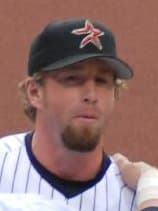
Jeff Bagwell in Houston Astros uniform.
Photo credit: Unknown photographer via Wikimedia Commons
Jeff Bagwell hit from a crouch so wide it looked like a stunt, and out of it came one of the great first basemen of his time. He came to Houston in a trade so lopsided it still makes Boston wince, won a Most Valuable Player award by unanimous vote, and spent all 15 of his seasons as the face of the Astros. An arthritic shoulder cut him down before he could chase the round numbers his pace promised, and an era's suspicion slowed his path to Cooperstown without a shred of evidence behind it. The BBWAA elected him to the Hall of Fame in 2017.
The Trade Boston Regrets
Bagwell was born on May 27, 1968, in Boston and grew up in Connecticut in a house where the Red Sox were religion and the Yankees were not to be named. He starred at the University of Hartford, and the Red Sox drafted him and watched him hit his way up the minor leagues. Then, on August 30, 1990, with Boston chasing a division title and short on bullpen help, the Red Sox traded the 22-year-old for the veteran reliever Larry Andersen. Andersen pitched 15 fine games and left as a free agent that winter, and Bagwell became a Hall of Famer, which is why the deal is remembered as one of the worst a team ever made. "I was one of the saddest guys you'll ever see," Bagwell said. "All my life everything had been Boston."
The Crouch
The first thing anyone noticed about Bagwell was the stance, a squat so deep and a base so wide that opposing dugouts joked he looked like he was sitting down. It was a swing built on physics, the spread keeping him from lunging, the coiled legs feeding an uppercut that drove balls out to all fields. Joe Torre, who managed against him, understood it. "That wide stance keeps him from over striding," Torre said, "which can be your biggest problem when you're trying to hit for power." Ugly or not, the crouch worked, and it became one of the signature looks of the era.
Rookie of the Year and a Lost MVP Season
Bagwell reached Houston in 1991 and won the National League Rookie of the Year, taking 23 of 24 first-place votes after a conversion to first base just two weeks before opening day. He was better still in 1994, the year a players' strike swallowed the season. Bagwell hit .368 with 39 home runs and 116 runs batted in across just 110 games, a pace that would have threatened records, and the writers named him the unanimous Most Valuable Player. The season ended in the cruelest way, an Andy Benes pitch breaking his hand on August 12, one day before the strike shut everything down for good.
A Power-Speed First Baseman
For a slugger built like a fire hydrant, Bagwell ran better than anyone expected. He stole 202 bases in his career and put up two seasons of at least 30 home runs and 30 stolen bases, in 1997 and 1999, a feat almost no first baseman has matched. He drove in 100 runs and scored 100 runs and hit 30 home runs in six straight seasons from 1996 through 2001, and in 2000 he scored 152 runs, the most by any player since Ted Williams in 1949. He finished with 449 home runs, 1,529 runs batted in, and 1,517 runs scored, a complete offensive line for a one-team career.
The Killer B's and the Long Wait for October
Bagwell and Craig Biggio were the Killer B's, the two stars who carried the Astros for 15 years and grew old together in the same uniform. "It's been like a marriage more than anything else," Bagwell said. The teams won and the Octobers ended early, often at the hands of the Atlanta Braves, until 2005, when Houston reached the first World Series in its history. By then Bagwell's shoulder was failing, and he played the Series as a part-time hitter, going one for eight as the Chicago White Sox completed a four-game sweep. It was the only Series he ever reached, and his body barely let him into it.
The Shoulder
An arthritis in his right shoulder ended everything before he was ready. The joint deteriorated until he could not throw, and a physical in early 2006 found him able to manage only about 35 miles an hour on a short toss, enough for a doctor to declare him disabled. He tried to come back as a hitter and could not get through spring training, and he walked away at 38 with the round milestones still in sight. "It's been a great ride," he said. "I wish I could still play, but I'm not physically able to do that anymore. I'm OK with that."
Cooperstown and the Cloud That Cleared
The Hall of Fame made Bagwell wait seven years, and the reason was an era more than a man. His muscular build and the timing of his power led some voters to suspect steroids, though no test, no investigation, and no evidence ever tied him to them. "I know what I did. I know how hard I worked," he said. "If someone thinks I took crap because I was in that era, what am I going to do to show them I didn't?" His vote total climbed from 41.7 percent in 2011 to 86.2 percent in 2017, when the writers finally elected him on his seventh ballot. He went in wearing a Houston cap, his number 5 already retired, the homegrown star who never wore another team's uniform.