Profile
Ferguson Jenkins
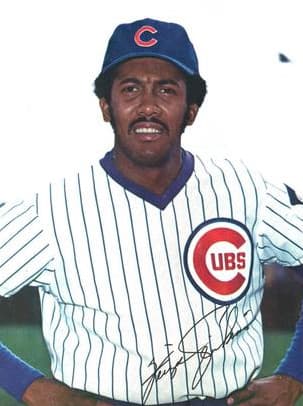
Ferguson Jenkins portrait, 1973.
Photo credit: Unknown author via Wikimedia Commons (Public domain)
Ferguson Arthur Jenkins Jr. grew up in Chatham, Ontario, a small city in southwestern Ontario with roots running back to the Underground Railroad. His father, the son of Barbadian immigrants, worked as a chef and chauffeur and played for the Chatham Coloured All-Stars. His mother Delores, who descended from enslaved Africans who escaped through the Railroad and settled in the region, stood five feet ten and was an accomplished bowler. She was blind, and she died of cancer in 1970 at 52. Jenkins won 284 games with 3,192 strikeouts and fewer than 1,000 walks across 19 seasons, won the 1971 NL Cy Young Award, threw six consecutive 20-win seasons for the Chicago Cubs while averaging 306 innings a year, and became the first pitcher in history to finish his career with 3,000 strikeouts and fewer than 1,000 walks. He lost 13 complete games by 1-0 scores because the Cubs could never score for him, and he never appeared in a postseason game despite a Hall of Fame career. "I buried a mother, fifty-two," Jenkins once said, counting the losses that followed him off the field. "I buried a wife, only thirty-two. I buried a daughter, only three." The BBWAA elected him to the Hall of Fame in 1991 on 75.4 percent of the ballot, clearing the threshold by a single vote and becoming the first Canadian born player inducted into Cooperstown.
Chatham
Jenkins was born on December 13, 1942, the only child of Ferguson Sr. and Delores. He signed with the Philadelphia Phillies in 1962 for $6,500 and debuted as a reliever on September 10, 1965. The Phillies traded him to the Cubs on April 21, 1966, and manager Leo Durocher converted him from a reliever to a starter in 1967. Jenkins responded with a 20-13 record and began a run of six consecutive 20-win seasons that no Cubs pitcher matched before or since. In 1971 he went 24-13 with a 2.77 ERA, threw 30 complete games in 39 starts, struck out 263 batters while walking only 37, and won the Cy Young Award, the first Canadian and the first Cubs pitcher to receive the honor. He also hit six home runs and drove in 20 runs that year.
Durocher's instruction to Jenkins captured their working relationship. "Hey, big fella. It's your game, win or lose. Keep it going." Jenkins kept it going through 140 complete games across those six seasons, and his control was so precise that he led the National League in fewest walks per nine innings five times. The tradeoff for pitching deep into games and trusting his stuff over walks was 484 career home runs allowed, among the highest totals in history, but Jenkins believed a solo home run was a better bargain than a walk that started a rally.
In the offseason Jenkins played basketball for the Harlem Globetrotters from 1967 through 1969. The Globetrotters' marketing director approached him at Wrigley Field, and Jenkins recalled that his role was mostly "to give up a home run every night to Meadowlark Lemon."
Texas and the Losses
The Cubs traded Jenkins to the Texas Rangers after the 1973 season, and in 1974 he went 25-12, a franchise record that still stands, and won the AL Comeback Player of the Year award and Canada's Lou Marsh Trophy as the country's top athlete. In September 1980, customs authorities in Toronto found small quantities of cocaine, hashish, and marijuana in Jenkins' luggage. Commissioner Bowie Kuhn suspended him indefinitely, but an independent arbitrator overturned the suspension within two weeks, and a judge granted Jenkins an absolute discharge at trial. The incident delayed his Hall of Fame candidacy by years.
The personal losses were worse than anything a commissioner could impose. Jenkins' second wife Mary-Anne broke her neck in a car accident near their ranch in Guthrie, Oklahoma, in December 1990 and died of pneumonia in January 1991 at 32. In December 1992, his girlfriend Cynthia Takieddine parked a car on an isolated road near Perry, Oklahoma, with Jenkins' three-year-old daughter Samantha and connected a hose from the exhaust. Both died of carbon monoxide poisoning in what was ruled a murder-suicide. "There are two things in this sport," Jenkins said. "Either you win or you lose. Life is like that, too. How you get through it depends on how strong your faith is."
Chatham Again
Jenkins returned to the Cubs as a free agent in 1982 and retired after the 1983 season with 284 wins, the most by a black pitcher in major league history. The Cubs retired his number 31 on May 3, 2009 (shared with Greg Maddux), and a statue was unveiled outside Wrigley Field on May 20, 2022, followed by a second statue outside the Chatham Civic Centre in his hometown on June 10, 2023. The 1991 All-Star Game in Toronto was dedicated to Jenkins, and he threw the ceremonial first pitch. He ran for the Ontario provincial legislature in 1985, placing third, and was named to the Order of Canada in 1979, though the investiture ceremony did not take place until 2007, 27 years later. Jenkins lives on a ranch near Guthrie, Oklahoma, where he runs the Fergie Jenkins Foundation, supporting causes related to cancer and blindness in honor of his mother.