Profile
Greg Maddux
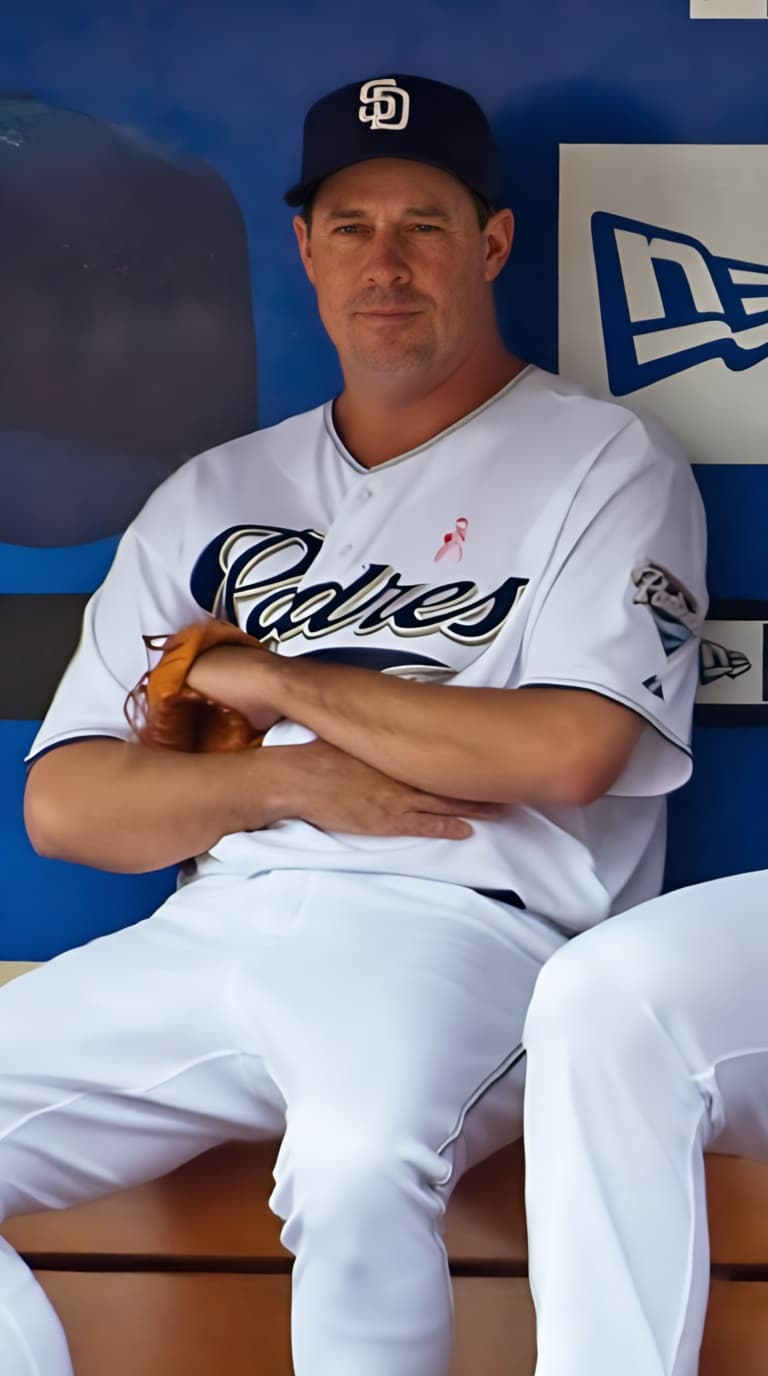
Greg Maddux in the dugout.
Photo credit: Unknown photographer via Wikimedia Commons
Greg Maddux won more games than any pitcher of his generation by outthinking hitters instead of overpowering them. He stood a shade under six feet, threw a fastball that rarely reached 90, and looked more like an accountant than an ace, and he used a located fastball and a mind two pitches ahead of the hitter to dominate the highest-scoring era the game had seen. He won 355 games and four straight Cy Young Awards, took a record 18 Gold Gloves, and walked fewer than 1,000 men in more than 5,000 innings. They called him Mad Dog and the Professor, and only one of those nicknames made sense. The BBWAA elected him to the Hall of Fame in 2014, on the first ballot with 97.2 percent of the vote.
A Thinking Pitcher from Las Vegas
Maddux was born on April 14, 1966, in San Angelo, Texas, and grew up in Las Vegas, where he pitched at Valley High School and followed his older brother Mike, a major league pitcher himself, into the game. The Chicago Cubs drafted him in the second round in 1984, and he reached the majors at 20 in 1986, a skinny right-hander without the fastball scouts wanted, the kind of pitcher who has to think his way through a lineup because he cannot throw it past anybody. What he had instead was command of every pitch he owned and a mind that read hitters two and three pitches ahead, and over the next two decades he built one of the most cerebral careers the game has produced.
Command and the Located Fastball
Maddux made his living on the edges of the strike zone, running a sinking fastball in and out at the knees until hitters chased pitches that started over the plate and finished off it. He reduced the whole craft to a sentence. "The best pitch in baseball is a located fastball," he said, "and the more ways you can put it in more places at more speeds, the better. That's pitching." The numbers behind the idea are almost hard to believe. He walked 999 men in his career and struck out 3,371, the only pitcher ever to pair 3,000 strikeouts with fewer than 1,000 walks, and in 2001 he went more than 72 straight innings without issuing a walk, a National League record. In 1997 he walked 20 batters all season across more than 230 innings. "It's the greatest command I've ever seen on a consistent basis," his pitching coach Leo Mazzone said.
Four Consecutive Cy Young Awards
Maddux won his first Cy Young Award with the Cubs in 1992, then turned down a larger offer from the Yankees to sign with the Atlanta Braves, a choice that helped build a dynasty. He won the award three more times in a row, the first pitcher in history to take four straight, a run later matched only by Randy Johnson. For most of the 1990s he was the best pitcher in baseball, the front man of a rotation with Tom Glavine and John Smoltz that pitched Atlanta to division title after division title, and it was not an argument anyone bothered to have.
The 1994 and 1995 Peak
At his height Maddux pitched at a level the modern game had not seen. He posted a 1.56 earned run average in 1994 and a 1.63 in 1995, marks so far below the league that he was more than twice as good as the average pitcher, two of the five best run-prevention seasons in baseball history. In 1994 he gave up four home runs in 202 innings, in the year the home run boom began, a figure no other 200-inning pitcher had matched in 60 years. Hitters batted .222 against him that season, a higher number than his earned run average. He led the National League in earned run average four times and threw 200 innings in 20 straight seasons, stopped only by the strike of 1994.
The 1995 World Series
The Braves won the World Series in 1995, beating Cleveland in six games for the franchise's only title in Atlanta, and Maddux opened it with a masterpiece. In Game 1 he threw a complete game and gave up two hits and no earned runs in a 3-2 win, walking nobody, the only Cleveland baserunners coming on singles by Kenny Lofton and Jim Thome. It was the lone championship of his career, and the rotation he led became the model every other contender chased for a decade.
A Real-Life Chess Match
What set Maddux apart, more than the command even, was that he seemed to know what was about to happen. His teammates told story after story. Watching an opponent from the dugout on an off day, he turned to the bench after two pitches and said they had better call an ambulance for the first base coach, sure the hitter was about to scorch one down the line, and the hitter did. Sitting beside the Padres pitcher Chris Young, he warned him to move because the next pitch would be fouled at his head, and it was lined to exactly that spot in the dugout. "He's a real-life Rain Man," one beat writer wrote. "He would have made a great detective in another life." Bobby Cox, who managed him for 11 years, put it plainly. "I had never seen anyone hit a target like he did," Cox said.
Eighteen Gold Gloves
Maddux fielded his position better than any pitcher who ever played it, and the trophy case proves it. He won 18 Gold Gloves, more than any player at any position in the history of the game, including one in each of his four Cy Young seasons and 13 in a row at one stretch. He came off the mound like a fifth infielder, smothered bunts, started double plays, and held the career record for putouts by a pitcher. The same balance and economy that let him repeat his delivery a thousand times left him squared and ready the instant the ball was hit.
The Maddux and 355 Wins
The efficiency became its own kind of legend. Years after he retired, writers coined the term a Maddux for a complete-game shutout thrown in under 100 pitches, and named it for him because he threw more of them than any pitcher in the age of pitch counts. In 1997 he beat the Cubs in a complete game on 78 pitches, the fewest of his career. He won 15 games or more for 17 straight seasons, the longest such streak in history, and he made just one trip to the disabled list in 23 years, for a back problem in 2002, never once for his arm. He returned to the Cubs in 2004 and won his 300th game that August in San Francisco, then wound down with the Dodgers and the Padres before he retired after the 2008 season, finishing 355-227 with a 3.16 earned run average.
First Ballot to Cooperstown
Off the mound Maddux was nothing like professorial, a relentless and gleefully juvenile clubhouse prankster his teammates remember as warmly as his pitching. On it he was the most precise craftsman the position has produced, a man who beat the strongest lineups of a slugging era with location, patience, and a half-step head start on everyone he faced. The BBWAA elected him to the Hall of Fame in 2014 with 97.2 percent of the vote, a first-ballot inductee the moment he came eligible, and he went in alongside his old teammate Glavine and his manager Bobby Cox. The Braves and the Cubs both retired his number 31.