Profile
Tom Glavine
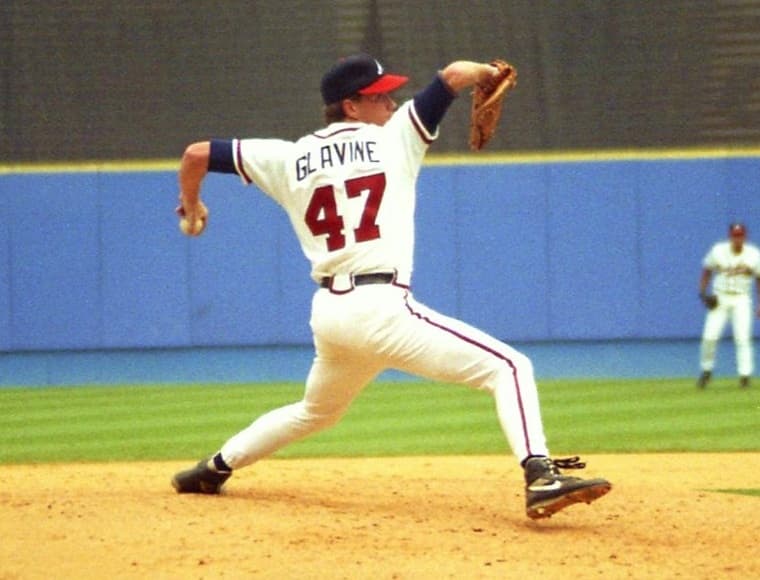
Tom Glavine pitching for the Atlanta Braves, 1993.
Photo credit: Unknown photographer via Wikimedia Commons (Public domain)
Tom Glavine won 305 games over 22 years without an overpowering pitch, a left-hander who lived on the outside corner, changed speeds, and refused to give a hitter anything he could drive. He won two Cy Young Awards, made 10 All-Star teams, and was the Most Valuable Player of the 1995 World Series, where he threw eight innings of one-hit baseball to bring Atlanta its only title. He was a good enough hockey player that the Los Angeles Kings drafted him, and he grew into one of the most polarizing union men of the 1994 strike. The BBWAA elected him to the Hall of Fame in 2014, on the first ballot.
A Two-Sport Athlete from Massachusetts
Glavine was born on March 25, 1966, in Concord, Massachusetts, and grew up in Billerica, a hockey town where he was good enough that the Los Angeles Kings drafted him in 1984, a few days after the Atlanta Braves took him in the second round of the baseball draft. He chose baseball, signed with Atlanta for an $80,000 bonus, and reached the majors in 1987. He lost 17 games for a terrible Braves team in 1988, his first full season, the kind of start that breaks some pitchers and taught this one how to compete without his best.
The Changeup He Stumbled Onto
For a while Glavine threw a forkball he was proud of, until a minor league catcher named Ned Yost set him straight. "That pitch sucks," Yost told him, warning that big league hitters would not chase it. Shagging flies in spring training soon after, Glavine caught a ball that settled across his middle and ring fingers, and the grip felt right. He tried it the next day in the bullpen. "Oh man," he thought, "I might have something here." The pitch was a circle change that sank instead of fading, and he learned to throw it to both sides of the plate, the weapon that would define him.
Working the Outside Corner
Glavine built his career on the outer edge of the strike zone, painting it with the changeup and the fastball until hitters either reached for a pitch they could not handle or watched it called a strike. He stood on the far end of the rubber to widen the angle, and the corner he lived on became its own legend, with rivals sure the umpires gave him more than the rules allowed. "When I caught him, the strike zone was always 18 inches," Mike Piazza said. "When I faced him, it was at least 20." Greg Maddux, who worked the same edges, gave the simplest answer to the complaint. "You could say we got more pitches," Maddux said, "but we made more pitches."
Worst to First in 1991
The Braves had finished last when Glavine broke through in 1991, going 20-11 with a 2.55 earned run average, leading the league in wins, and taking the National League Cy Young Award as Atlanta climbed from the bottom of its division to the World Series. The worst-to-first season launched a run of 14 straight division titles and made Glavine the steady left-handed heart of it. He pitched two scoreless innings in the All-Star Game that summer and struck out three of the American League hitters he faced.
The Maddux-Glavine-Smoltz Rotation
Glavine anchored a rotation with Maddux and John Smoltz that has a claim as the best any team has ever run out, three aces who among them won seven Cy Young Awards and pitched the Braves to the postseason year after year. Glavine was the durable one, making 30 or more starts in 17 seasons and leading the league in starts four years running, and he did not make his first trip to the disabled list until 2008, at 42, near the very end. He won 164 games in the 1990s, more than any pitcher in the National League except Maddux.
The 1995 World Series
Glavine's masterpiece came on October 28, 1995, in Game 6 against Cleveland, with the Braves one win from the franchise's only championship in Atlanta. He carried a no-hitter into the sixth inning and surrendered nothing but a soft single to Tony Peña, finishing with eight innings of one-hit baseball in a 1-0 win that turned on a David Justice home run. They named him the Series MVP. The night carried extra weight in a city still sore over the strike that had canceled the previous fall, and Glavine, the union man fans had booed, won them back with the best game of his life.
The Face of the Strike
Glavine had paid for that game in advance, because as the Braves' representative to the players' union, he was one of the most visible figures in the 1994 strike that wiped out the World Series, quoted constantly, blamed widely, and booed at home when the game came back in 1995. The Braves' own team president defended him. "He was vilified as the leader of the union," Stan Kasten said. "The fans' anger was misplaced." Glavine kept showing up and kept winning, and the resentment slowly turned back into respect.
Three Hundred Wins and a Painful Finale
Glavine left Atlanta for the New York Mets in 2003, and it was in a Mets uniform that he won his 300th game, beating the Cubs at Wrigley Field on August 5, 2007, the 23rd pitcher and the fifth left-hander ever to reach the mark. The good years in New York ended in a single bad afternoon. On the last day of the 2007 season, with a playoff spot there for the taking, he gave up seven runs and recorded just one out as the Mets completed one of the worst September collapses in history. "Devastation is for things in life that are much more important than this," he said afterward, a line that followed him for years. He went home to Atlanta for a final season in 2008 and finished 305-203.
First Ballot to Cooperstown
Glavine pitched the way he carried himself, prepared and unbothered, and his teammates took their cue from him. "His kind of poise, his mentality, his way of going about his business," Chipper Jones said, "well, that's what won him over 300 games." The Braves retired his number 47 in 2010, and at the ceremony he told the crowd what he had tried to be. "When you saw number 47 walk to the mound," he said, "you knew I was going to give you everything I had." The BBWAA elected him to the Hall of Fame in 2014, on the first ballot, alongside his old teammate Maddux and his manager Bobby Cox.