Profile
Harry Stovey
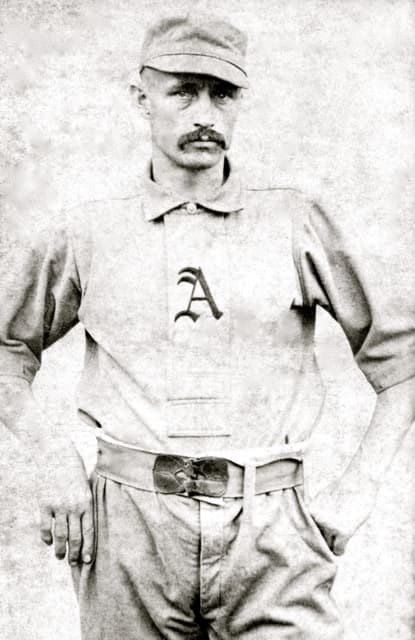
Harry Stovey with the Philadelphia Athletics.
Photo credit: Unknown photographer via Wikimedia Commons
Harry Stovey hit for power and ran like few men of his time, a combination that made him one of the best all around players of the 1880s. He was the first player in major league history to reach 100 career home runs, the all time leader in the category when he walked away in 1893, and a baserunner so daring that the game credits him with popularizing the feet first slide and the padded protection that came with it. Stovey led his league in home runs five times, scored nearly 1,500 runs, and starred on champions in two different leagues, all of it under a name he had invented to keep his family from learning he played at all. For decades the researchers who weigh the game by its modern numbers have pressed his Hall of Fame case.
The Boy Who Changed His Name
Stovey was born Harry Duffield Stow on December 20, 1856, in Philadelphia, into a family that looked on professional baseball as something close to disreputable. He took up the game anyway, and to keep his mother from discovering what her son was doing with his afternoons, he played under the altered name Stovey, the name that would follow him into the record books for good. The small deception says something about the era he entered, when ballplayers were rough company and respectable families wanted their boys in steadier trades. He climbed out of the Philadelphia amateur ranks and into the National League with Worcester in 1880, a tall, fast, powerful young man who could do everything a ballfield asked. The name was a disguise at first and then simply who he was, the only name the sport ever knew him by.
The First to One Hundred
Stovey was the premier slugger of his generation in a low scoring, dead ball age, and the home run totals that look modest now towered over his contemporaries. In 1883 he set the major league single season record with 14 home runs, a mark that stood until Ned Williamson cleared it the next year, and he kept hitting them long enough to pass milestones no one had reached before him. On September 3, 1890, he became the first player in history to reach 100 career home runs, and he finished with 122, the most anyone had hit when he retired and still the third highest total in the game as late as 1920, on the eve of the Babe Ruth revolution. He did it without the lively ball and the short fences that later sluggers enjoyed, driving the ball into the deep outfields of the nineteenth century. For a decade he was the closest thing the sport had to a home run king.
Power and Speed
What made Stovey more than a slugger was the speed he paired with the power, a blend the era rarely produced in one man. He scored nearly 1,500 runs in fourteen seasons, crossing the plate a hundred times or more in nine of them, and he stole bases in bunches once the rules began tracking them, leading his league twice. The stolen base figures from his time come with a caveat, since the early scorers awarded steals for feats a modern rule would not, and no totals at all survive from his first several seasons. Even so, the picture is consistent across every account, a big man who hit the ball as hard as anyone and ran the bases like a player half his size. He batted .289 for his career and slugged at the top of his league year after year. That blend of power and speed put him in a class the nineteenth century could count on one hand.
The Slide
Stovey's baserunning left a mark on the sport that outlasted his statistics, in the form of a sliding style the game adopted from him. He is widely credited with popularizing the feet first slide, going into the bag with his spikes ahead of him at a time when most runners still went in headlong, and with introducing the padded protection that spared a base stealer's hips the constant bruising. The claims rest on tradition more than on documents, and the sources that repeat them tend to hedge, so the careful version is that he made the technique common rather than that he invented it outright. What is not in question is that he ran the bases harder and smarter than almost anyone of his day, and that other players copied what they saw him do. The slide became standard equipment for the position players who followed. Stovey was the man they learned it from.
Champion in Two Leagues
Stovey anchored winners in the alphabet soup of nineteenth century leagues, starring for champions in two of them across a single decade. He was the offensive centerpiece of the 1883 Philadelphia Athletics, the American Association pennant winners, leading the league in runs, home runs, doubles, total bases, and slugging and scoring the run that clinched the pennant while hurt. When the players broke away to form their own circuit in 1890, he jumped to the Boston Reds of the Players League and helped them to that league's only championship, hitting for power and scoring 145 runs in its lone season. He gave each club the same thing, a bat that led the league and legs that turned singles into runs. Few players of the era contributed so much to so many winners across so many leagues.
The Cooperstown Case
Stovey has become a favorite cause of the analysts who reexamine the nineteenth century, the kind of player the traditional voting missed and the advanced numbers rescued. He drew a handful of votes in the 1936 balloting, his only appearance before the writers, and he has surfaced since as a finalist on the era committees that consider the game's oldest candidates, always falling short of election. His supporters point to the power and speed and the wins above replacement that rank him among the best position players of his decade, a résumé that would fit comfortably inside the building. Baseball's research society named him an Overlooked Legend in 2011, a recognition that doubles as an indictment of the omission. His champions have made the argument for nearly a century, and they keep making it.
The New Bedford Police Captain
Stovey settled in New Bedford, Massachusetts, after his playing days, the city where he had married years earlier and put down roots, and he gave the back half of his life to its police force. He joined in 1895 and served 28 years, earning a sergeant's stripes for bravery after he dove off a pier to save a drowning boy of seven, rising to captain in 1915, and retiring in 1923. The slugger who had terrorized American Association pitching spent his later decades keeping the peace in a New England mill town, a steady public servant a long way from the rowdy ballparks of his youth. Stovey died in New Bedford on September 20, 1937, at 80, his playing fame long faded in the town that knew him as a policeman. More than a century later, the first man to a hundred home runs stands among the great all around players the nineteenth century produced.