Profile
Hoyt Wilhelm
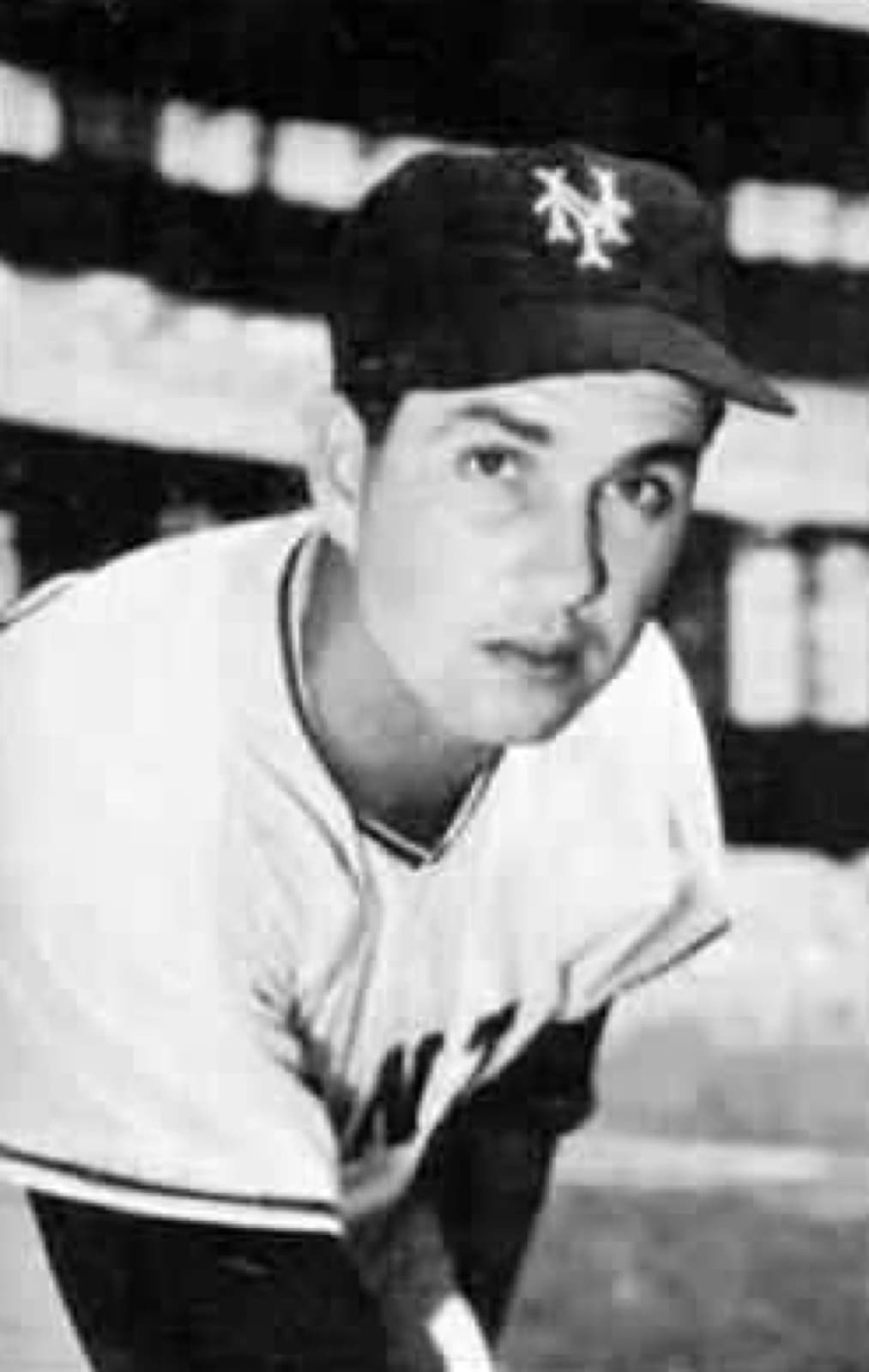
Hoyt Wilhelm portrait.
Photo credit: Bowman Gum via Wikimedia Commons (Public domain)
James Hoyt Wilhelm learned the knuckleball as a teenager in North Carolina after reading about Dutch Leonard's grip, practiced it with a tennis ball, carried it through the Battle of the Bulge with shrapnel in his back, and threw it for 21 major league seasons until he was older than some of his managers. Wilhelm pitched in 1,070 games, more than anyone in history at the time of his retirement, won 143 and saved 228, posted a 2.52 career ERA, and hit a home run in his first major league at bat on April 23, 1952, then never hit another in 431 subsequent trips to the plate. Ted Williams said, "Don't let anybody tell you they saw a better knuckleball than Wilhelm's." Gus Triandos, who caught him in Baltimore and led the league in passed balls because of it, offered a different perspective. "Heaven is a place where no one throws a knuckleball." The BBWAA elected Wilhelm to the Hall of Fame in 1985 on 83.8 percent of the ballot, making him the first relief pitcher to receive the honor.
Huntersville
Wilhelm was born on July 26, 1922, in Huntersville, North Carolina, one of 11 children born to John and Ethel Wilhelm, who worked as tenant farmers. He attended Cornelius High School, where the knuckleball became the only pitch he trusted. "I figured it was my only ticket," Wilhelm said. Before the pitch could take him anywhere, the Second World War intervened. Wilhelm entered the Army in November 1942 and served with the 395th Infantry Regiment of the 99th Infantry Division in the European Theater. At the Battle of the Bulge he was hit by fragments that lodged in his back and stayed there for the rest of his life. He earned a Purple Heart, attained the rank of staff sergeant (which gave him the nickname "Old Sarge"), and returned home in 1945 to resume pitching in the minor leagues, where he won 41 games across two seasons at Mooresville before working his way up to the Giants.
The Knuckleball
Wilhelm debuted with the New York Giants on April 18, 1952, at 29, old for a rookie because the war and the minor leagues had consumed his twenties. Five days later he stepped to the plate against Dick Hoover of the Boston Braves and hit a home run over the short right field wall at the Polo Grounds. In 21 more years of professional baseball, he never hit another. His rookie season was brilliant. He went 15-3 with a 2.43 ERA and 11 saves across 71 games, led the National League in ERA, and finished fourth in MVP voting.
The knuckleball was not a secondary pitch or a trick he pulled out when his fastball faded. It was the only pitch he threw with any frequency, and he threw it from the day he signed until the day he retired. Before Wilhelm, the knuckleball was considered an old man's pitch, something a fading arm reached for as a last resort. Wilhelm threw it as a young man and redefined it as a weapon that could anchor a career. The pitch moved in ways that defeated hitters and catchers in roughly equal measure. In 1954, Giants catcher Ray Katt committed four passed balls in a single inning behind Wilhelm, a record that still stands. In 1959, Orioles catchers Gus Triandos and Joe Ginsberg combined for 49 passed balls, nearly all of them on Wilhelm's knuckleball. In 1965, White Sox catcher J.C. Martin set the modern single-season record with 33 passed balls, most of them from catching knuckleballers Wilhelm and Eddie Fisher. In 1960, Orioles manager Paul Richards designed a catcher's mitt 42 inches in circumference specifically to handle the pitch, and when baseball outlawed gloves over 38 inches in 1965, the White Sox engineered a mitt with a hinged thumb.
On September 20, 1958, Wilhelm threw a no-hitter against the Yankees at Memorial Stadium in Baltimore, winning 1-0. It was only his ninth career start, the first no-hitter in Orioles franchise history, and the last batter, Hank Bauer, bunted foul before popping up to second base.
Old Sarge
Wilhelm pitched for nine major league teams across 21 seasons and became more effective as he aged, which is the opposite of what happens to almost every pitcher who ever lived. From 1964 through 1968, pitching for the White Sox between the ages of 41 and 45, he went 41-33 with 99 saves and a 1.92 ERA across 361 games. More than half his career saves and nearly half his career appearances came after he turned 40. On July 24, 1968, he surpassed Cy Young's record of 906 career games pitched. On May 10, 1970, he became the first pitcher to appear in 1,000 games.
Wilhelm mentored Wilbur Wood, convincing the young pitcher to throw the knuckleball full time, and Wood won 13 games with a 1.87 ERA in 1968 as a result. Wilhelm also taught the pitch to Charlie Hough, who in turn taught it to R.A. Dickey decades later, extending a lineage that traces directly back to a teenager in North Carolina reading about Dutch Leonard's grip.
Sarasota
Wilhelm pitched his final game on July 10, 1972, for the Los Angeles Dodgers, 16 days before his 50th birthday (though his listed birth year of 1923 made him appear to be 49; records examined after his death revealed he had been born in 1922). He spent two decades after retirement managing and coaching in the minor leagues, working 22 years as a roving pitching instructor for the Yankees.
Wilhelm died of heart failure on August 23, 2002, in a nursing home in Sarasota, Florida, at 80. At his Hall of Fame induction he said he had achieved all three goals he set when he reached the majors. He wanted to pitch in a World Series (he earned a save in the Giants' 1954 sweep of Cleveland), make an All-Star team (he made eight), and throw a no-hitter. The knuckleball, the pitch he learned from a magazine article, got him to all three.