Profile
Jesse Haines
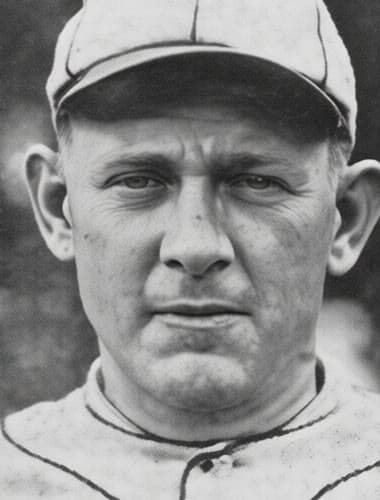
Jesse Haines portrait, 1924.
Photo credit: The Boston Globe via Wikimedia Commons (Public domain)
Jesse Haines pitched 18 seasons for the St. Louis Cardinals, won 210 games, and was part of the franchise's transformation from a perennial loser into one of the dominant teams in the National League. He threw a no-hitter in 1924, pitched in four World Series, won championships in 1926, 1931, and 1934, and developed a knuckleball that extended his career deep into his forties. He was a workhorse who relied on durability and craft rather than overpowering stuff, and the Cardinals kept running him out to the mound for nearly two decades because he kept finding ways to get hitters out. The Veterans Committee elected him to the Hall of Fame in 1970.
Ohio
Jesse Joseph Haines was born on July 22, 1893, in Clayton, Ohio, a small town northwest of Dayton. He grew up on a farm and pitched in semipro and minor league ball for several years before getting his first taste of the major leagues. The Cincinnati Reds gave him a single appearance in 1918, and the experience was brief enough to barely register on his record. The Cardinals purchased his contract in 1920, and he joined a franchise that had never won a pennant and had finished in the second division for most of its existence.
Haines won 13 games in his first full season and gradually established himself as a dependable mid-rotation starter. He went 20-13 in 1923, his first 20-win season, and followed it with the defining moment of his individual career. On July 17, 1924, he threw a no-hitter against the Boston Braves at Sportsman's Park, a 5-0 victory that was the first no-hitter by a Cardinals pitcher in the modern era. He walked three batters and struck out five, getting through nine innings with the kind of efficiency that characterized his pitching throughout his career.
The 1926 World Series
The Cardinals won their first pennant in 1926 under player-manager Rogers Hornsby, and Haines was a central figure on the pitching staff. He went 13-4 during the regular season and earned the start in Game 3 of the World Series against the New York Yankees, throwing a complete-game five-hitter to give the Cardinals a 2-1 series lead. He started Game 7 as well and pitched effectively into the seventh inning before a raw, bleeding finger on his pitching hand forced him from the game with the Cardinals leading 3-2 and the bases loaded.
What happened next became one of the most famous moments in World Series history. Manager Hornsby bypassed the bullpen and summoned Grover Cleveland Alexander from the bench. Alexander, who had pitched a complete game the day before in Game 6, walked to the mound and struck out Tony Lazzeri on four pitches to end the threat. He held the Yankees scoreless through the eighth and ninth innings, and the Cardinals won their first championship. Haines's willingness to pitch through a damaged finger until he physically could not continue, and his honesty in telling Hornsby he was done, created the situation that Alexander walked into, and the two performances together remain inseparable in the story of that Series.
The Knuckleball
Haines learned his knuckleball in 1923 and refined it into his most effective weapon over the following seasons. The pitch danced and fluttered on its way to the plate, defying the timing of hitters who had prepared for fastballs and curveballs, and it placed far less strain on his arm than a conventional breaking ball. The knuckleball allowed him to pitch deep into games when his other pitches lost their sharpness, and it extended his career by years.
He won 24 games in 1927, the best record of his career, and 20 in 1928. He pitched on the 1928 pennant winners that lost to the Yankees, the 1930 team that fell to the Philadelphia Athletics, the 1931 championship team managed by Gabby Street that defeated the Athletics, and the 1934 Gashouse Gang that beat the Detroit Tigers. By the early 1930s, Haines was working more frequently in relief as younger arms took over the rotation, but he remained a useful pitcher on a staff that included Dizzy Dean and his brother Paul. Manager Frankie Frisch trusted Haines in situations where experience and composure counted for more than pure velocity, and Haines delivered often enough to justify the trust.
He went 12-3 in 1931 and continued contributing through 1937, when he retired at 44 with a career record of 210-158 and a 3.64 ERA. His 210 wins rank among the most in Cardinals franchise history, and his 18 seasons in a St. Louis uniform represented a loyalty to one organization that was unusual even in an era when free agency did not exist.
After Baseball
Haines returned to Ohio after his playing career ended and settled in Phillipsburg, a small town near Dayton where he had grown up. He lived quietly for four decades, far from the public attention that followed more famous players of his era. The Veterans Committee elected him to the Hall of Fame in 1970 alongside Earle Combs, Ford Frick, and others, recognizing a career built on durability, craft, and the willingness to pitch through whatever his arm gave him on any particular day.
He died on August 5, 1978, in Dayton, Ohio, at age 85.