Player Profile
Johnny Evers
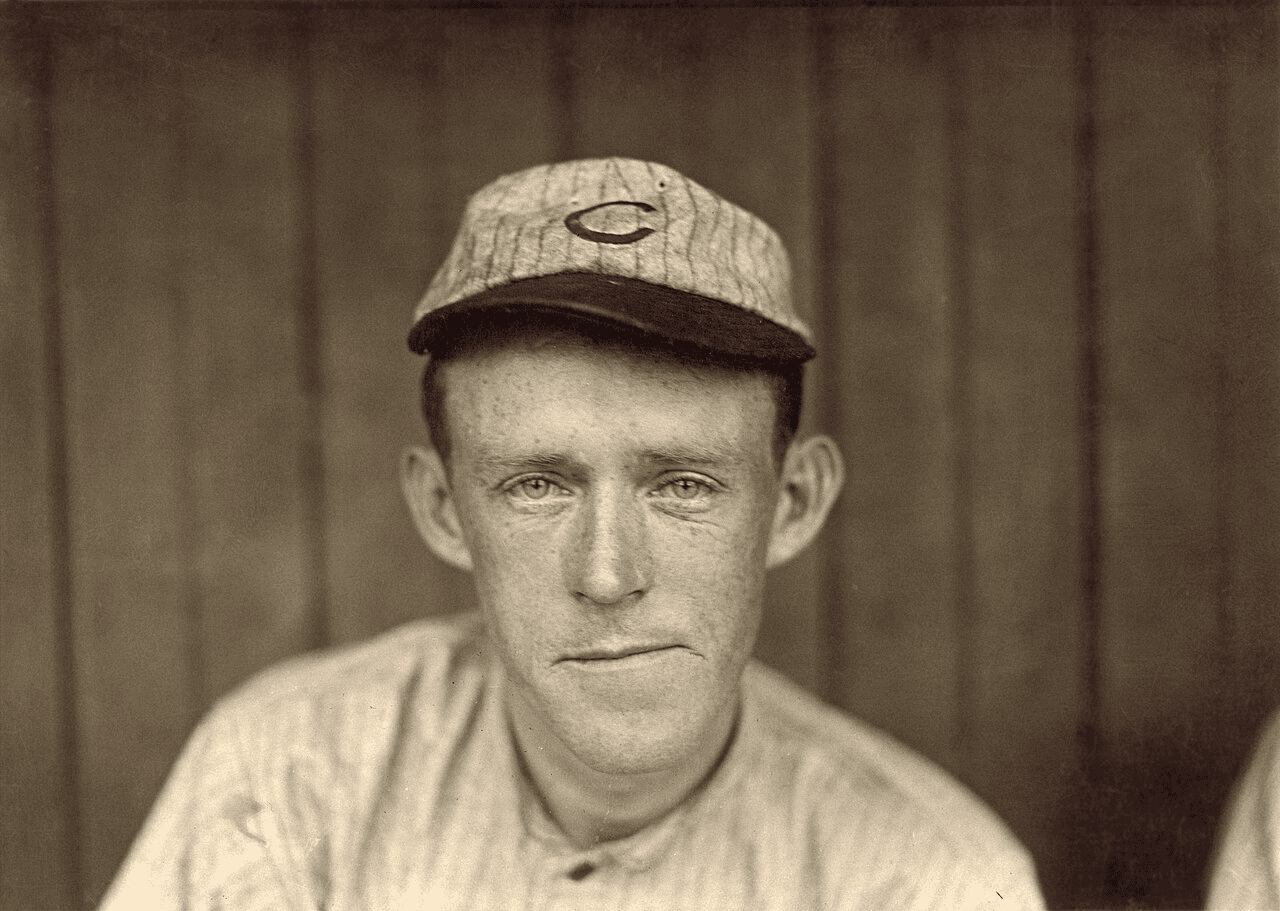
Johnny Evers portrait, 1910.
Photo credit: Bain News Service via Wikimedia Commons (Public domain)
John Joseph Evers played second base for 18 major league seasons, weighed barely 125 pounds at his peak, and shaped the outcome of pennant races through a knowledge of the rulebook that exceeded most of his contemporaries. He enforced an obscure rule in September 1908 that overturned an apparent Giants victory and eventually handed the pennant to the Cubs. Six years later, he helped transform a last-place team into a World Series champion between July and October. He played the game with a nervous energy that never relented, and it eventually consumed him.
Troy to the West Side Grounds
Evers was born in Troy, New York, in 1881. He was small and thin for a professional ballplayer, listed at 5-foot-9 and 125 pounds, though some sources put him lighter. He arrived in Chicago in 1902 at age 21 and claimed the starting second base job almost immediately. His range was exceptional, his arm was strong enough for the position, and his baseball intelligence was obvious from the start.
He joined an infield that already included shortstop Joe Tinker and would soon include first baseman Frank Chance, who became player-manager in 1905. The three of them formed a defensive combination that newspaper columnist Franklin Pierce Adams immortalized in an eight-line poem in 1910. The poem gave them lasting fame, though their actual double play totals were not exceptional by the standards of the era. The three men frequently did not get along. Tinker and Evers stopped speaking to each other after a fight over a cab ride to an exhibition game in 1905, and the silence lasted for years.
The Play That Decided a Pennant
On September 23, 1908, the Cubs played the Giants at the Polo Grounds in a game that shaped the National League pennant race. In the bottom of the ninth, with the score tied and runners on first and third, Al Bridwell singled to center field. The runner on third scored, and the Giants appeared to have won. But Fred Merkle, the runner on first, never touched second base. He saw the winning run cross the plate and walked toward the clubhouse, following common practice at the time.
Evers saw what Merkle had done. He called for the ball, stepped on second base, and argued that Merkle was forced out, nullifying the run. The umpires eventually ruled the game a tie. When the Cubs and Giants finished the regular season in a dead heat, the league ordered a replay. Christy Mathewson started for the Giants, and the Cubs beat him. They won the pennant and the World Series that followed. Merkle's failure to touch the base became the most discussed mental error in baseball history, and it only became a decisive play because Evers knew the rule and insisted on enforcing it.
The Miracle Braves
After a bitter departure from the Cubs, Evers joined the Boston Braves in 1914. The team sat in last place in the National League on July 4. Over the next three months, the Braves won at a rate that defied expectation and took the pennant by 10.5 games. In the World Series, they swept Connie Mack's heavily favored Philadelphia Athletics in four straight games. Evers won the Chalmers Award, a precursor to the modern MVP, for his role in the turnaround. His experience and intensity gave a young roster the composure it needed for a pennant run that no one outside the clubhouse had anticipated.
The Cost
Evers suffered from what contemporaries described as nervous breakdowns, and his health declined in the years after his playing career ended. He managed the Cubs briefly in 1921 and the White Sox briefly in 1924, without success in either role. Financial troubles followed him through retirement. The Old Timers Committee elected him to the Hall of Fame in 1946, alongside Tinker and Chance, but Evers was in poor health by then. He died on March 28, 1947, in Albany, New York, at age 65, less than a year after the announcement.