Profile
Max Carey
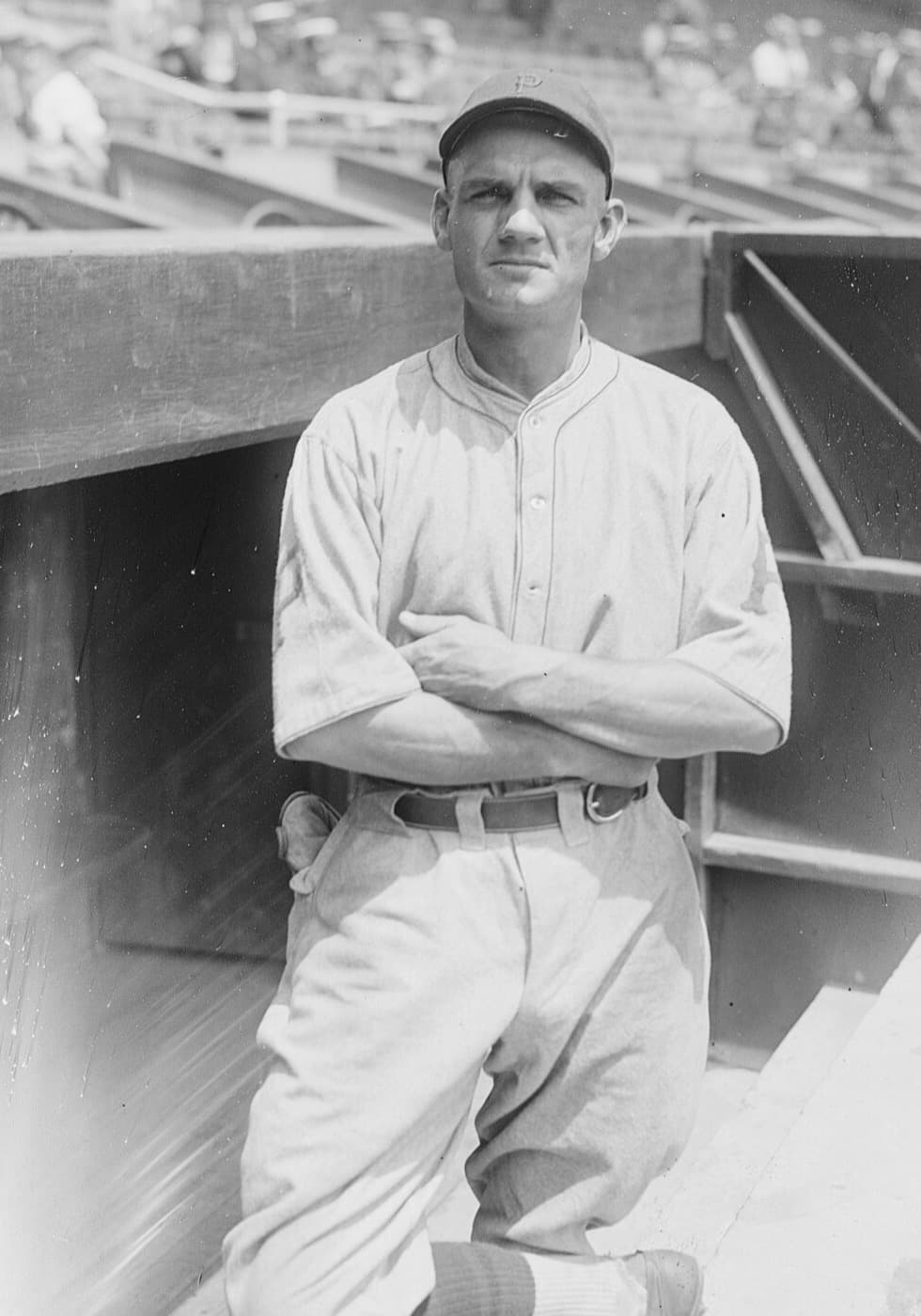
Max Carey portrait (Pittsburgh NL).
Photo credit: Bain News Service / Library of Congress via Wikimedia Commons (Public domain)
Maximilian George Carnarius changed his name, abandoned the seminary, and became the best baserunner in the National League for more than a decade. He led the league in stolen bases 10 times, swiped 738 bases over 20 seasons, and played center field with the range and intelligence of someone who studied every aspect of the game with the same discipline he had once applied to preparing for the Lutheran ministry. He was a thinking player in an era that rewarded speed, and he used both qualities to dominate the basepaths from 1910 through the mid-1920s. The Veterans Committee elected him to the Hall of Fame in 1961.
Terre Haute
Carey was born on January 11, 1890, in Terre Haute, Indiana. He attended Concordia College in Fort Wayne, a pre-seminary school affiliated with the Lutheran Church-Missouri Synod, where he studied theology and prepared for the ministry. He was a gifted athlete, and when his baseball ability attracted the attention of professional scouts, he left school to pursue the game. He signed with the South Bend club of the Central League and adopted the surname "Carey" to protect his amateur standing and to spare his family any embarrassment over his decision to play professional baseball rather than enter the church. The Pittsburgh Pirates purchased his contract in 1910, and he appeared in two games at the end of the season before earning a full-time roster spot the following year.
Pittsburgh
Carey became the regular center fielder for the Pirates in 1911 and immediately established himself as one of the fastest players in the league. He led the National League in stolen bases for the first time in 1913 with 61 steals, and he led the league again in 1915, 1916, 1917, 1918, 1920, 1922, 1923, 1924, and 1925. His 10 stolen base titles remain a National League record.
What separated Carey from other fast players of his generation was not raw speed alone but the precision with which he applied it. In 1922, he stole 51 bases and was caught only twice, a success rate of 96 percent that stands as one of the most remarkable baserunning seasons in baseball history. He studied pitchers' pickoff moves, timed their deliveries to the plate, and chose his moments with a patience that turned stolen bases from gambles into near certainties. His approach to the basepaths was methodical rather than reckless, and that discipline allowed him to remain an effective base stealer well into his thirties.
At the plate, Carey hit .285 over his career and served as a dependable leadoff hitter throughout his years in Pittsburgh. He batted .329 in 1922 and .343 in 1925, seasons that demonstrated he could hit for average when the rest of his game demanded it. In center field, he covered the expansive outfield at Forbes Field with the range and positioning that the ballpark's dimensions required. He led National League outfielders in putouts nine times, a reflection of both his speed and his ability to read the ball off the bat.
1925
The 1925 season brought Carey the championship that had eluded him for 15 years in Pittsburgh. The Pirates won the National League pennant and faced the Washington Senators in the World Series. Washington took a commanding three-games-to-one lead, and the Pirates appeared finished. Pittsburgh won Game 5, then Game 6, and Carey entered Game 7 having already stolen three bases in the Series. The Pirates won Game 7 in the rain at Forbes Field, 9-7, completing one of the great comebacks in World Series history. Carey batted .458 across the seven games, the finest postseason performance of his career and one of the best by any player in a single World Series.
The Pirates also had Kiki Cuyler and Pie Traynor on that roster, and the combination of Carey's baserunning, Cuyler's hitting, and Traynor's defense at third base gave Pittsburgh a team built for October. Carey was 35 years old during the Series, and the championship validated a career that had been defined by individual excellence on teams that rarely contended.
Brooklyn and After
Carey's time in Pittsburgh ended bitterly during the 1926 season. Fred Clarke, the former Pirates manager who had returned to the organization as a vice president and bench coach, clashed with several players over his clubhouse presence and authority. Carey sided against Clarke and led a group of players who protested Clarke's influence. The Pirates released Carey in August 1926 and placed him on waivers. Brooklyn claimed him, ending a 16-year association with Pittsburgh.
He played three seasons for the Brooklyn Robins, batting .266 in 1927, .247 in 1928, and .304 in 1929 before retiring as a player at age 39. He managed the Brooklyn Dodgers in 1932 and 1933, compiling a 146-161 record across two seasons that produced little beyond experience. He later managed in the minor leagues and scouted for several organizations.
Carey finished with 2,665 hits, 419 doubles, 159 triples, and 738 stolen bases across 20 seasons. He died on May 30, 1976, in Miami, Florida, at age 86.