Profile
Nolan Ryan
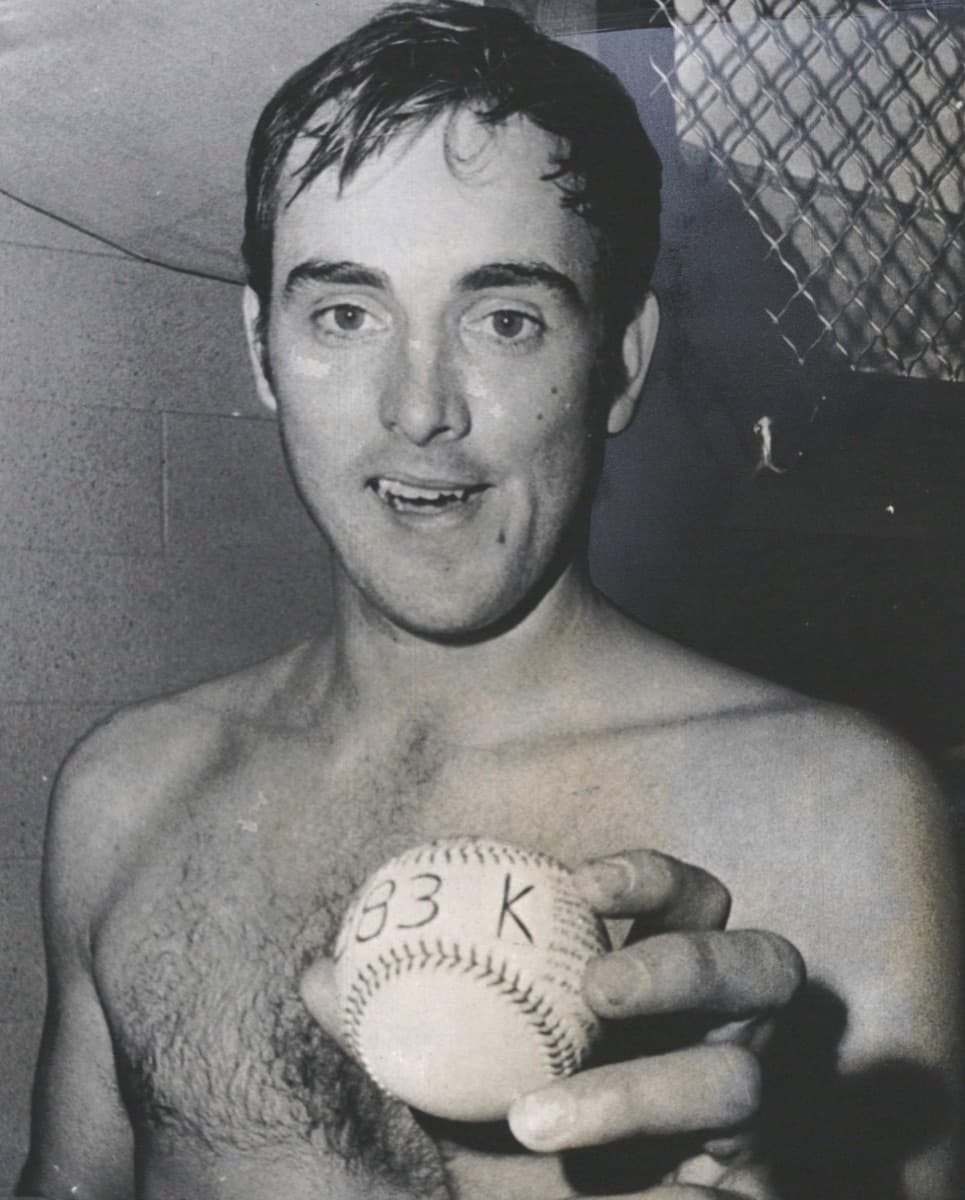
Nolan Ryan portrait (1973).
Photo credit: Unknown photographer via Wikimedia Commons (Public domain)
Nolan Ryan pitched for 27 seasons, struck out 5,714 batters, and threw seven no-hitters, records so far beyond the reach of any other pitcher that they will almost certainly stand for as long as baseball is played. He threw harder than anyone the game had measured and kept throwing that hard into his mid-forties, outlasting contemporaries, successors, and the reasonable limits of a human arm. The BBWAA elected him to the Hall of Fame on the first ballot in 1999 with 98.79 percent of the vote.
Texas
Lynn Nolan Ryan Jr. was born on January 31, 1947, in Refugio, Texas, and moved with his family to Alvin, south of Houston, when he was six weeks old. His father worked as a supervisor at an oil company, and from the time Nolan was eight years old the two of them delivered the Houston Post together on a predawn route that started at one in the morning and ended around four. Ryan later credited those years of throwing rolled newspapers from a moving car with building the arm that carried his career.
He played baseball from the age of seven and pitched for the Alvin High School varsity as a sophomore. Mets scout Red Murff first saw him at a game in League City and wrote in his scouting report that Ryan had "the best arm I've seen in my life." By his senior year Ryan had posted a 19-3 record with 211 strikeouts and thrown a no-hitter against Brenham. Murff lobbied the Mets to draft him in the 1965 amateur draft, the first in major league history, and New York selected him in the 12th round with the 295th overall pick.
The Mets
Ryan pitched in the minor leagues for two years while fulfilling his Army Reserve obligations, and the military disrupted his schedule throughout his time in New York. He reached the majors in September 1966 and spent parts of five seasons with the Mets, winning 29 games against 38 losses. The organization devoted its pitching development to Tom Seaver, Jerry Koosman, and Gary Gentry, and pitching coach Rube Walker offered Ryan little guidance beyond the instruction to throw as hard as he could for as long as he could.
Ryan's best moments in New York came during the 1969 postseason. He won Game 3 of the NLCS against the Atlanta Braves with seven innings of relief to clinch the pennant, and in Game 3 of the World Series against the Baltimore Orioles he entered in the seventh inning with the bases loaded and shut Baltimore out for the rest of the game. It was the only World Series appearance of his 27-year career.
On December 10, 1971, the Mets traded Ryan, Leroy Stanton, Don Rose, and Frank Estrada to the California Angels for shortstop Jim Fregosi. Fregosi played 146 games for the Mets before they shipped him to Texas, and the trade became one of the most lopsided in baseball history.
California
Angels pitching coach Tom Morgan overhauled Ryan's delivery, taught him a curveball, and gave him the mechanical foundation the Mets never had. Ryan also began lifting weights, becoming one of the first pitchers in the major leagues to train with a strength program, and he solved his chronic blister problem by using a surgeon's scalpel to remove calluses before each start. The transformation was immediate and permanent.
In 1973, Ryan went 21-16 with a 2.87 ERA and struck out 383 batters, breaking Sandy Koufax's single-season record of 382. He threw two no-hitters that season. The first came on May 15 against the Kansas City Royals, and the second on July 15 against the Detroit Tigers, when he struck out 17 and walked four. Norm Cash of the Tigers walked to the plate in the ninth inning carrying a table leg instead of a bat. The umpire made him go back for a real one, and Cash popped out to end the game.
On August 20, 1974, at Anaheim Stadium, a radar gun clocked Ryan at 100.9 miles per hour, a measurement taken ten feet in front of home plate that translates to roughly 108 miles per hour at the release point where modern guns record velocity. He threw his third no-hitter on September 28 that year against the Minnesota Twins, bringing him within one of Koufax's career record of four, and tied it on June 1, 1975, with his fourth against the Baltimore Orioles.
Ryan led the American League in strikeouts in seven of his eight California seasons, but the Angels' offense was so poor that a contemporary joke held that the team could take batting practice in a hotel lobby and never break anything. After the 1979 season, general manager Buzzie Bavasi publicly declared that Ryan could be replaced by two 8-7 pitchers, and Ryan left as a free agent.
Houston
On November 19, 1979, Ryan signed a four-year, $4.5 million contract with the Astros, making him the first professional athlete paid a million dollars a year. He had grown up thirty minutes from the Astrodome, and the chance to pitch close to home after eight years in Anaheim pulled him back to Texas. He gave the Astros nine seasons that reshaped the record book.
Ryan threw his fifth no-hitter on September 26, 1981, against the Los Angeles Dodgers, breaking Koufax's career record and establishing a mark that seemed unreachable even then. He called it his favorite because his family was in the stands and the Astros were in a division race. He finished that strike-shortened season with a 1.69 ERA.
On April 27, 1983, he broke Walter Johnson's career strikeout record of 3,509, which had stood since 1927, and he reached his 4,000th strikeout on July 11, 1985. In the 1986 NLCS against the Mets, Ryan carried a no-hitter into the fifth inning of Game 5 and struck out 12 in nine innings while pitching through a stress fracture in his right foot. The Mets won the game in 12 innings.
In 1987, at the age of 40, Ryan led the National League in both strikeouts and ERA but went 8-16 because the Astros almost never scored behind him. He led the league in strikeouts again in 1988, and when owner John McMullen responded by demanding a pay cut, Ryan left for the Texas Rangers.
Arlington
Ryan signed with the Rangers in December 1988 at the age of 41, and the final chapter of his career produced some of its most indelible moments. In his first season the Rangers drew over two million fans for the first time in franchise history, and on nights Ryan pitched attendance ran roughly 8,000 higher than any other game.
On August 22, 1989, Ryan struck out Rickey Henderson on a 96-mile-per-hour fastball for career strikeout number 5,000. Henderson had worked the count full, fouled off two pitches, and then swung through the last one. Ryan was 42 years old and had just recorded a milestone that no other pitcher will reach.
On June 11, 1990, he threw his sixth no-hitter against the defending champion Oakland Athletics while pitching through a stress fracture in his lower back. Seven weeks later, on July 31, he won his 300th game against the Milwaukee Brewers, throwing 146 pitches over seven and two-thirds innings. His seventh no-hitter came on May 1, 1991, against the Toronto Blue Jays, the best-hitting team in the league. He was 44 years old, struck out 16, and threw the hardest pitches of the game in the ninth inning.
On August 4, 1993, in what became one of the most replayed moments in baseball history, 26-year-old Robin Ventura of the White Sox charged the mound after Ryan hit him with a pitch. Ryan, who was 46, put Ventura in a headlock and landed several punches to the top of his head before catcher Ivan Rodriguez and the rest of the Rangers pulled them apart. The umpires ejected Ventura and let Ryan stay in the game, and he pitched seven innings and earned the win.
Ryan's final game came on September 22, 1993, at the Kingdome in Seattle. In the first inning, while facing Dave Magadan, he felt his ulnar collateral ligament tear on his third pitch. He threw one more, reportedly clocked at 98 miles per hour, before walking off the mound for the last time. He finished his career with a 324-292 record, a 3.19 ERA, 5,714 strikeouts, 2,795 walks, 222 complete games, and 61 shutouts across 27 seasons with four teams. The strikeout record stands 839 ahead of Randy Johnson, the only other pitcher to reach 4,875.
After Baseball
The BBWAA elected Ryan to the Hall of Fame in 1999 alongside George Brett and Robin Yount, and he wore a Texas Rangers cap on his plaque. He served as president and CEO of the Rangers from 2008 through 2013, the first Hall of Fame player to run a major league franchise in more than 80 years, and oversaw the team's first two World Series appearances in 2010 and 2011. He later joined the Astros as an executive advisor and was with the organization through 2019. He still lives near Alvin, not far from the route where he delivered newspapers with his father before dawn.