Profile
Pete Browning
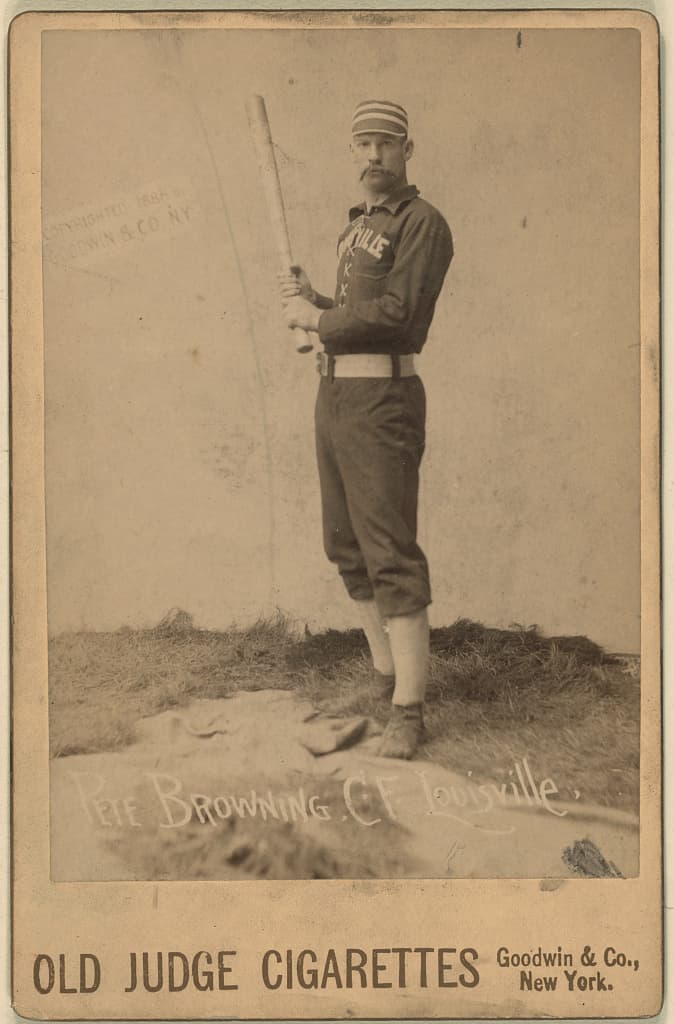
Pete Browning baseball card portrait.
Photo credit: Unknown photographer via Wikimedia Commons
Pete Browning hit a baseball as well as any man of the nineteenth century, and almost everything else about his life worked against him. He won three batting titles in two different major leagues, finished with a .341 career average no hitter of his era could match from the right side, and gave his name to the first Louisville Slugger, the bat a teenage woodturner carved for him in 1884. Deafness left him in pain and apart from the world, drink wore him down, and he could neither read nor write, and so the player they called The Gladiator fought as hard off the field as on it. He died at 44, broken and largely forgotten, and the recognition he earned came mostly after he was gone.
A Louisville Boy Who Could Hit
Browning was born Louis Rogers Browning on June 17, 1861, in Louisville, Kentucky, the youngest of eight children in a family that ran a grocery and a small farm. A childhood illness left him with mastoiditis, a chronic infection of the inner ear that brought lifelong pain, vertigo, and a deafness that deepened as he aged. The condition kept him out of school almost from the start, and he grew into adulthood unable to read or write, cut off from much of the conversation around him and reliant on his eyes and his hands. What those hands could do with a bat became obvious early, on the sandlots and amateur fields of Louisville, where a powerfully built young man with an unteachable swing began to draw crowds. He signed with the hometown Louisville Eclipse of the American Association in 1882, and from his first season he was one of the best hitters alive.
The Best Average From the Right Side
Browning batted .341 across thirteen major league seasons, a figure that stands among the ten highest in the history of the game and the highest ever posted by anyone batting from the right side. He collected 1,646 hits in only 1,183 games, and his adjusted OPS of roughly 162 ranks among the dozen best of all time, ahead of a long line of names already in the Hall of Fame. He did it without a batting coach, without film, and without the use of one of his senses, reading a pitch off the pitcher's hand and driving it where the fielders were not. Contemporaries who watched him swing came away convinced they had seen the purest hitter of the age, a man who needed no instruction because instruction had nothing to teach him. The numbers have only grown more impressive with time, and they remain the heart of his Hall of Fame case.
Three Titles in Two Leagues
As a rookie of 21 in 1882, Browning led the American Association with a .378 average, and he added a second batting crown in 1885 at .362, dominating the league with bat in hand even as his life frayed around him. When the Players League formed in 1890, he jumped to the Cleveland Infants and won a third title at .373, becoming one of the few men ever to lead two different major leagues in hitting. His finest year came in 1887, when he batted .402 with 220 hits, 103 stolen bases, and 118 runs driven in, a season second in the Association only to Tip O'Neill's .435. The 1887 averages were briefly inflated by a rule, in force for a single season, that counted walks as hits, and the modern record books have since stripped those walks back out, leaving Browning's .402 as the recalculated figure that stands today. By any accounting it was one of the great offensive seasons of the century.
The First Louisville Slugger
In 1884 an apprentice woodturner of 17 named Bud Hillerich slipped out of his father's Louisville shop to watch Browning play, and the bat he turned afterward would launch the most famous brand in the sport. The cinematic version, the one the company told for decades, has Browning breaking his bat, the young Hillerich offering to carve a new one overnight, and the slugger rapping out three hits the next day, and most of those details appear to be later marketing invention rather than documented history. What survives scrutiny is the year and the connection, Browning and the early Hillerich bats and the Louisville shop that grew into Hillerich and Bradsby. The company registered the Louisville Slugger trademark a decade later, in 1894, by which time the custom bats had become a business. Baseball's most recognized name in lumber began with a deaf, unlettered hitter who cared more about his bats than almost anything else in the world.
The Bats He Named
Browning treated his bats the way other men treated family, and the rituals he built around them passed into legend during his own lifetime. He gave each one a name, many drawn from the Bible, and he believed every bat held a finite number of hits and retired it once he judged the supply spent, storing the veterans in a collection that ran into the hundreds. He tracked his batting average on the cuffs of his shirts because he could not keep it any other way, and he was said to stare at the sun in the belief that it strengthened his batting eye. The superstitions made him an easy target for the press, who turned his oddities into copy, and the nickname The Gladiator grew out of the constant public battles he fought, with sportswriters, with his own body, and with the bottle. Beneath the eccentricity was a craftsman's obsession, a man who had built his whole identity around the one thing he could do better than anyone.
The Bottle
Drinking ran through Browning's career and finally consumed it, a steady erosion that the deafness and the pain only deepened. A suspension cost him the last two months of the 1889 season for drunkenness, and as his thirties wore on the great swing began to leave him, the reflexes dulled and the body worn down. Browning drifted from Louisville to Cleveland to Pittsburgh and Cincinnati and back, his average sliding, his welcome thinning, until he played his last major league games in 1894. The man who had read pitches better than anyone could no longer catch up to them, and the league that had marveled at him moved on. He went home to Louisville with little to show for the best bat to swing from the right side in the nineteenth century.
The Asylum
Browning's last years were grim, his health collapsing under the combined weight of the ear disease, the drinking, and other illness closing in. In June 1905 a court declared him insane and committed him to an asylum at Lakeland, and his sister removed him about two weeks later and brought him to a Louisville hospital, where surgeons operated on his ear and treated a tumor. He died there on September 10, 1905, at 44, and was buried at Cave Hill Cemetery in the city he had never really left. Recognition came late and partial, an Overlooked Legend honor from baseball's researchers and a permanent place in the Louisville Slugger story. More than a century on, the highest average anyone has ever posted batting from the right side still belongs to a deaf, unlettered hitter from Louisville, remembered as much for his bats and his sorrows as for the swing itself.