Profile
Tip O'Neill
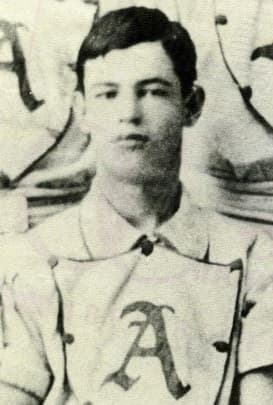
Tip O'Neill portrait.
Photo credit: Unknown photographer via Wikimedia Commons
Tip O'Neill produced the finest offensive season any hitter managed in the nineteenth century, and he carried it home to Canada. In 1887 he won the American Association's Triple Crown for the St. Louis Browns, leading the league in batting average, home runs, and runs batted in while topping nearly every other category on the page. His .435 mark that year, as the modern record books recalculate it, trails only Hugh Duffy's .440 as the highest single season average in major league history. Born in Ontario and revered as Canada's answer to Babe Ruth, he batted .326 across ten seasons and won two batting titles, and his home country built him into its baseball hall of fame and named its highest honor for a Canadian player after him, recognition the American game has been far slower to grant.
The Innkeeper's Son
O'Neill was born James Edward O'Neill on May 15, 1860, in Springfield, Ontario, into a large family that kept a hotel in nearby Woodstock, the town that would forever claim him as its own. Some records place his birth two years earlier and in Woodstock itself, a discrepancy his Canadian biographers have never fully settled, but the Woodstock hotel and the Ontario roots are not in doubt. He grew into a powerful young man, six feet tall and broad through the shoulders, and he drifted south across the border to chase a living in the American professional game. Like many young men with strong arms, he started as a pitcher, betting that his arm would carry him before anyone discovered what his bat could do. The bet paid off in a way he could not have predicted, because the bat would carry him much further than the arm ever could.
From the Pitcher's Box to the Outfield
O'Neill reached the major leagues in 1883 with the New York Gothams of the National League, taking the box as a pitcher and getting knocked around enough to suggest his future lay elsewhere. He signed with the St. Louis Browns of the American Association in 1884, split that first season between pitching and the outfield, and then put the ball down for good and became a hitter full time. Once owner Chris Von der Ahe moved him to left field and left him there, the transformation was swift and total, and within two years he was the most feared bat in the league. The arm that had brought him to America turned out to be the least of his gifts. O'Neill had found the thing he was born to do, and he set about doing it better than anyone alive.
The Triple Crown of 1887
The 1887 season belonged to O'Neill the way few seasons have ever belonged to a single hitter. He won the Triple Crown, leading the American Association in batting average, home runs, and runs batted in, and he kept going, pacing the league in hits, doubles, triples, total bases, on base percentage, slugging, and runs scored, eleven of the twelve major offensive categories by one accounting. He piled up 225 hits, 52 doubles, 19 triples, 14 home runs, 123 runs batted in, and a staggering 167 runs scored, and he hit for the cycle twice inside of six days that spring. No hitter before or since has led a league in doubles, triples, and home runs in the same year. For one summer the best pitchers in the Association had no answer for the big Canadian in left field, and the record book still carries the marks he left.
The Average That Needs a Footnote
O'Neill's 1887 batting average comes with a story attached, because the American Association spent that single season counting every base on balls as a base hit. Under that one season rule his average was recorded as .492, the highest figure in the league's history, and when the game's statisticians standardized the records in 1968 and stripped the walks back out, the number settled at .435. Even reduced, it stood as the highest single season average in major league history until Hugh Duffy hit .440 seven years later, and it remains second on the all time list to this day. Purists have argued both sides ever since, one baseball historian insisting late in the twentieth century that a walk counted as a hit in 1887 should stay a hit forever. By either number it was one of the great hitting seasons the sport has produced, and it anchors his Hall of Fame case.
The Browns Dynasty
O'Neill hit in the middle of the order for the best team of the 1880s, the rowdy, brilliant St. Louis Browns who won four straight American Association pennants from 1885 through 1888. The club belonged to Von der Ahe, a saloonkeeper who ran his ballplayers loud and ran his business louder, and O'Neill was its quiet engine, the bat that made the noise around him pay off. In the postseason series of those years, the nineteenth century forerunners of the World Series, the Browns met the National League champions from Chicago, and in 1886 they won, with O'Neill hitting around .400 across the games. He played through a Brooklyn crowd that turned ugly enough in 1889 that he expected, by his own account, that the whole team might be lynched. The pennants and the danger were of a piece in that era, and O'Neill came through both as the steadiest hitter on a volatile champion.
Canada's Babe Ruth
O'Neill finished with a .326 career average and roughly 1,385 hits across ten seasons, winning batting titles in both 1887 and 1888 and ranking among the elite hitters of his time. He returned to his great year again and again in the public memory, the Canadian who had outhit every American in the game, and the country he came from never let go of him. Generations later the Canadian Baseball Hall of Fame enshrined him, in 1983, and named its annual award for the top Canadian player the Tip O'Neill Award, so that his name is spoken every season north of the border. He stands as the finest player born in Canada in the nineteenth century and one of the best the country has ever sent to the major leagues. The nickname that followed him, Canada's Babe Ruth, was a stretch only in its timing, since O'Neill came first.
Montreal
When his playing days ended after the 1892 season with Cincinnati, O'Neill went home to Canada and built a life in Montreal rather than the American cities where he had starred. He helped establish the Montreal Royals, umpired and scouted, and eventually ran the Hoffman Café on Notre Dame Street, taking the business over after his brother George died. On the last day of 1915, stepping off a streetcar in Montreal, he suffered a heart attack and died at 55, and they buried him back in Woodstock a few days into the new year. The footnote about walks counting as hits and the short career have worked against a candidacy his peak ought to carry, and the American voters have looked past him for more than a century. His own country settled the question long ago, enshrining the best Canadian hitter of his age and putting his name on the trophy its finest player takes home every season.