Profile
Pud Galvin
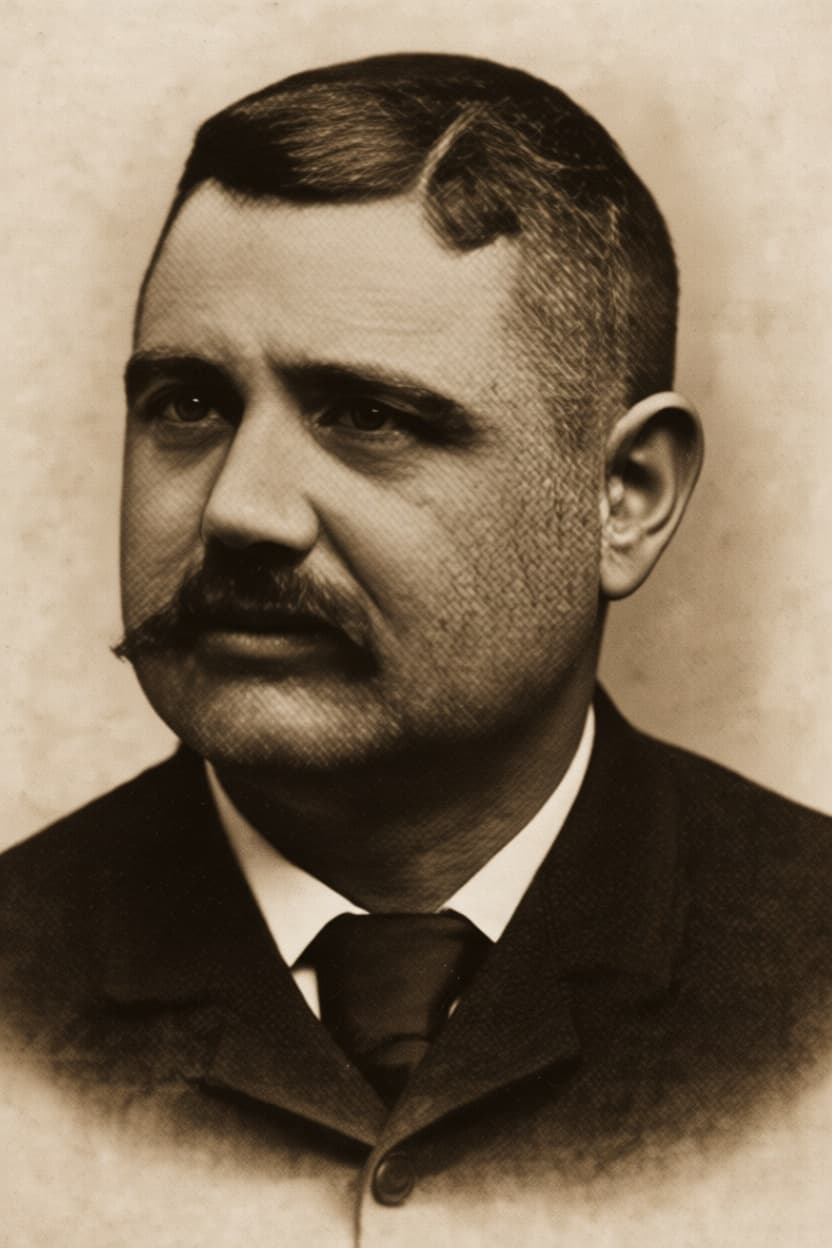
James 'Pud' Galvin portrait (clean headshot).
Photo credit: User-provided image via User-provided image
James Francis Galvin won 365 games, the first pitcher in major league history to reach 300, and he did it by pitching more innings than almost any human being should be asked to pitch. He completed 646 of his 688 career starts, threw more than 6,003 innings, and worked through the 1870s, 1880s, and 1890s with a durability that bordered on the absurd. He stood five foot eight and weighed close to 190 pounds, built like a fireplug with hands too small to throw a curveball, and he pitched until the game no longer wanted him. He died at 45, broke and far from the fame his workload had earned, and the Veterans Committee elected him to the Hall of Fame in 1965, more than six decades after his death.
Kerry Patch
Galvin was born on December 25, 1856, in the Kerry Patch neighborhood of St. Louis, a crowded district of shacks and mud streets populated by Irish immigrants who had arrived during and after the Great Famine. His parents, Martin and Bridget Galvin, had emigrated from Ireland, his father from County Clare and his mother from County Mayo. The neighborhood was rough, and Galvin trained as a steamfitter before turning to baseball as a profession. The nickname "Pud" reportedly derived from his ability to make batters look like pudding, though teammates also called him "The Little Steam Engine" for his compact power and "Gentle Jeems" for a disposition that contradicted the toughness of his upbringing. He married Bridget Griffin in 1878, and they had eleven children together.
He began his professional career in the mid-1870s, debuting briefly with the St. Louis Brown Stockings of the National Association in 1875. He worked his way through the minor leagues and reached the National League with the Buffalo Bisons in 1879, going 37-27 in his first full season and establishing himself immediately as one of the most durable pitchers in the game.
Buffalo
Galvin pitched for the Buffalo Bisons from 1879 through mid-1885, and the workloads he absorbed during those years are staggering even by the standards of the era. He pitched 656 innings in 1883 and 636 in 1884, winning 46 games in each of those seasons. He started 75 games in 1883, tying a record for the era, and completed 72 of them. He accounted for more than half of his team's total victories in several seasons. The Bisons were a modest franchise with limited resources, and Galvin was the foundation on which the team's competitiveness rested.
His abnormally small hands prevented him from throwing a curveball, a limitation that would have destroyed most pitchers' careers but may have paradoxically extended his own. He relied on a fastball, a variety of drops and changes of speed, and a control so precise that his walks-per-nine-innings rate ranked among the lowest in baseball history. He pounded the strike zone with the understanding that contact was inevitable and that his defense would handle most of what was hit.
He threw two no-hitters during his time in Buffalo. The first came on August 20, 1880, against the Worcester Ruby Legs, a 1-0 victory that made him the first major league pitcher to throw a no-hitter on the road. The second came on August 4, 1884. That same month, he pitched 39 innings across four games against Detroit without allowing an earned run, striking out 36 batters and walking none. The Detroit Free Press compared him to Maud S, the record-setting racehorse. On September 9, 1884, he shut out Providence 2-0, ending Old Hoss Radbourn's 18-game winning streak and Providence's 20-game team winning streak.
He also possessed one of the most deceptive pickoff moves in the game. On September 23, 1886, after he had moved to Pittsburgh, he picked off three Brooklyn base runners in a single inning using a jumping-jack motion that drew attention across the league. Cap Anson and John Montgomery Ward later protested the move as an illegal balk in separate confrontations over the following seasons. Buck Ewing, one of the era's finest catchers, said that if he had Galvin to catch, no one would ever steal a base on him.
Pittsburgh
Pittsburgh purchased Galvin's contract from Buffalo in mid-July 1885, and the Bisons disbanded later that season after selling off their remaining players. Galvin pitched for the Pittsburgh Alleghenys, later the Pirates, through 1889, winning 28 games for a poor 1887 team and reaching 300 career victories in 1888, the first pitcher in major league history to achieve the milestone.
In August 1889, a Pittsburgh newspaper reported that Galvin had been a test subject at a local medical college for the Brown-Sequard Elixir, a substance derived from guinea pig and dog testicle extracts that the French physiologist Charles-Edouard Brown-Sequard had promoted as a rejuvenating treatment. Galvin pitched a two-hit shutout after receiving the injection. The Washington Post covered the episode favorably, calling it "the best proof yet furnished of the value of the discovery." No one in baseball or the press expressed concern. A 2002 study demonstrated that the elixir was biologically inert, and any benefit Galvin experienced was placebo. The episode is sometimes cited as the earliest known case of a professional athlete using a performance-enhancing substance, though the substance itself enhanced nothing.
He pitched for the Pittsburgh Burghers of the Players' League in 1890, returned to Pittsburgh's National League club, and finished his career with the St. Louis Browns in 1892. He attempted a comeback with the Buffalo Bisons of the Eastern League in 1894 at roughly 250 pounds, pitched poorly in three games, and was released. His final at-bat, in what would be the last professional game of his career, was a home run.
365 Wins
Galvin retired with a career record of 365-310, a 2.85 ERA, and 6,003 innings pitched. He was the first pitcher to reach 300 wins, a milestone Cy Young would eventually surpass on the way to 511. He won 20 or more games in ten different seasons without ever playing for a pennant winner, the only pitcher in history to carry that particular distinction.
After baseball, Galvin umpired briefly in the National League in 1895 but found the role unpleasant. He worked as a pipe-layer, a contractor, and a saloon owner in Pittsburgh, though none of these ventures succeeded. He opened a saloon and employed nine bartenders over its life, each of whom left to open their own successful establishments while his failed. He died on March 7, 1902, in Pittsburgh, at 45, from catarrh of the stomach, leaving his wife Bridget and six surviving children in poverty. A fundraising event with boxing and music was held to support his family.
The Veterans Committee elected him to the Hall of Fame in 1965, sixty-three years after his death. At the induction ceremony, his son Walter, then 78 years old, addressed the audience and said, "I thank you for remembering him. You waited a long time to catch up with the old gent."