Profile
Red Faber
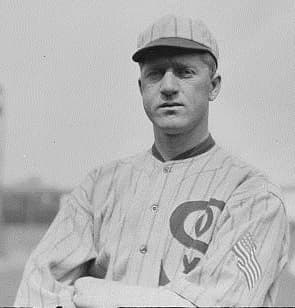
Red Faber portrait (1917).
Photo credit: Bain News Service via Wikimedia Commons (Public domain)
Red Faber spent his entire 20-year career with the Chicago White Sox, won three games in the 1917 World Series, and then missed the 1919 Series with an injury that kept him off the roster entirely. The eight teammates who conspired to throw that Series went down in history as the Black Sox. Faber, who would have been the staff's best pitcher had he been healthy, was never touched by the scandal, and the timing of his absence is one of the strangest footnotes in the game's darkest chapter.
Cascade
Urban Clarence Faber was born on September 6, 1888, in Cascade, Iowa, a small town in the northeastern part of the state. He pitched in the minor leagues before joining the White Sox in 1914 and establishing himself as a durable starter who relied on a spitball, a pitch that was legal at the time and that Faber threw with enough movement to keep hitters off balance for two decades.
When Major League Baseball banned the spitball after the 1920 season, 17 pitchers who depended on the pitch were grandfathered in and allowed to continue throwing it for the rest of their careers. Faber was one of them. He outlasted all but Burleigh Grimes on that list, and the spitball remained his primary weapon through the mid-1920s, when he gradually shifted to a conventional repertoire as his command of the wet pitch declined.
1917
Faber's finest moment came in the 1917 World Series against the New York Giants. He started four games, won three, pitching complete games in Games 2 and 6 and winning Game 5 in relief. His Game 6 victory clinched the championship. His three wins in a single Series tied a record, and his dominance gave the White Sox their most recent legitimate World Series title. He also stole a base during the Series, one of the few pitchers in World Series history to do so, though the story is better remembered for the base-running blunder in which Faber reportedly tried to steal third base with a teammate already standing on it.
1919
Faber had battled influenza during the 1918 season, and a combination of lingering illness and ankle injuries kept him off the 1919 World Series roster entirely. He pitched only 25 games during the regular season, winning 11 and was in no condition to contribute in October. The White Sox lost the Series to the Cincinnati Reds in eight games, and the following year the fix became public. Eight players, including Shoeless Joe Jackson and first baseman Chick Gandil, who had organized the scheme, were banned from baseball for life by Commissioner Kenesaw Mountain Landis.
Faber's absence from the 1919 Series is a permanent source of speculation. He had been the team's best pitcher in 1917 and would have been difficult for the fixers to work around. Whether his presence on the roster would have changed the outcome or made the fix impossible to execute is unknowable, but the question has followed the 1919 White Sox ever since.
The Long Career
Faber pitched through the 1933 season, winning 254 games against 213 losses with a 3.15 career ERA. He won 20 or more games in four seasons, led the American League in ERA in 1921 and 1922, and completed 273 of his 483 career starts. Like Luke Appling, who arrived in Chicago near the end of Faber's career, he spent his entire tenure with a franchise that was rebuilding from the damage the scandal had inflicted. The White Sox of the 1920s and early 1930s were a diminished team, and Faber pitched through the lean years without complaint.
He retired at 45 and remained in Chicago for the rest of his life. The Veterans Committee elected him to the Hall of Fame in 1964, and he died on September 25, 1976, in Chicago, at 88. He was the last surviving member of the 1917 World Series champions and one of the last links to the era of the legal spitball.