Profile
Smoky Joe Wood
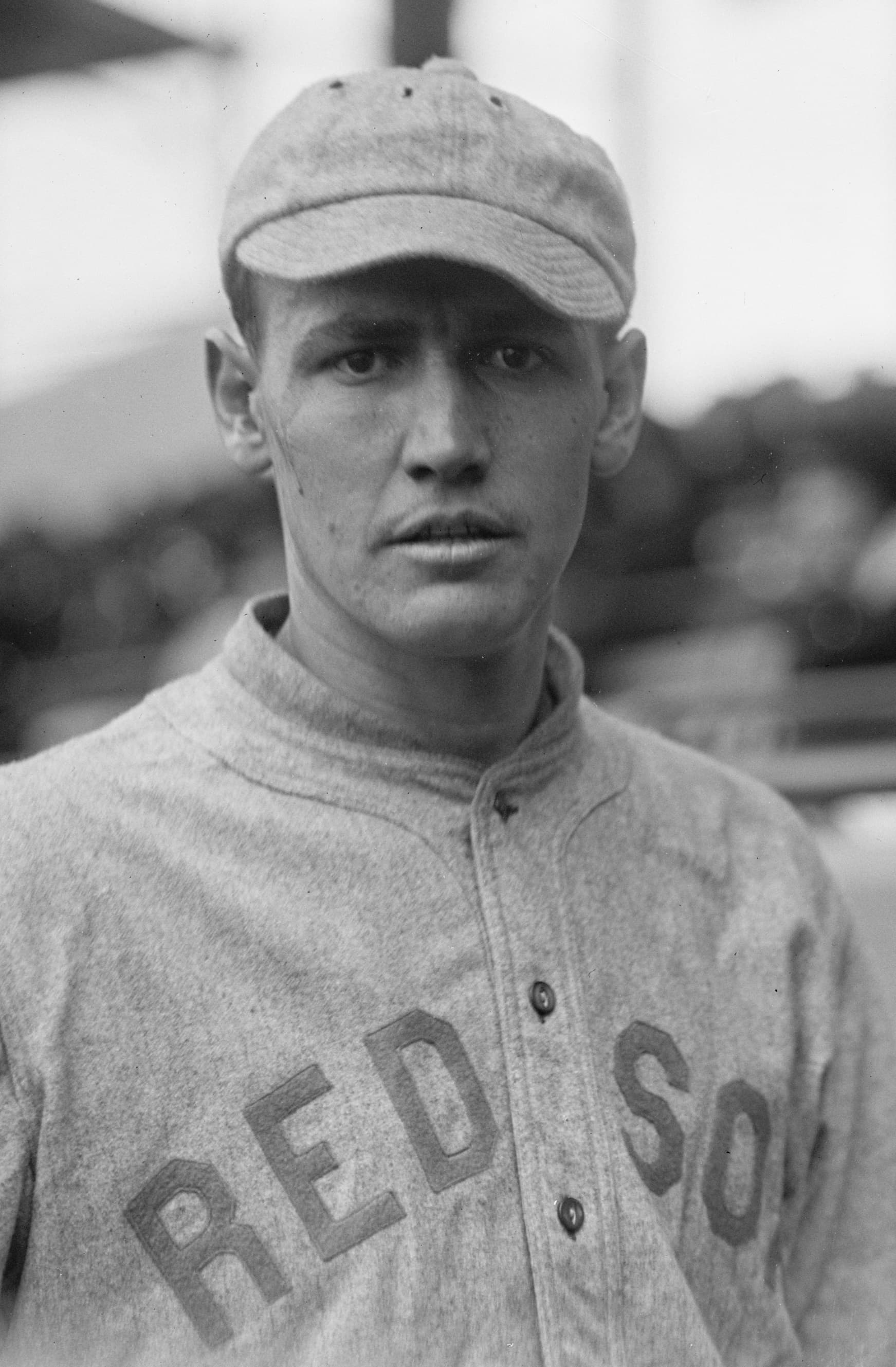
Smoky Joe Wood, Boston AL, 1915.
Photo credit: Harris & Ewing via Wikimedia Commons (Public domain)
Joe Wood threw so hard that Walter Johnson, the fastest pitcher of the Dead-Ball Era, said he had never seen anyone throw harder. In 1912, at age 22, Wood went 34-5 with a 1.91 ERA, led the Boston Red Sox to a World Series championship, and looked like the best pitcher in baseball. He broke his thumb midseason the following year, altered his delivery to compensate, and destroyed his arm. He was effectively finished as a pitcher by his mid-twenties. What happened next, his reinvention as an outfielder for the Cleveland Indians, turned a tragedy into one of baseball's strangest and most resourceful career arcs.
Kansas to Boston
Howard Ellsworth Wood was born on October 25, 1889, in Kansas City, Missouri. His father, John Wood, was an attorney who had built a successful practice in Chicago before moving the family west. The Woods lived in Ouray, Colorado, where John published a newspaper, and later in Ness City, Kansas. Joe pitched for semipro teams as a teenager and attracted attention from scouts with a fastball that had no comparison in the small-town circuits where he played. The Red Sox signed him and brought him to Boston in 1908, when he was 18 years old.
Wood was wild in his early seasons, walking too many batters and struggling to locate his fastball consistently. He developed better control by 1911, when he went 23-17 with a 2.02 ERA and showed that the raw velocity could be paired with enough command to pitch deep into games. Nothing about that record prepared anyone for what he would do the following year.
The 1912 Season
In 1912, Wood won 34 games and lost 5, posted a 1.91 ERA, and threw 10 shutouts. He struck out 258 batters in 344 innings, and his winning percentage of .872 was the highest in the American League. He was 22 years old, and no pitcher in baseball could match him that season.
On September 6, he faced Walter Johnson in a head-to-head matchup that had been promoted like a heavyweight championship fight. Johnson had set a 16-game winning streak earlier in the season that had recently ended, and Wood entered the game with 13 consecutive victories, chasing Johnson's American League record. Roughly 29,000 fans packed Fenway Park, which had opened that same April. Wood won the game 1-0 when Tris Speaker doubled and Duffy Lewis drove him in with another double down the right-field line. Wood extended his winning streak to 14 and eventually reached 16 consecutive wins on September 15, tying Johnson's record. The streak ended on September 20, but the September 6 duel with Johnson became one of the most famous pitching matchups of the Dead-Ball Era.
In the 1912 World Series against the New York Giants, Wood went 3-1 across four appearances. He won the decisive final game in relief after the Giants' famous tenth-inning error by center fielder Fred Snodgrass, who dropped a routine fly ball that allowed the Red Sox to rally and win the championship. At 22, Wood appeared to be the foundation on which the Red Sox could build a pitching staff for the next decade.
The Arm
On July 18, 1913, Wood slipped on wet grass while fielding a ground ball and broke the thumb on his pitching hand. He returned to the mound before the thumb had fully healed, and the compensations he made in his delivery to protect the injury put destructive strain on his shoulder. He went 11-5 that season, but his mechanics had changed in ways that could not be undone.
His shoulder deteriorated over the next two seasons, though he continued to pitch. He went 10-3 in 1914 and 15-5 in 1915, respectable records that masked the fact that his fastball had lost the velocity that once matched Walter Johnson's. The Red Sox sold his contract to the Cleveland Indians in February 1917 for $15,000. He sat out the entire 1916 season on his farm, unsure whether he could still compete at the major league level, and when he arrived in Cleveland it was as a different kind of player entirely.
The Second Career
Wood joined the Indians in 1917 and appeared in only a handful of games as the transition from pitcher to position player began. He played more regularly over the next several seasons, learning the outfield from the ground up and proving that his bat could sustain a major league career even after his arm could not.
He hit .296 in 1918 and continued to produce as a part-time outfielder and occasional pitcher. In 1920, he was part of the Cleveland Indians team that won the World Series, contributing as a reserve outfielder on a roster managed by Speaker. The man who had been the hardest thrower in baseball eight years earlier won a second championship ring with his bat rather than his arm.
His best offensive season came in 1921, when he hit .366 in 66 games and 194 at-bats, showing the kind of consistent contact ability that suggested he could have been a productive everyday hitter from the start of his career if circumstances had been different. He retired after the 1922 season with a combined career line of .283 as a hitter and 117-57 with a 2.03 ERA as a pitcher, a statistical portrait split between two entirely different careers.
Yale and After
Wood joined Yale University as freshman baseball coach in 1923 and was promoted to varsity head coach the following year. He held the position until 1942, when the university let him go amid wartime budget constraints. He had spent nearly two decades coaching college players in New Haven, bridging the gap between the Dead-Ball Era he had dominated and the modern game that followed it.
He lived to be 95, the last surviving player from the 1912 World Series and one of the final living links to the Dead-Ball Era. He gave interviews into his nineties about Johnson, Speaker, and the game as it had been played before the lively ball changed everything. He never expressed bitterness about the injury, at least not publicly. He had been the best pitcher in baseball for one magnificent season, had rebuilt himself into a different kind of player, and had won two World Series rings in two different roles. Most careers that end in the mid-twenties are simply tragedies. Wood's was a tragedy with a second act.
He died on July 27, 1985, in West Haven, Connecticut.