Profile
Tony Mullane
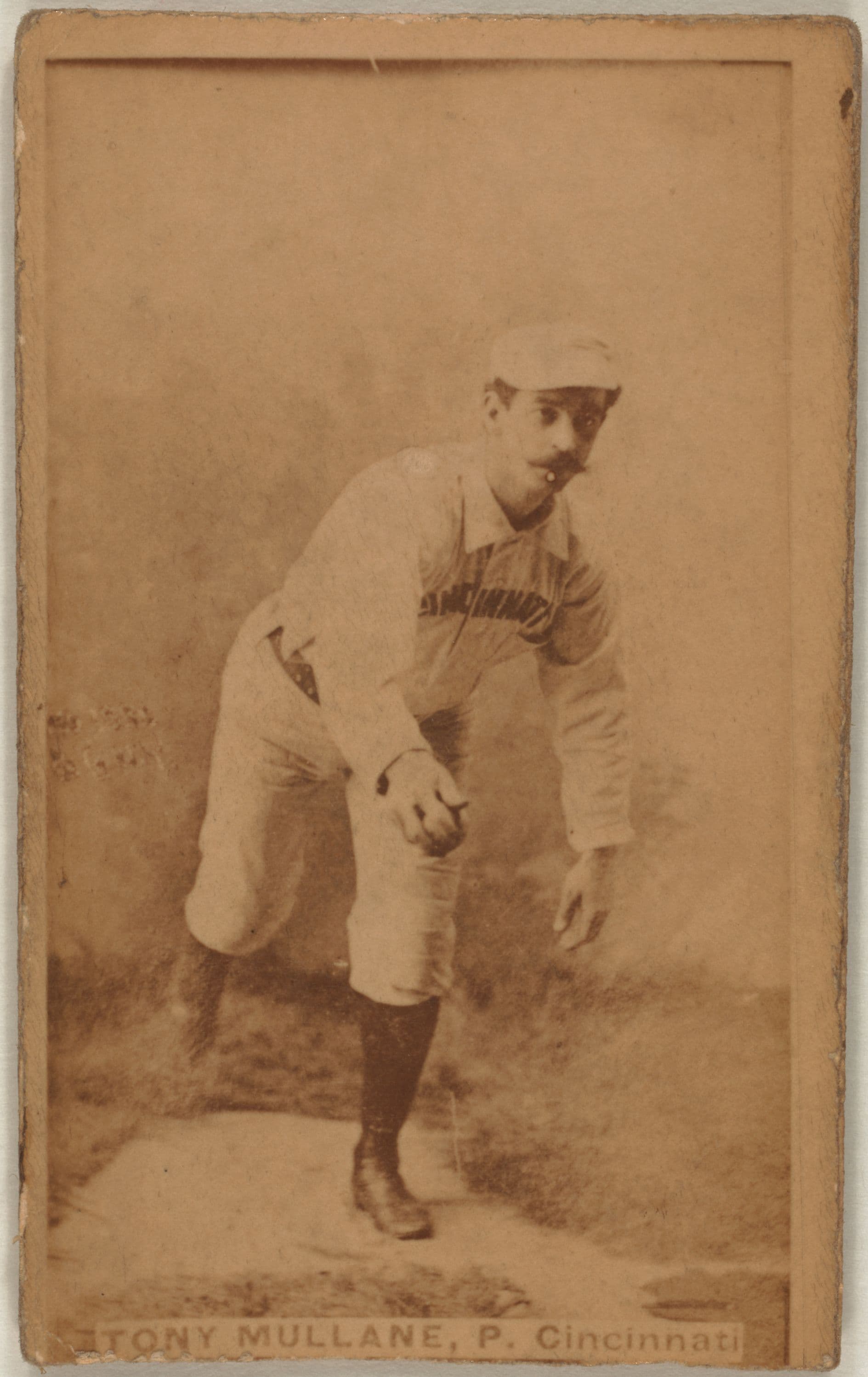
Tony Mullane baseball card portrait.
Photo credit: Unknown photographer via Wikimedia Commons
Tony Mullane could pitch with either arm, and across thirteen seasons he beat the best hitters of the 1880s with both of them. Mullane won 284 games, threw with a velocity and command contemporaries marveled at, and stood on the mound without a glove so he could switch arms between batters, the first true ambidextrous pitcher the major leagues ever saw. A handsome, vain man the newspapers called the Apollo of the Box, Mullane drew crowds with his looks as much as his arm, and he might have reached 300 victories had a contract fight not cost him a full season. One thing more keeps his name alive, a battery he formed with Moses Fleetwood Walker that exposed the ugliest current running through the game he played. Among pitchers eligible for Cooperstown, only Bobby Mathews won more games and stayed out.
The Apollo of the Box
Mullane was born Anthony John Mullane on January 30, 1859, in County Cork, Ireland, and came to America as a small child when his family emigrated and settled in Erie, Pennsylvania, in the early 1860s. He grew into a strikingly handsome young man, and once he reached the majors the sportswriters fixed two nicknames on him, the Count for his bearing and the Apollo of the Box for the face that brought women to the ballpark to watch him work. That vanity followed him onto the field, where he pitched with a low delivery and a command of the ball one Boston paper called wonderful. Few pitchers of the era looked the part the way Mullane did, and fewer still backed the image with the arm he owned. Before the word existed he was a star in the modern sense, a draw at the gate and a force on the mound at once.
Two Good Arms
What set Mullane apart from every pitcher before him was the ability to throw hard with either arm. He had taught himself to pitch with his left arm after hurting his right, and rather than abandon the trick he kept it, standing on the rubber barehanded and switching arms to suit the man at the plate. On July 18, 1882, pitching for the Louisville Eclipse and getting hammered with his right arm early, Mullane changed to his left arm in the middle of the game, the first pitcher to throw with both arms in a single major league contest. He batted from both sides as well, dangerous enough to play other positions on his off days. The trick made him a curiosity and a headache for opponents who never knew which Mullane they would face. No one in the game's first half century did what he did, and almost no one has since.
The Winning Machine
For six years Mullane ranked among the most durable and effective pitchers alive, and the win totals show it. Five times between 1882 and 1887 he won 30 or more games, going 30-24, then 35-15, then 36-26, before adding seasons of 33 and 31, all of it built on workloads that ran past 4,500 innings. Mullane finished 284-220 with a 3.05 earned run average and 1,803 strikeouts, the record of a pitcher who took the ball every other day and gave his team a chance every time. A mark no one wants followed him too, 343 career wild pitches, the most in major league history and the price of a hard thrower in an era of primitive catching gear. That wildness was part of the package, the same untamed arm that made him so hard to hit. He worked through the 1880s as a true workhorse, the kind the game has not asked for since.
The Year He Sat Out
Mullane threw away a season and perhaps a place in Cooperstown over money, in the chaotic years when players and owners fought over who controlled a career. After the 1883 season the St. Louis Browns reserved him, but he took advance cash from one club and then signed with Toledo for 1884, and when he jumped again to Cincinnati for 1885 the American Association suspended him for the entire year and fined him a thousand dollars. Mullane sat out all of 1885 in his prime, pitching local games in Ohio and waiting for reinstatement that October, and the lost year cost him the 16 or more wins that would have carried him past 300. He came back and pitched well for years more, but the milestone was gone, surrendered to a contract dispute he could not win. That lost season became the great unanswered question of his career, the difference between a borderline candidate and an all but certain plaque.
Fleet Walker's Battery Mate
In 1884 Mullane pitched for the Toledo Blue Stockings, and his catcher for much of that season was Moses Fleetwood Walker, the first black man to play openly in the major leagues. Years later, in a 1919 interview reported in the New York Age, Mullane delivered one of the most revealing admissions in baseball's racial history, praising Walker and degrading him in the same breath. "He was the best catcher I ever worked with," Mullane said, "but I disliked a Negro and whenever I had to pitch to him I used to pitch anything I wanted without looking at his signals." The wild pitcher who led his league in wild pitches had refused the guidance of the finest catcher he ever threw to, and Walker, behind the plate without a mask or a glove, had to guess what was coming because of the color of his skin. Talent and cruelty meet in that one sentence. It remains the most cited thing Mullane ever said, and the reason his name belongs beside Walker's in any complete telling of the game.
Second on a List Nobody Wants to Lead
Mullane's 284 victories place him among the winningest pitchers the nineteenth century produced, and they carry a particular sting in the Hall of Fame debate. His total ranks second among all eligible pitchers left out of Cooperstown, behind only Bobby Mathews and his 297, a fraternity of arms the voters have passed over. That lost 1885 season shadows the argument, the wins, more than a dozen, that would have lifted him to 300 and forced the question in a way 284 never quite has. Baseball's researchers honored him in 2015 as an Overlooked Legend, a nod to a candidacy the writers and committees keep declining. His Hall of Fame case rests on the wins, the durability, and the singular ability to throw with either arm, and the voters have always wanted more. Mullane ranks among the best pitchers outside the building, kept there by a hairline a single season would have erased.
The Beat Cop
When his pitching days ended in the mid-1890s, Mullane stayed in the public eye in a new uniform, joining the Chicago Police Department and rising to complaint sergeant. He survived a brush with death around 1911, a brain abscess that nearly killed him, and returned to the force before retiring in the 1920s. Mullane lived on in Chicago into his eighties, a relic of the game's rough early decades, and died there in the spring of 1944 at 85. The Cincinnati club he had starred for placed him in its team hall of fame long after he was gone. The Apollo of the Box, the man with two good arms and one famous, damning sentence, faded into the city he had policed, his 284 wins and his place in the Walker story the marks he left on a game that never quite knew what to make of him.