Profile
Moses Fleetwood Walker
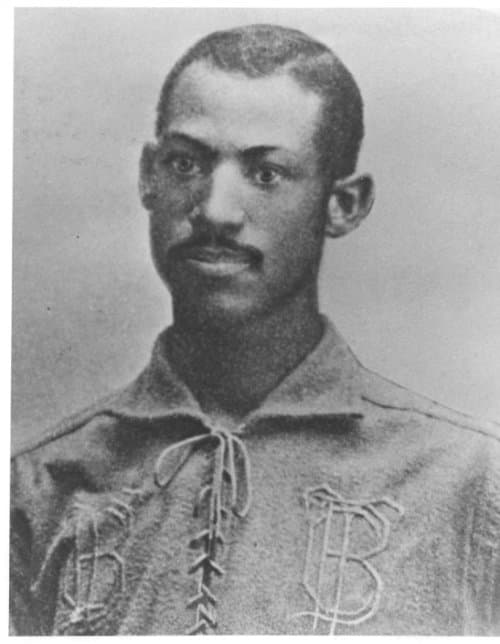
Moses Fleetwood Walker portrait.
Photo credit: Unknown photographer via Wikimedia Commons
Moses Fleetwood Walker caught for the Toledo Blue Stockings in 1884, and that summer he became the first black man to play openly in a major league, more than six decades before Jackie Robinson walked onto a field in Brooklyn. The color line that hardened across the 1880s pushed him out of the game he had earned his place in, and the rest of his life carried him further from baseball than almost any player's ever has. He was an Oberlin and Michigan man, an inventor who held four patents, a newspaper editor, and the author of a book on race that one historian judged the most learned work any professional athlete ever produced. The game he opened owes him a debt it has been slow to name.
The Doctor's Son from Mount Pleasant
Walker was born on October 7, 1856, in Mount Pleasant, Ohio, into an abolitionist corner of the state where the Underground Railroad had run for a generation. His father, Moses W. Walker, became one of the first black physicians in Ohio and later a Methodist minister, and he raised his children to expect more of the world than it was prepared to grant them. Fleet, as everyone called him, enrolled at Oberlin College in the late 1870s, played on the school's first varsity baseball team, and then transferred to the University of Michigan, where he studied law and caught for the Wolverines. Few ballplayers of his era had seen the inside of a college classroom, and fewer still had studied law, and the education shaped a man who would spend his later years writing, inventing, and arguing about the future of his race. He arrived in professional baseball already an unusual figure, learned and composed, a catcher who read books.
A Place in the Major Leagues
Walker signed with Toledo of the Northwestern League in 1883, and when the club jumped to the American Association in 1884, he went with it into what was then one of the country's two major leagues. He made his debut on May 1, 1884, and over 42 games he batted .263, a mark that stood third on the team and well above the league average, all of it caught barehanded in the era before masks and padded gloves were standard. His younger brother, Weldy Wilberforce Walker, joined him for five or six games in the outfield that same season, which made the two of them the first and second black men to appear in the majors. Pitchers threw to Fleet without the protection a modern catcher takes for granted, and he absorbed foul tips and crossed up fastballs on naked hands, finishing the year with the kind of toughness the position demanded. Toledo's ace, Tony Mullane, later called Walker the best catcher he ever worked with, and admitted in the same breath that he threw whatever he pleased without heeding Walker's signals because of the color of his skin. The season was brief, and it would prove to be his only one at the game's highest level.
Cap Anson and the Color Line
No written rule barred black players from the majors in 1884, only an understanding among white men that grew more rigid every year, and Cap Anson did as much as anyone to enforce it. As far back as an 1883 exhibition, Anson had threatened to keep his Chicago White Stockings off the field rather than share it with Walker, and Toledo's manager called the bluff and played his catcher anyway. The objections returned in 1887, when Anson refused to let his club face an exhibition team that included Walker and the pitcher George Stovey, and the pressure he applied helped push the color line from custom into iron. Historians caution against laying the whole barrier at Anson's feet, since he was the loudest voice in a chorus rather than its only singer, but his refusals carried weight, and the doors closed behind Walker one by one. By the end of the decade, organized baseball had quietly agreed to sign no more black players, and it kept that agreement for almost sixty years.
The Battery with George Stovey
Released by Toledo after 1884, Walker spent five more seasons working his way through the minor leagues as the welcome for black players narrowed around him. He caught for Cleveland and Waterbury, then landed with the Newark Little Giants of the International League in 1887, where he and George Stovey formed the first black battery in professional baseball, the catcher and a pitcher who won 30 games that season working as one. Syracuse came next, and Walker helped the Stars to the 1888 pennant before his release in 1889 closed out his career in the high minors, the last black man to play at that level until Jackie Robinson reached Montreal in 1946. The game had decided it had no place for him, and the decision arrived not as a single verdict but as a slow accumulation of slammed doors. Walker left the field for good at 33, his playing days behind him and the larger part of his life still ahead.
A Night in Syracuse
In April 1891, outside a Syracuse saloon, a confrontation with a group of white men turned deadly, and the rest of Walker's reputation would carry its shadow. The accounts that survive describe racial insults and drinking on both sides, a stone thrown at Walker, and Walker drawing a pocket knife and stabbing a man named Patrick Murray, who died of the wound. Prosecutors charged him with murder in the second degree, he argued that he had acted to defend himself, and on June 3, 1891, a jury of white men acquitted him, a verdict the courtroom reportedly met with cheers. The episode reads now as a man cornered by the same hostility that had driven him from baseball, defending his life and walking free by the narrowest of margins. He emerged from the trial convinced that the country would never grant black Americans an equal place, and that conviction would shape everything he wrote and built afterward.
The Inventor and the Editor
Walker spent his middle years as a businessman and a tinkerer, a man whose mind worked in directions the ballfield had never asked of it. He patented an improved artillery shell concerned with controlling when the round detonated, and later he secured three patents tied to motion picture reels, devices meant to ease a projectionist's switch from one reel to the next. He and his brother Weldy ran hotels and a theater, and in Cadiz, Ohio, Walker operated an opera house that showed live acts and the new moving pictures, the reel patents and the theater feeding one another. With Weldy he also published a newspaper called The Equator, a journal on black affairs of the early 1900s, though no copies are known to survive and its contents reach us only secondhand. The catcher who read books in the 1880s had become an inventor, a publisher, and a proprietor, building a life out of the talents baseball had refused to use.
Our Home Colony
In 1908 Walker published a slim treatise titled "Our Home Colony," a book that surveyed the past and present of black life in America and concluded that equality would never come, and that emigration to Africa offered the only future he could see. That argument grew straight out of his own experience, the doors he had watched close on the diamond and the night in Syracuse that nearly ended him, and the historian David Zang later called it the most learned book a professional athlete ever wrote. Walker died on May 11, 1924, in Cleveland, of pneumonia, his playing career a half forgotten footnote and his second life as a thinker barely known beyond Ohio. Recognition arrived in pieces long after he was gone, a square named for him in Toledo, a place in every history of integration, an Overlooked Legend honor from baseball's researchers in 2022. Six decades before the major leagues called themselves integrated, Moses Fleetwood Walker had already caught one, and the doors that swung shut behind him took the rest of his life and longer to reopen.