Profile
Will Clark
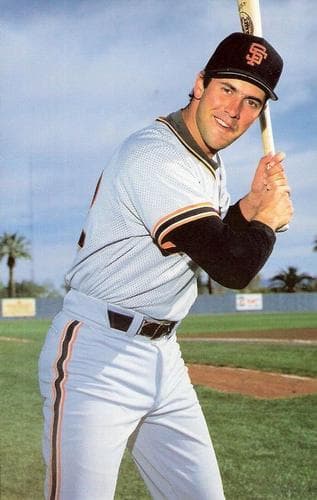
Will Clark in a 1986 Giants postcard portrait.
Photo credit: Unknown photographer via Wikimedia Commons
Will Clark swung a bat as beautifully as anyone of his generation, a left-handed stroke that scouts compared to a buggy whip and fans simply called a thrill. He hit .303 across 15 seasons, carried the Giants to a pennant with one of the great Championship Series performances ever, and brought a snarling competitive fire to every at-bat that made him as feared as he was admired. He came up just short of the milestones that guarantee a plaque, and his old team gave him the honor anyway. The Giants retired his number 22 in 2022.
Will the Thrill
Clark was born on March 13, 1964, in New Orleans, and starred at Mississippi State alongside Rafael Palmeiro, the two of them a college tandem nicknamed Thunder and Lightning. He won the Golden Spikes Award as the best college player in the country in 1985, and the San Francisco Giants drafted him second overall that summer, a hitter so polished he looked ready immediately. He was, the nickname Will the Thrill attaching itself to a young slugger with a perfect swing and a glare that told pitchers exactly how the at-bat would go. The talent was obvious, and so was the edge.
The Debut
In his first major league at-bat, on April 8, 1986, at the Astrodome, the 22-year-old rookie hit a home run off Nolan Ryan, one of the most intimidating pitchers in the game, a 420-foot blast to center field. It was the kind of arrival that becomes legend, a kid stepping in against a future Hall of Famer and depositing his first swing into the seats, and it set the tone for a career built on rising to the moment. Clark would hit Ryan well for the rest of his career, but nothing topped the first time.
The Greatest Series
In October 1989, in the National League Championship Series against the Cubs, Clark put together one of the finest performances any hitter has produced in a postseason series, batting .650 with two home runs and eight runs batted in, dragging the Giants to the pennant almost single-handedly. He was named the Most Valuable Player of the series, and his team reached the World Series, where the earthquake interrupted everything and the Athletics swept them. He had finished second in the regular-season MVP vote to his teammate Kevin Mitchell, but that October the stage belonged to Clark.
The Sweet Swing
For a decade Clark was one of the best pure hitters in baseball, the swing producing line drives and the competitiveness producing runs. He hit .303 for his career with 284 home runs and 1,205 runs batted in, made six All-Star teams, and posted an adjusted on-base-plus-slugging well above league average, a complete offensive player who also won a Gold Glove at first base. His peak, from 1987 through 1991, ranked him among the very best in the game, a left-handed force in the middle of the Giants order. The numbers fell short of the round figures, but the quality of the hitter was never in doubt.
The Long Goodbye and the Last Hurrah
Clark left San Francisco after 1993 and spent productive years with the Texas Rangers and the Baltimore Orioles, a star past his peak but still dangerous. The fitting end came in 2000, when the Cardinals acquired him at midseason to replace the injured Mark McGwire, and the 36-year-old responded with the best half-season of anyone's imagination, hitting .345 with 12 home runs down the stretch and .412 in the Championship Series. Then he walked away, retiring on top to care for his young son, choosing family over a few more years in the game. It was a rare clean exit, a great hitter leaving while the bat still worked.
Thunder and Lightning
The thread of Clark's story is his old college partner Rafael Palmeiro, the Thunder to his Lightning at Mississippi State. They were stars together and then rivals apart, their friendship fracturing after Clark signed with Texas in a deal that Palmeiro felt pushed him out, and the two went years without speaking. They reconciled eventually, decades later, two aging stars making peace with a rift that had outlived its cause. The pairing had launched both careers, and in the end it survived the falling-out that came between them.
This Is My Hall of Fame
Clark fell off the writers' ballot after a single year, drawing just 4.4 percent in 2006, a one-and-done verdict that undersold a career better than the vote suggested. The Giants disagreed with the writers. In 2022 they retired his number 22, a rare honor for a player not in the Hall of Fame, and Clark accepted it for exactly what it was. "This is my Hall of Fame," he said, and for a player so beloved in San Francisco, the number on the wall at the ballpark may have meant more than any plaque ever could.