Profile
Amos Rusie
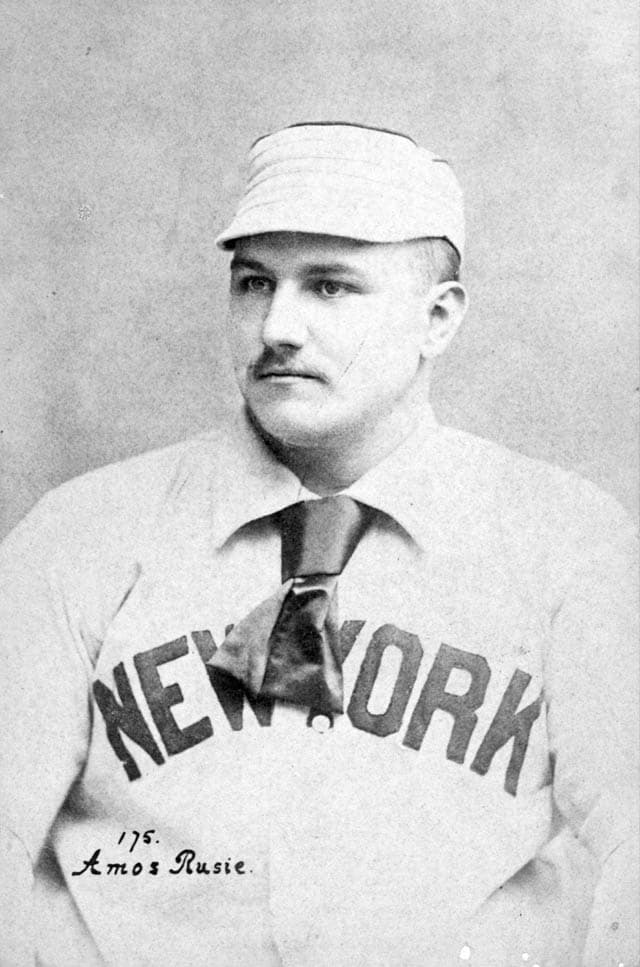
Amos Rusie portrait.
Photo credit: Unknown author via Wikimedia Commons (Public domain)
Amos Wilson Rusie threw so hard that batters could not see the ball and catchers could not hold it. Dick Buckley, who caught him in Indianapolis and New York, inserted a sheet of lead covered with a handkerchief and sponge into his glove to absorb the impact. Connie Mack, whose career in professional baseball spanned more than six decades and every great fastball pitcher from Rusie to Bob Feller, said Rusie was the fastest of them all. "And they looked like peas as they sailed by me," Mack recalled. "All I saw of them was what I heard when they went into the catcher's mitt." Rusie won 245 games in ten seasons, led the National League in strikeouts five times, and threw with such terrifying velocity that batters' complaints helped move the pitching distance to 60 feet 6 inches in 1893. He dominated anyway. The Veterans Committee elected him to the Hall of Fame in 1977.
Mooresville
Rusie was born on May 30, 1871, in Mooresville, Indiana, about 20 miles southwest of Indianapolis. His father William Asbury Rusie joined the 33rd Indiana Volunteer Infantry at 16 during the Civil War and lost his left leg above the knee. After the war William worked as a brick mason and moved the family to Indianapolis, where Amos was the second of four children. Amos dropped out of school at 16, worked as a varnisher in a furniture factory, and played baseball on evenings and Sundays for amateur and semipro teams. He started as an outfielder and switched to pitcher when the regular pitcher was knocked out of the box and Rusie relieved him.
Playing for a semipro team called the Sturm Avenue Never Sweats, Rusie shut out two touring National League clubs, the Boston Beaneaters and the Washington Nationals, in 1888. John T. Brush, owner of the NL Indianapolis Hoosiers, signed him to a professional contract. Rusie pitched four games for Burlington in the Central Inter-State League and was called up to Indianapolis for his major league debut on May 9, 1889, at 17. When Indianapolis folded after the season, he was assigned to the New York Giants.
The Hoosier Thunderbolt
Rusie arrived in New York in 1890 and became a celebrity overnight. On May 12 he beat Kid Nichols 1-0 in a 13-inning duel at the Polo Grounds, with both pitchers allowing only three hits through 12 innings and Mike Tiernan winning it with a line-drive home run in the 13th. Restaurants named drinks after him. Vaudevillians wrote skits about him. A paperback titled "Secrets of Amos Rusie, the World's Greatest Pitcher" sold for a quarter. Lillian Russell, the most famous Broadway star of the day, reportedly asked to meet him.
Rusie threw 548 innings that first year in New York, walked 289 batters (a single-season record that still stands), struck out 341, and went 29-34 for a terrible team. Rusie won 30 or more games in four consecutive seasons from 1891 through 1894 and led the league in strikeouts five times. On July 31, 1891, he pitched a game without a hit against the Brooklyn Bridegrooms, the first in Giants history.
In 1893, the National League moved the pitching distance from 55 feet 6 inches to 60 feet 6 inches, a change driven in part by batters' fears of Rusie's velocity. The extra distance barely slowed him down. He led the league in strikeouts in 1893, 1894, and 1895, and in 1897 a Rusie fastball struck Hughie Jennings in the head and left him comatose for four days. In 1894 he won the pitcher's Triple Crown with a 36-13 record, 195 strikeouts, and a 2.78 ERA in a year when the league average ERA was 5.32.
Sportswriter Sam Crane described the man behind the arm without admiration for his habits. "Rusie went through his active pitching days as though on a continuous joy ride," Crane wrote. "He broke training whenever he felt like it and never looked upon life as a serious matter."
The Holdout
After the 1895 season, Giants owner Andrew Freedman deducted $200 from Rusie's salary, $100 for allegedly missing curfew and $100 for "not trying hard enough." Rusie thumbed his nose at Freedman, the 19th-century equivalent of a raised middle finger, and demanded the fines be restored. Freedman refused. Rusie sat out the entire 1896 season.
Represented by attorney John Montgomery Ward, the former player turned lawyer, Rusie sued Freedman for $5,000 and release from his contract. The other National League owners, terrified that a court ruling might invalidate the reserve clause, collectively paid Rusie $5,000 to drop the suit. Rusie later noted that the $5,000 he received for not playing was "almost $2,000 more than I would have been paid for playing all season." He returned to the Giants in 1897 and led the league in ERA, but his arm was beginning to fail.
In August 1898, pitching against Chicago, Rusie attempted a quick pickoff throw without his usual windup and something snapped in his shoulder. "My arm felt dead," he said. He never recovered his fastball. After two years away from the game, the Giants traded him to the Cincinnati Reds on December 15, 1900, for a 20-year-old pitcher named Christy Mathewson. The deal is remembered as perhaps the most lopsided transaction in baseball history. Rusie won zero games for Cincinnati. Mathewson won 372 for the Giants.
Seattle
Rusie returned to Indiana after baseball and struggled for the rest of his life. He worked at a paper mill in Muncie, did manual labor in Vincennes, and hunted for pearls in the mussels of the Wabash River. John McGraw brought him back to New York around 1921 as a groundskeeper at the Polo Grounds, and Rusie worked there for nearly a decade before returning to the Pacific Northwest. Rusie purchased a chicken ranch near Auburn, Washington, that failed during the Depression. In July 1934 he was injured in an automobile accident and was unconscious for four days with a concussion and broken ribs, and he never worked again.
By his final years, Rusie and his wife Susie May survived on $63 a month, a $35 pension from the Association of Professional Ball Players and $28 from state old-age payments. The Seattle Post-Intelligencer and The Sporting News ran fundraising campaigns that provided enough to keep them housed. May died on October 7, 1942. Rusie died of chronic heart disease on December 6, 1942, at Ballard General Hospital in Seattle, at 71. They were buried side by side at Acacia Memorial Park on the shores of Lake Washington.
The Veterans Committee elected him 35 years later. His Hall of Fame plaque reads that he was "generally considered fireball king of nineteenth-century moundsmen."