Profile
Barry Larkin
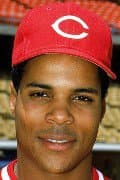
Barry Larkin headshot.
Photo credit: Baseball-Reference / SABR collection via Baseball-Reference
Barry Larkin played 19 seasons at shortstop for his hometown Cincinnati Reds, the rare star who spent a whole career with the team he grew up watching, and for most of the 1990s the people inside the game considered him the best shortstop in baseball. He won a World Series in 1990, the National League MVP in 1995, and became the first shortstop in history to hit 30 home runs and steal 30 bases in a season. He made 12 All-Star teams and could beat a team every way a shortstop can. The BBWAA elected him to the Hall of Fame in 2012.
The Hometown Kid
Larkin was born on April 28, 1964, and grew up in a Cincinnati suburb dreaming of playing shortstop for the Reds, the team of the Big Red Machine he watched as a boy. He starred at Archbishop Moeller High School, the same school that produced Ken Griffey Jr., and he became the local kid who never left, playing all 19 of his major league seasons in a Reds uniform, one of the few men ever to spend an entire career in Cincinnati. "In retrospect, it means more now than it did when I was playing," he said. "I'm very proud of the fact that I stayed there."
Choosing Baseball at Michigan
Larkin went to the University of Michigan on a football scholarship, a defensive back for Bo Schembechler, and after a redshirt year he walked into the coach's office and told him he was giving up football for baseball. Schembechler did not take it well. "Larkin, this is THE UNIVERSITY OF MICHIGAN," he bellowed, papers flying off his desk. Larkin never regretted the choice, becoming a two-time All-American and a two-time Big Ten Player of the Year, playing for the 1984 United States Olympic team, and going to the Reds in the draft. "The best decision Bo Schembechler ever made," Larkin said, "in my opinion."
The Best Shortstop Nobody Talked About
Ozzie Smith owned the highlight reels and Cal Ripken Jr. owned the headlines, but the people who watched closely knew the best all-around shortstop in baseball was Larkin. A Reds scout called him a seven-tool player, adding makeup and leadership to the usual five. He hit for average and power, ran the bases beautifully, and fielded the position with a quiet precision that won three Gold Gloves he might have won many more of had Smith not been winning them all. "Barry could do it all," Dusty Baker said. "He is the six-tool player all the scouts are looking for now, one with all the baseball skills plus intellect."
A Wire-to-Wire Title in 1990
The 1990 Reds led their division every day of the season and then ran into a buzzsaw of their own, the Nasty Boys bullpen, on the way to a World Series nobody gave them a chance to win. They swept the defending champion Oakland Athletics in four straight games, and Larkin hit .353 against a team built to beat them. It was the only championship of his career, won at 26, with the best years still in front of him.
The 1995 MVP
Larkin had his finest season in 1995, batting .319 with power and 51 stolen bases, and won the National League MVP, the first shortstop to take the award since Maury Wills in 1962. He did not expect it. "I thought the MVP would go to a guy like Dante Bichette because of the home runs," he said. "But I was wrong." The next year he did something no shortstop had ever done, hitting 33 home runs and stealing 36 bases, though he waved off the slugger label. "I'm not a home run hitter," he said. "I'm a line drive hitter. I hit 33 line drives that went over the fence."
The Injuries
Injuries dogged Larkin throughout his career, the one real mark against him. Hamstrings, a calf, an Achilles, a neck that needed surgery, a groin, all of it kept him off the field for long stretches in six different seasons, and the time lost is the reason his career totals fall short of what his rate of play projects. He finished with 2,340 hits and a .295 average, numbers that undersell a player his peers ranked among the best shortstops who ever lived. Healthy at the end, he could still hit .289 at 40, a glimpse of what the injuries had taken.
A Captain and a Family of Athletes
The Reds named Larkin their captain in 1997, the first man to wear the C in Cincinnati since Dave Concepción, a nod to the intelligence and leadership the scouts had seen in him as a kid. He came from a family stocked with athletes. His brother Stephen reached the majors with the Reds, his brother Byron played college basketball at Xavier, and his son Shane became a first-round NBA draft pick. On one night in 1998 Barry and Stephen took the infield against the brothers Bret and Aaron Boone, the first time two sets of brothers had been on a major league field at the same time.
Cooperstown
It took the writers three years to elect Larkin, because the all-around game he played did not pile up the single gaudy number that wins votes fast, but in 2012 they put him in with 86.4 percent, and the Reds retired his number 11. He went in alongside Ron Santo, spoke part of his speech in Spanish for his Latin teammates, and held onto a lesson a mentor once handed him at Dodger Stadium. He had been told never to lose sight of how small any one player is against the long history of the game, and he never did.