Profile
Ron Santo
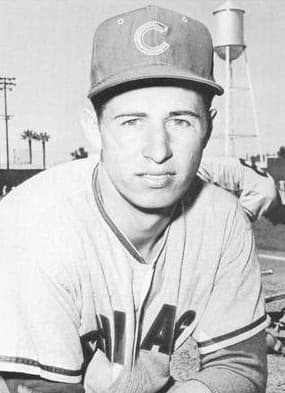
Ron Santo portrait in Chicago Cubs uniform, 1964.
Photo credit: Unknown photographer via Wikimedia Commons
Ron Santo played third base for the Chicago Cubs for 14 years and did it while hiding a disease that should have ended his career before it began. He made nine All-Star teams, won five Gold Gloves, and hit 342 home runs as a Type 1 diabetic in an era when nobody around him knew he was sick, then spent the rest of his life as the most beloved voice in Cubs radio. He waited decades for the Hall of Fame and died a year before it finally came. The Golden Era Committee elected him in 2012.
A Diagnosis at Eighteen
Santo was born on February 25, 1940, in Seattle and signed with the Cubs as a teenager, and a physical before his first pro season turned up Type 1 diabetes. A doctor told the 18-year-old he might have 25 years left if he took care of himself, and that the major leagues were probably beyond him. Santo told almost no one, and he played a Hall of Fame career while managing the disease in secret, eating a candy bar in the clubhouse when his blood sugar dropped and losing the ball in the Wrigley Field shadows when it fell too far. "I didn't want anyone to know," he said, "because I felt that people would think I was copping out." He kept the secret until Ron Santo Day at Wrigley Field in 1971, and decades later the disease took both his legs below the knee.
The Summer of 1969
Santo was the heart of the 1969 Cubs, the team that broke the city's heart. After a walk-off win that June he jumped and clicked his heels coming down the line, and the manager Leo Durocher liked it enough to ask him to do it after every home win, a flourish that delighted the fans and needled the other team. The season turned in September. A black cat crossed in front of Santo in the on-deck circle at Shea Stadium and stopped to stare into the Cubs dugout, the Mets ran the Cubs down and passed them, and a club that had led all summer finished eight games out. Santo carried the collapse the rest of his life.
One of the Best Third Basemen Alive
Santo could play, winning five straight Gold Gloves from 1964 through 1968 and leading National League third basemen in nearly every fielding category for years, retiring with league records for assists and double plays that stood until Mike Schmidt broke them. He hit with power and patience both, 342 home runs and a stack of walks the voters of his day undervalued, and by the modern measures he ranks among the best third basemen who ever played. In 1973 he became the first player to use the new ten-and-five rule to block a trade, then agreed to a deal across town to the White Sox, where he played his final season.
Banks, Williams, and the Cubs Who Could Not Win
Santo spent his prime alongside three other Hall of Famers, Ernie Banks, Billy Williams, and Ferguson Jenkins, on Cubs teams good enough to contend and cursed enough never to reach a World Series. They were the best Cubs of their generation and the most heartbreaking, and Santo, the kid who arrived in 1960 and gave the team everything for 14 years, became the face of the long futility. He played his entire Cubs career without ever reaching the postseason, a fact that gnawed at him in the broadcast booth years later as he watched and waited right along with the fans.
The Long Snub
For all of it, the Hall of Fame would not let him in. The writers passed him over for 15 years, never coming close to the votes he needed, and the Veterans Committee turned him down again and again after that, a slight the historian Bill James found indefensible. Leaving Santo out while lesser third basemen got in, James wrote, was like filling a zoo with house pets and letting the lions roam the streets. The wait ran two decades past his playing days and did not end in his lifetime.
The Voice of the Fan
Santo found his second life in the Cubs radio booth, where he called games on WGN alongside Pat Hughes for two decades and put his whole heart on the air, groaning and crying and living and dying with every pitch. His anguished "Oh, no" became a Cubs sound. One cold opening day at Shea his toupee caught fire from a heat lamp in the cramped booth, and Hughes, hearing what he took for sizzling bacon, turned to find Santo's head aflame and doused it with a cup of water. The fans loved him without reservation, because he suffered exactly the way they did.
A Fortune Raised Against Diabetes
Off the air Santo turned his disease into a cause, lending his name and his time to the Ron Santo Walk to Cure Diabetes, which raised more than sixty million dollars for research over the years. He gave the work the same heart he gave the broadcasts, staying for hours to sign autographs and talk with families who lived with what he lived with. He never hid the cost of the disease again after 1971, and he carried it in plain sight, on two artificial legs, to the very end.
The Election He Did Not Live to Hear
Santo died on December 3, 2010, at 70, of complications from bladder cancer and the diabetes he had fought for more than half a century. A year and two days later the Golden Era Committee elected him to the Hall of Fame with 15 of 16 votes. His widow, Vicki, accepted the plaque in 2012 and built her speech around the secret he had kept so long. "On a given day he played doctor and patient, as well as third base," she said. "He tested his sugars by taking batting practice." The Cubs had retired his number 10 in 2003, and the honor he wanted most arrived just too late for him to hear it.