Profile
Bob Caruthers
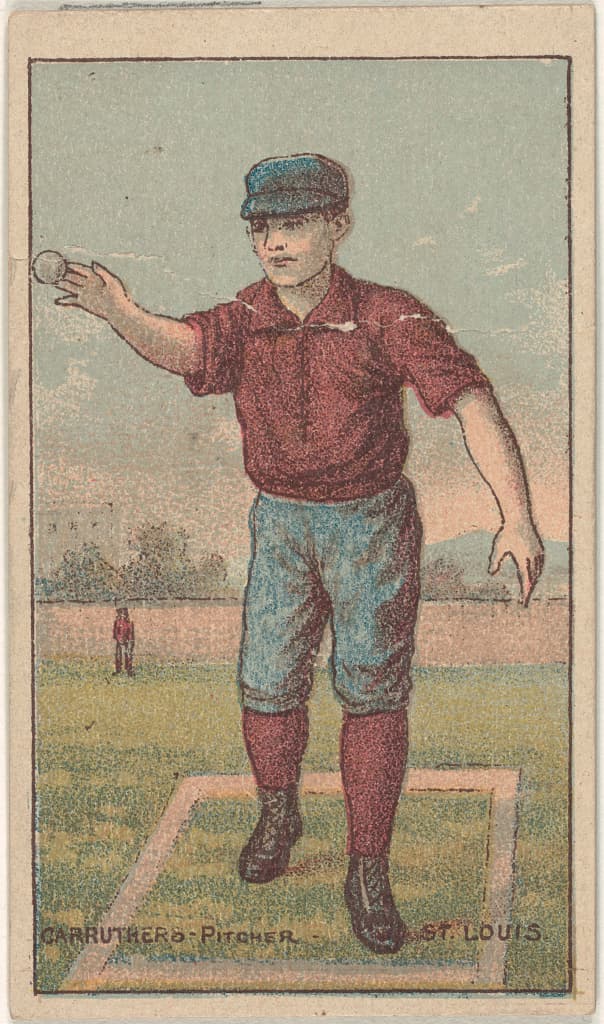
Bob Caruthers baseball card portrait.
Photo credit: Unknown photographer via Wikimedia Commons
Bob Caruthers did two things better than almost anyone of his time, and he did them at once. He pitched at the front of a rotation and hit in the middle of the order, winning 218 games against 99 losses for a .688 winning percentage while batting .282 with the kind of power that kept him in the cleanup spot on days he was not in the box. A slight man at five foot seven and 138 pounds, he carried the St. Louis Browns and the Brooklyn club to five pennants in six seasons, negotiated a famous contract by cable from Paris, and burned out before he turned 30. He died at 47 with a two way résumé the game has matched, across its whole history, only in Babe Ruth.
From Memphis to the Browns
Caruthers was born Robert Lee Caruthers on January 5, 1864, in Memphis, Tennessee, and raised largely in Chicago, where a comfortable family let him chase baseball rather than a trade. He pitched in the minors at Grand Rapids and Minneapolis before the St. Louis Browns of the American Association signed him, and he closed the 1884 season by going 7-2 in 13 games for owner Chris Von der Ahe and captain Charles Comiskey. The Browns had found the cornerstone of a dynasty in a pitcher who could also rake, and they built the next four years around him. He was 20 years old, undersized, and already one of the best players in the league. The combination he offered, a true ace who was also a feared bat, made him singular in an era full of stars.
The Ace
On the mound Caruthers was overpowering, and the win totals from his best seasons read like misprints to a modern eye. He went 40-13 in 1885 with a 2.07 earned run average, leading the Association in wins, winning percentage, earned run average, and shutouts, and he followed with a 30-win season in 1886 and a 29-9 mark in 1887. After a sale to Brooklyn he won 40 again in 1889, the second 40-win season of his short career, and he finished with a 2.83 earned run average across nearly 2,829 innings and 298 complete games. His .688 career winning percentage ranks behind only Whitey Ford among pitchers with 200 or more decisions, the best of anyone who worked before the modern era. He threw all those innings before he was 30, and the workload that built the record also shortened the career.
The Cleanup Hitter Who Also Pitched
Caruthers set himself apart with the bat, the one he carried to the plate on days he stayed out of the box and on many when he pitched too. He finished with a .282 average, a .391 on base percentage, and a .400 slugging mark, hitting .334 in 1886 and .357 in 1887 while serving as his team's best pitcher, and on one August afternoon in 1886 he drove out two home runs, a triple, and a double in a single game. By one careful accounting, he and Babe Ruth are the only players ever to lead the major leagues in both adjusted ERA and adjusted OPS, a credential that places him in company almost no one else can claim. Ruth, John Montgomery Ward, and Caruthers are also the only men with at least 16 wins above replacement as both a hitter and a pitcher. That two way greatness was the core of his value, and it still makes the strongest case for his enshrinement.
Parisian Bob
After the 1885 season Caruthers sailed for Europe, and when it came time to settle his next contract he conducted the negotiation from a hotel in Paris, haggling with Von der Ahe over the transatlantic cable. The drawn out, expensive exchange of telegrams across the ocean delighted the press, who hung the nickname Parisian Bob on him, and it stuck for the rest of his life and beyond. The episode captured the man, a star confident enough to make his employer chase him across an ocean and clever enough to come away paid. He returned to St. Louis and went out and won 30 games, which was the other half of the bargain. Few nineteenth century players left behind a nickname as good or a story to match it.
Five Pennants in Six Years
Caruthers spent the heart of his career on winners, the front line arm and the middle of the order bat on one champion after another. He helped the Browns to American Association pennants in 1885, 1886, and 1887, and after Von der Ahe sold him to Brooklyn for $8,250 he pitched the Bridegrooms to the 1889 Association pennant and the 1890 National League pennant, five in all across six seasons. The Browns met the National League champion Chicago White Stockings in the postseason series of 1885 and 1886, the 1885 set ending in a disputed tie and the 1886 series going to St. Louis four games to two, with Caruthers throwing a shutout on one hit. He was, for half a decade, the best player on the best teams in the sport. The pennants came in two leagues and two cities, and he was central to all of them.
The Slide into Decline
The enormous early workload caught up with Caruthers fast, and the slight body that had carried it began to give way before he reached his thirties. His effectiveness fell off after 1890, and by 1892 he was back in St. Louis pitching sparingly, his velocity gone and his place in the order shrinking. He split his final major league season in 1893 between Chicago and Cincinnati, then drifted into the minor leagues for a few more years as a player who could no longer be what he had been. Drinking compounded the decline, and the confident young star of the Paris cable hardened into a touchy veteran the newspapers found difficult. Caruthers left the playing field in the late 1890s with the wear of a thousand innings on a frame never built to throw them.
Peoria
Caruthers found a second act in umpiring, working the American League in 1902 and 1903 and the minor leagues after that, including a Boston dispute in 1903 that put him briefly back in the headlines. His health and his circumstances declined together in the years that followed, and in the spring of 1911 the press described a nervous breakdown, after which he served a short workhouse term for public drunkenness before falling ill for the last time. He died on August 5, 1911, in Peoria, Illinois, at 47, after a month long illness that contemporary accounts never precisely named. Baseball's researchers honored him as an Overlooked Legend in 2017, a small recognition for a player whose two way brilliance the sport had largely set aside. On the short list of men who starred with both the bat and the arm, his only company is Babe Ruth, and that company is the case his supporters have made for Cooperstown ever since.