Profile
Chipper Jones
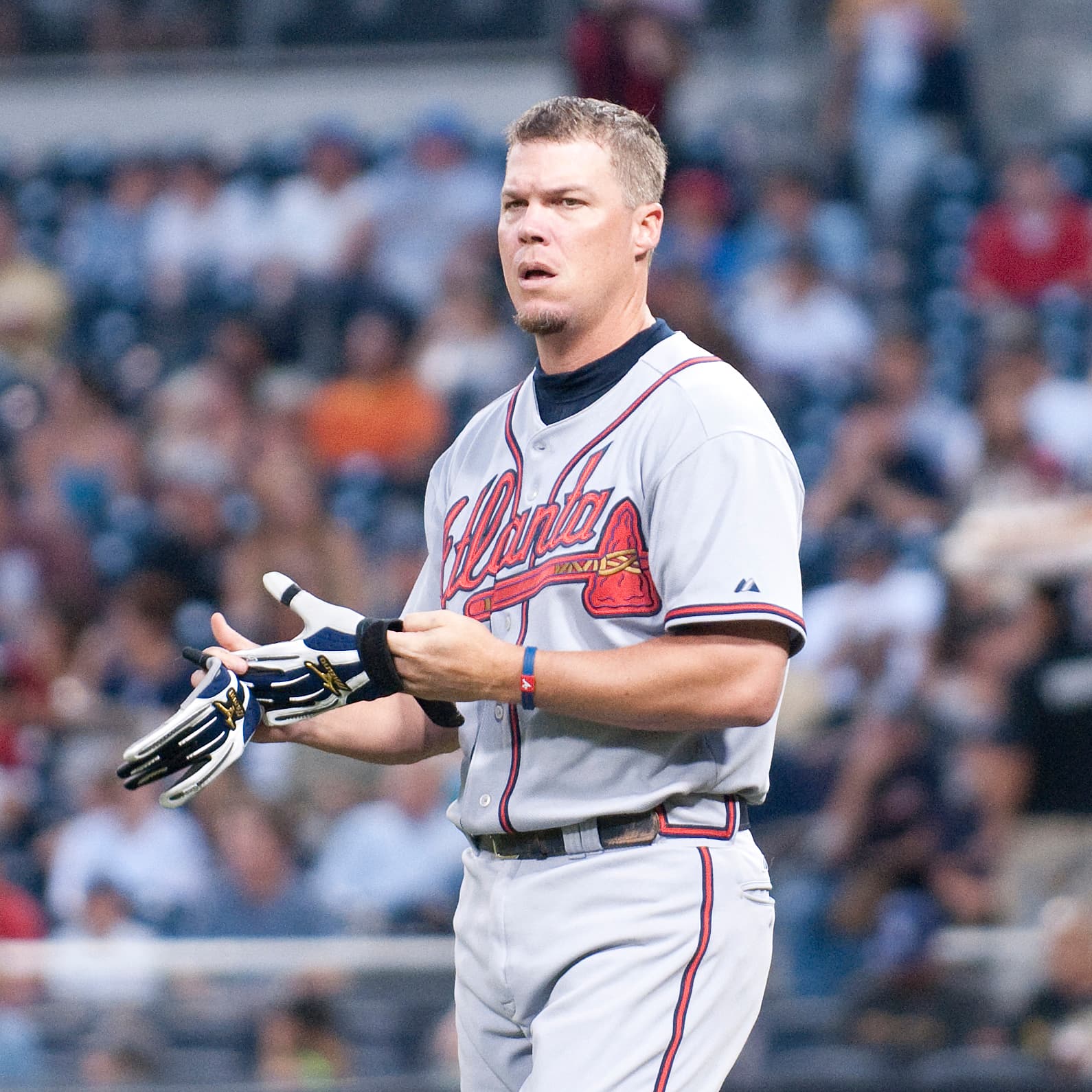
Chipper Jones in San Diego.
Photo credit: Unknown photographer via Wikimedia Commons
Chipper Jones hit from both sides of the plate for 19 years and did it better than anyone of his time, the only switch-hitter in history to finish with a .300 average and 400 home runs. He played his whole career for the Atlanta Braves, won a Most Valuable Player award and a batting title 15 years apart, and tormented the New York Mets so thoroughly that he named a son after their ballpark. He was the heart of the order through a long run of contenders and the last great link to the team's only championship. The BBWAA elected him to the Hall of Fame in 2018, on the first ballot.
A Chip Off the Old Block
He was born Larry Wayne Jones Jr. on April 24, 1972, in DeLand, Florida, and a relative took one look at the newborn who resembled his father and called him a chip off the old block, which became Chipper. His father Larry Sr. taught math and coached high school baseball, and he raised his son to switch-hit early, drilling both swings until each felt natural. The Atlanta Braves made him the first pick in the entire 1990 draft, chosen by Bobby Cox over the higher-priced pitcher Todd Van Poppel, who had said he would rather attend college. Jones never forgot the slight that helped him. "If Todd Van Poppel didn't want to be an Atlanta Brave," he said, "I was more than happy to take his place."
The Rookie on a Champion
A torn knee ligament wiped out his 1994 season and preserved his rookie status for 1995, and he made the wait pay. Jones hit .265 with 23 home runs as a 23-year-old, finished second in the Rookie of the Year vote, and helped the Braves win the World Series, the only title of their run of 14 straight division crowns. He stepped into a clubhouse already built around Greg Maddux, Tom Glavine, and John Smoltz, and he gave that pitching a young bat to grow around. The kid Cox had drafted was a champion before he was fully established.
The MVP and the Mets
Jones reached his peak in 1999, a season that doubled as a statement against Atlanta's chief rival. He hit .319 with 45 home runs, the most ever by a switch-hitter in a season, drove in 110 runs, scored 116, and stole 25 bases, and he saved his best for the stretch. In a pivotal late-September series against the Mets, he homered four times, twice from each side of the plate, and drove in seven of the 13 Atlanta runs that helped clinch the division. He won the National League Most Valuable Player award, and he turned New York's hostility toward him into fuel. "Now all those Mets fans can go home," he said after one clinch, "and put their Yankees stuff on."
The Greatest Switch-Hitter of His Time
The body of work set Jones apart from nearly every switch-hitter who came before. He finished with a .303 career average, 468 home runs, 1,623 runs batted in, and a .401 on-base percentage, and when he hit his 400th home run he joined only Mickey Mantle and Eddie Murray among switch-hitters to reach that number. He is the only one of the three who also hit .300 for his career, and he trails only Murray in runs batted in among switch-hitters. He drew nearly as many walks as strikeouts and rarely had a bad year, the rare slugger who never traded patience for power.
A Batting Title at Thirty-Six
The most improbable season came near the end. In 2008, at 36, Jones flirted with .400 deep into June and finished at .364, winning the first batting title of his career and the highest single-season average any switch-hitter has ever posted in a qualifying season. He led the league in on-base percentage at .470 that year, the discipline still sharp even as the knees gave out. No switch-hitter had won a batting title at his age, and the achievement underlined a truth about him, that the bat stayed dangerous long after the legs went.
The Long Goodbye
Knee and foot injuries dogged the back half of his career, and Jones announced before the 2012 season that it would be his last, setting off a year of tributes around the league. He gave the farewell tour a fitting moment on September 2, when his 468th and final home run came as a walk-off three-run shot against the Phillies' Jonathan Papelbon. The Braves reached the playoffs that fall, and his career ended in the wild-card game, a quiet exit for a player who had spent two decades making noise. He had played every inning of those 19 years in one uniform.
Cooperstown and Number Ten
The writers elected Jones to the Hall of Fame in 2018 with 97.2 percent of the vote, an easy first-ballot choice, in a class with Jim Thome, Vladimir Guerrero, and Trevor Hoffman. He went in as a Brave, the only organization he ever knew, and Atlanta had already retired his number 10. He had been the first overall pick, the rookie on a champion, the MVP, and the batting champion at 36, the constant through a generation of Atlanta baseball. The chip off the old block finished as one of the greatest switch-hitters the game has ever produced.