Profile
Dale Murphy
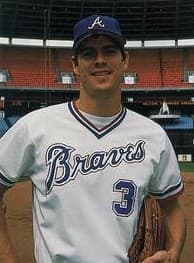
Dale Murphy in 1984.
Photo credit: Unknown photographer via Wikimedia Commons
Dale Murphy was the best player in the National League for a stretch in the early 1980s and one of the most admired men ever to play the game. A five-tool center fielder and the face of the Atlanta Braves, he won back-to-back Most Valuable Player awards, hit 398 home runs, and built a reputation for decency so spotless that teammates called him a boy scout and meant it as the highest praise. The Hall of Fame never came, despite a long and devoted fan campaign, but the respect did. The Braves retired his number 3 in 1994.
The Boy Scout
Murphy was born on March 12, 1956, in Portland, Oregon, and grew into a clean-cut, devout man who did not smoke, drink, curse, or carouse, a rarity in any clubhouse. He converted to the Church of Jesus Christ of Latter-day Saints as a young player, married at the temple in Salt Lake City, and raised eight children, the family life as central to him as the baseball. The Atlanta Braves drafted him fifth overall in 1974, and he reached the majors a few years later, a wholesome midwestern-mannered slugger who became the public face of a struggling franchise, an image that was no pose. He really was that person.
From Catcher to Center Field
His path to stardom ran through a problem that nearly derailed it. Murphy came up as a catcher, but he developed a throwing yips so severe that his tosses to second base sailed in every direction, some bouncing in front of the mound, and the Braves had to find him another position. They moved him to first base and then, in 1980, to center field, where his athleticism finally had room to play, and he turned into a Gold Glove defender at the most demanding outfield spot. The conversion saved his career and unlocked the player he was meant to be, a power hitter who could also run and field.
Back-to-Back MVPs
For two seasons Murphy was simply the best player in his league. He won the National League Most Valuable Player award in 1982 and again in 1983, one of the few players ever to win it in consecutive years, and the youngest to do it at the time. In 1983 he hit .302 with 36 home runs and 121 runs batted in and stole 30 bases, a 30-30 season from a slugger, the complete package of power, speed, and defense. He led the league in home runs and runs batted in across those years and made seven All-Star teams, the dominant position player of the early 1980s.
The Home Run for Elizabeth
The story that captures Murphy best is also the one most often told wrong. In June 1983 he met a six-year-old girl named Elizabeth Smith, who had lost both hands and a leg to a live power line, sitting in the stands at a Braves game, and her nurse asked him to hit a home run for her. Murphy did not know what to say. "I just sort of mumbled, well, O.K.," he recalled, and then he went out and hit two home runs that day, driving in all the runs in a 3-2 win. He never sought credit for the moment, and the legend grew anyway, the rare feel-good baseball story that happens to be true.
The Numbers and the Decency
Murphy finished with 398 home runs, two short of 400, along with 1,266 runs batted in, five Gold Gloves, and four Silver Sluggers, a career that put him on the edge of Cooperstown without quite carrying him in, and the character was its own record. He won the Roberto Clemente Award in 1988 for his community work and the Lou Gehrig Award for his sportsmanship, and across 2,180 games he was never once ejected, a model of conduct on a field that does not always reward it. He was admired as much for who he was as for what he did, and that admiration outlasted the statistics.
The Fall
Murphy had been baseball's iron man, playing in 740 consecutive games, and after the streak ended in 1986 his production fell off sharply in his early thirties, the bat slowing years before it should have. The Braves traded him to Philadelphia in 1990, and he hung on for a few more seasons before finishing with the expansion Colorado Rockies and retiring in 1993. The sudden drop cost him the counting stats that might have made his Hall of Fame case airtight, leaving a career defined by a brilliant peak and a short prime.
The Long Campaign
The Hall of Fame has been the one honor that eluded him. Murphy spent the full 15 years on the writers' ballot and never came close, peaking at around 23 percent, his case caught in the debate over whether a great peak and a sterling character can outweigh a short career. His fans never gave up, mounting one of the most persistent campaigns for any candidate, and the veterans committees have continued to consider him without electing him. The Braves retired his number 3 in 1994, a permanent honor from the team he was the face of, and the argument over his rightful place goes on, a tribute in itself to how good and how beloved he was.