Profile
Edd Roush
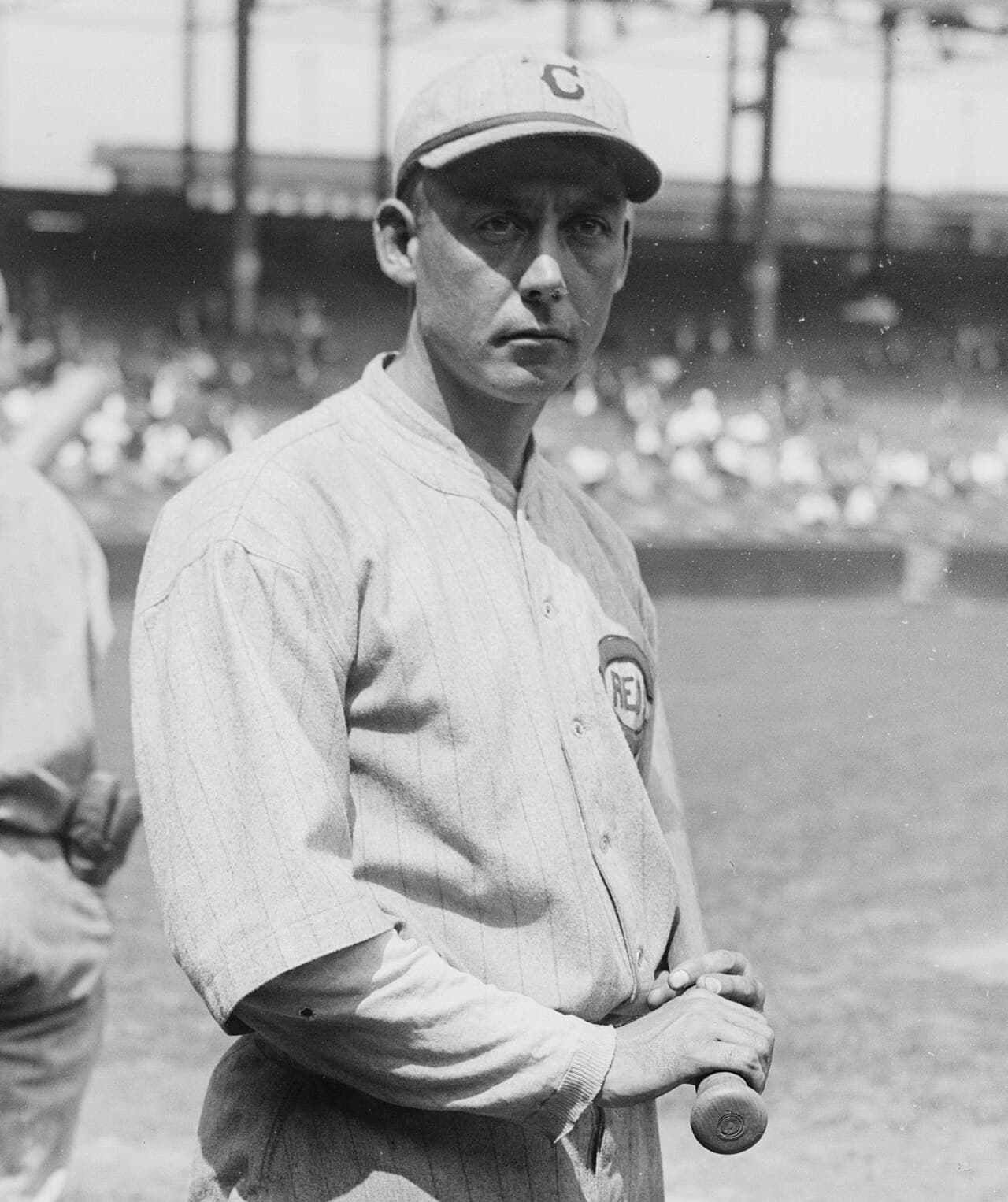
Edd Roush portrait (Cincinnati NL).
Photo credit: Bain News Service / Library of Congress via Wikimedia Commons (Public domain)
Edd Roush swung a 48-ounce bat with a handle thick enough to resemble a wagon spoke, and he placed the ball wherever he wanted with it. He played center field for the Cincinnati Reds during some of the most turbulent years in the franchise's history, won two National League batting titles, and fought with team ownership so fiercely and so often that the holdouts became as much a part of his reputation as the hitting. He finished with a .323 career batting average over 18 seasons, and when the Veterans Committee elected him to the Hall of Fame in 1962, he had been out of baseball for more than three decades.
Oakland City
Roush was born on May 8, 1893, in Oakland City, Indiana, a small town in the southwestern part of the state. He played semipro ball as a teenager and signed with the Chicago White Sox in 1913, though he appeared in only nine games before being sent to the minors. He moved to the Indianapolis Hoosiers of the Federal League in 1914, and when that league folded after the 1915 season, the New York Giants acquired his rights. John McGraw traded Roush to the Reds in July 1916 along with Christy Mathewson and Bill McKechnie in one of the most consequential deals of the era.
The Bat
Roush's bat was his signature. While most hitters of the period used bats weighing between 34 and 38 ounces, Roush preferred a 48-ounce Louisville Slugger with an unusually thick handle. He choked up on it and slapped the ball to all fields with a short, controlled swing rather than the long uppercut stroke that would become fashionable in the live-ball era. The approach made him one of the most consistent contact hitters in the National League. He won the batting title in 1917 with a .341 average and again in 1919 at .321, and he batted over .300 in 13 seasons, including a streak of 11 consecutive from 1917 through 1927.
He was also an exceptional defensive center fielder with strong instincts and a powerful throwing arm. Contemporaries compared him favorably to Tris Speaker, the standard by which outfield defense was measured.
1919
Roush played center field for the Reds team that defeated the Chicago White Sox in the 1919 World Series, the Series later revealed to have been fixed by eight White Sox players. Roush hit .214 in the Series and always maintained that the Reds had been good enough to win regardless of the fix. Cincinnati had won 96 games that season, and their pitching staff, anchored by Dutch Ruether and Slim Sallee, held the White Sox to a .226 batting average across the eight games. Roush played on the winning side of the most infamous event in baseball history and spent the rest of his life insisting the victory was legitimate.
The Holdouts
Roush's battles with Reds owner Garry Herrmann and later Sidney Weil became annual theater. He held out in the spring of multiple seasons, sometimes missing weeks of the schedule, and the holdouts grew longer and more bitter as the years went on. After the 1926 season, the Reds traded him back to the Giants, where he played three seasons under McGraw. When the Giants tried to cut his salary before the 1930 season, Roush refused to report and sat out the entire year rather than accept the reduction. He returned to the Reds in 1931 for a final season and retired at 38 with a .323 lifetime average and 2,376 hits.
After Baseball
Roush returned to Oakland City after retirement and lived there quietly for decades, working on his farm and occasionally attending old-timers' events. He was elected to the Hall of Fame by the Veterans Committee in 1962 alongside Bill McKechnie, while Bob Feller and Jackie Robinson entered that same year through the BBWAA ballot. He lived to 94, dying on March 21, 1988, in Bradenton, Florida, one of the last surviving links to the dead-ball era and to the 1919 World Series that still shadows the game.