Profile
Gorman Thomas
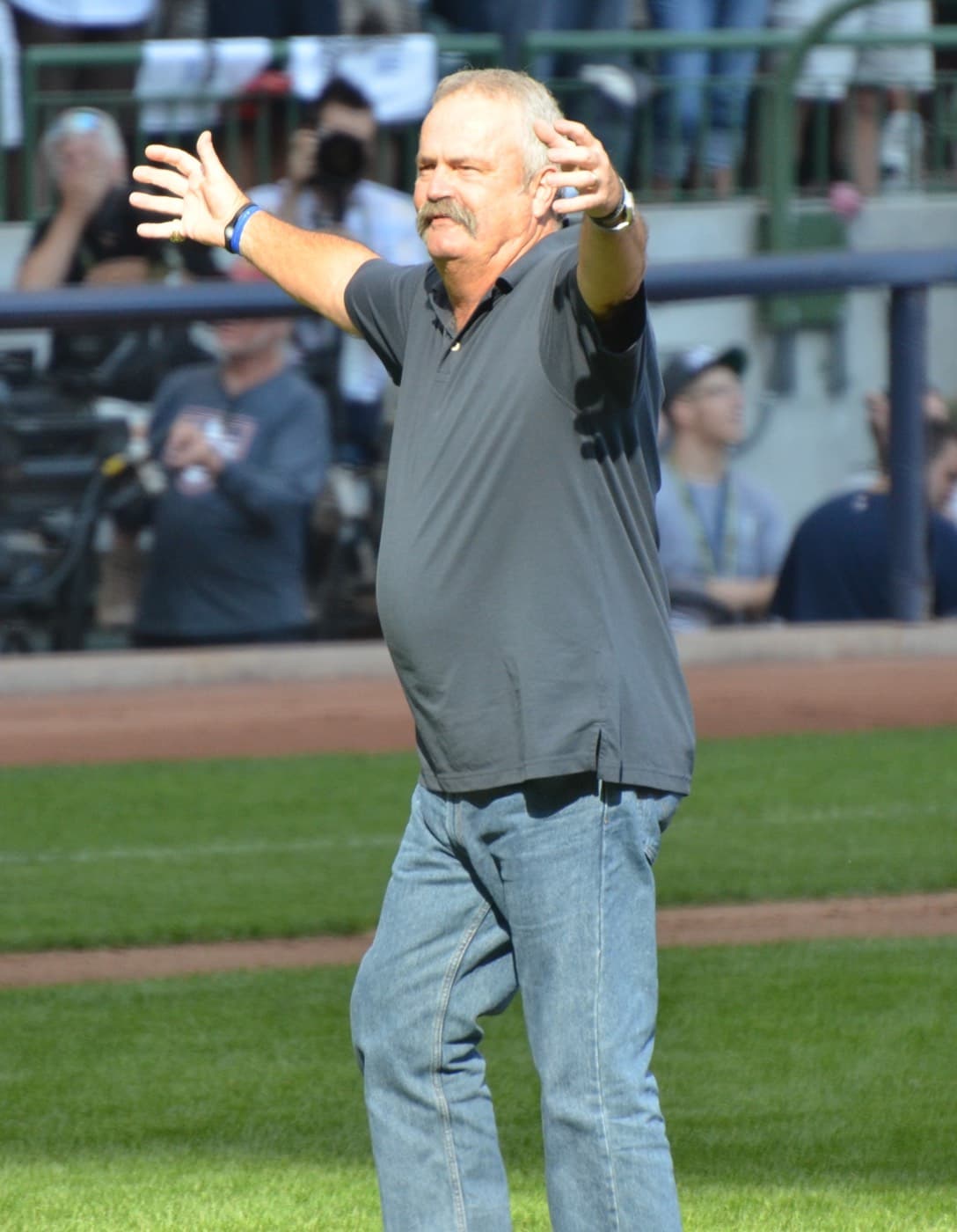
Gorman Thomas in 2011.
Photo credit: Unknown photographer via Wikimedia Commons
Gorman Thomas swung as hard as any man in baseball and missed nearly as often, an all-or-nothing slugger who hit towering home runs, struck out in bunches, and became the beating heart of the Milwaukee Brewers. With his thick mustache, his blue-collar swagger, and his habit of crashing into outfield walls, he embodied the rowdy power teams of the late 1970s and early 1980s, and Milwaukee loved him for all of it. He led the American League in home runs twice and helped carry the Brewers to their first pennant. He was a folk hero in a way few players ever are.
Stormin' Gorman
Thomas was born on December 12, 1950, in Charleston, South Carolina, and he became the very first player the expansion Seattle Pilots ever drafted, in 1969, a franchise that moved to Milwaukee and became the Brewers the next year. A coach hung the nickname Stormin' Gorman on him, and it fit a player who attacked everything, the fastball and the outfield wall alike. He was a three-true-outcomes hitter decades before anyone coined the phrase, a slugger whose at-bats ended in a home run, a walk, or a strikeout more than almost anyone's. He grew up in the Brewers organization and became its emblem.
The Slugger
For a stretch Thomas was one of the most prolific power hitters in the game. He led the American League in home runs in 1979 with 45, an outright crown, and again in 1982 with 39, that time tied with Reggie Jackson, a fearsome run for a player nobody had projected as a star. The home runs came with strikeouts, and plenty of them, as he led the league in whiffing in 1979 and 1980, the cost of a swing that held nothing back. He did not apologize for the trade-off. "Strikeouts are overrated," he said. "The only thing that means anything is RBIs."
Harvey's Wallbangers
Thomas's defining team was the 1982 Brewers, a slugging juggernaut nicknamed Harvey's Wallbangers for their manager Harvey Kuenn, the most fun team in baseball that year. He hit in the middle of a lineup that included Robin Yount, Paul Molitor, and Cecil Cooper, and he played center field every day, a key piece of the club that won the American League pennant. The Brewers reached the World Series and lost it to the Cardinals in seven games, with Thomas struggling at the plate down the stretch, but the season was the high point of his career and of Milwaukee baseball. The Wallbangers were his kind of team, all muscle and noise.
The Center Fielder
For all his slugger's bulk, Thomas was a better outfielder than anyone expected. He played a rangy, fearless center field, charging balls and crashing into walls with a recklessness that delighted the fans and worried the trainers, and he knew every outfield wall in the league from the inside. The defense was part of his appeal, a big man throwing his body around at a position usually reserved for smaller, faster players, refusing to give an inch. He was not graceful, but he was effective and utterly committed, and the effort was its own kind of skill.
The Numbers
Thomas finished with the classic line of his type, 268 home runs and 782 runs batted in against a .225 average, the power and the strikeouts and the low average all of a piece. He made one All-Star team, in 1981, and won a Comeback Player of the Year award later in his career, the numbers never the point so much as the way he produced them. He was a feast-or-famine hitter who gave fans the long ball and the empty swing in equal measure, the kind of player whose value lived in his home runs and whose entertainment lived in everything around them. The record reads exactly as he played, all extremes.
The Comeback
Injuries nearly finished Thomas in the middle of his career. Shoulder trouble wrecked his production after the Brewers traded him in 1983, and he looked done, a slugger whose body had given out on him. He answered in 1985 with a Comeback Player of the Year award, hitting for power again and proving the bat still had life in it, before returning to Milwaukee to close his career where it had begun. The resilience was its own kind of statement from a player who had always done things the hard way.
A Milwaukee Institution
What made Thomas special was the bond with his city. When the Brewers traded him to Cleveland in 1983, fans flooded the team switchboard in protest, and when he returned to Milwaukee in another uniform, the crowd chanted his name and gave him standing ovations. He played later for Cleveland and Seattle before coming home to the Brewers to finish, and he never really left the organization or the city afterward, an enduring fixture of Milwaukee baseball. "Milwaukee's my home," he said. "I love the people." Few players have been so completely embraced by a town, the mustachioed slugger who gave a blue-collar city a hero in its own image.