Profile
Jim Rice
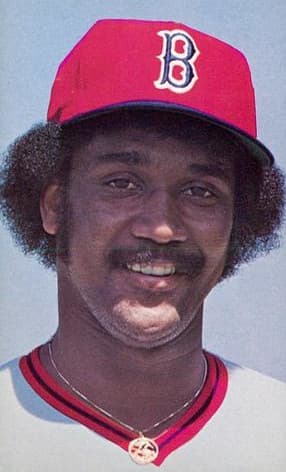
Jim Rice portrait, 1976.
Photo credit: Unknown photographer via Wikimedia Commons
James Edward Rice grew up in Anderson, South Carolina, attended a segregated high school before integration, transferred to T.L. Hanna High School and helped ease the transition, and turned down football scholarships from Clemson, North Carolina, and Nebraska to play baseball. He spent all 16 of his major league seasons with the Boston Red Sox, hit 382 home runs, drove in 1,451 runs, batted .298, and in 1978 produced the most dominant offensive season in the American League since Joe DiMaggio. He accumulated 406 total bases that year, a figure no American Leaguer has reached since. Goose Gossage said, "He had tremendous power, but yet he was an excellent hitter who could hit to the opposite field or go up the middle. Jim Rice had no big holes." The BBWAA elected him to the Hall of Fame in 2009 with 76.4% of the vote, on his 15th and final ballot, seven votes above the minimum.
Anderson
Rice was born on March 8, 1953, in Anderson, South Carolina. His parents Roger and Julia raised him in the segregated South. Rice attended Westside High School before transferring to T.L. Hanna High School after integration mandates. He was elected co-class president and helped bridge the racial divide at Hanna. He played football (earning all-state honors as a kick returner, defensive back, and wide receiver), basketball, and baseball. The Red Sox drafted him in the first round, 15th overall, in the 1971 draft and signed him for $45,000.
Rice dominated the minor leagues. He won the Eastern League batting title at Bristol in 1973, hitting .317 with 27 home runs and 93 RBI, and won the Triple Crown, Rookie of the Year, and MVP at Pawtucket in 1974, hitting .337 with 25 home runs. The Sporting News named him Minor League Player of the Year.
Fenway
Rice debuted in 1974 and hit .309 with 22 home runs and 102 RBI in his first full season in 1975, forming the "Gold Dust Twins" outfield tandem with Fred Lynn. He finished third in AL MVP voting behind Lynn and was headed for the postseason when Vern Ruhle fractured his hand with a pitch on September 21. Rice missed the entire ALCS and the 1975 World Series, watching Carlton Fisk's Game 6 home run and the seven-game loss to Cincinnati from the bench.
Rice led the American League in home runs with 39 in 1977, then produced his defining season in 1978. He batted .315 with 46 home runs, 139 RBI, 213 hits, 15 triples, and 406 total bases, leading the league in all six categories. He was the first American Leaguer to reach 400 total bases since Joe DiMaggio in 1937. He won the MVP with 20 first-place votes, beating Ron Guidry by 61 points, and came within a Bucky Dent home run of the postseason.
Rice hit 39 home runs again in 1979, collected 201 hits, and led the league in total bases for the third consecutive year. He joined the 1979 All-Star outfield alongside Carl Yastrzemski and Fred Lynn, the only time three Red Sox outfielders started together. He led the league in home runs and RBI again in 1983 and made eight All-Star teams between 1977 and 1986.
August 7, 1982
During a nationally televised game at Fenway Park on August 7, 1982, Dave Stapleton hit a line drive foul into the stands that struck four-year-old Jonathan Keane in the head, fracturing his skull above his left eye. Rice leaped from the dugout, climbed into the stands, picked up the unconscious boy, and carried him through the dugout to the clubhouse and the team physician. Dr. Arthur Pappas assessed the injury and placed Jonathan in a waiting ambulance. Emergency brain surgery saved his life.
Rice returned to the field in his blood-stained uniform and finished the game 1-for-4 with two RBI. He paid the boy's hospital bill. Jonathan's father Tom said, "Rice really made a heroic effort. He reacted immediately, which very much saved Jonathan's life." Rice said, "It was just a reaction. You don't have time to think about it. You just think about doing something." Jonathan made a full recovery, threw out the Opening Day first pitch in 1983, graduated from NC State, and carries only a small scar above his left eye.
The Ballot
Rice batted .324 with 200 hits and 110 RBI in 1986 and reached the only postseason of his career. The Red Sox lost the World Series to the Mets in seven games. Injuries to his elbow and knee, along with diminishing eyesight, shortened his final three seasons. He retired after 1989 with 2,452 hits, 373 doubles, 382 home runs, 1,451 RBI, and a .298 batting average across 2,089 games.
Rice spent his entire career clashing with the Boston press, and the writers who voted on the Hall of Fame were the same ones who covered him. His candidacy languished below 50% for years before Red Sox historian Dick Bresciani began circulating his statistical case to voters in 2005. The percentage climbed from 63% to 72.2% in 2008 (missing by 2.8%), and finally to 76.4% in 2009, his last year of eligibility. He was the fourth player elected on a final BBWAA ballot, the first since Ralph Kiner in 1975. He collected 3,974 total votes across all 15 ballots, the most by any player in history at that time.
At his induction, Rice said, "I am a husband, called Rice. I am a father, called Dad. I am a brother, called Ed. I am an uncle, called Uncle Ed. I am a grandfather, called Papa. I am a friend that doesn't call." He revealed he was watching The Young and the Restless when the call came. The Red Sox retired his number 14 on July 28, 2009.