Profile
Joe Sewell
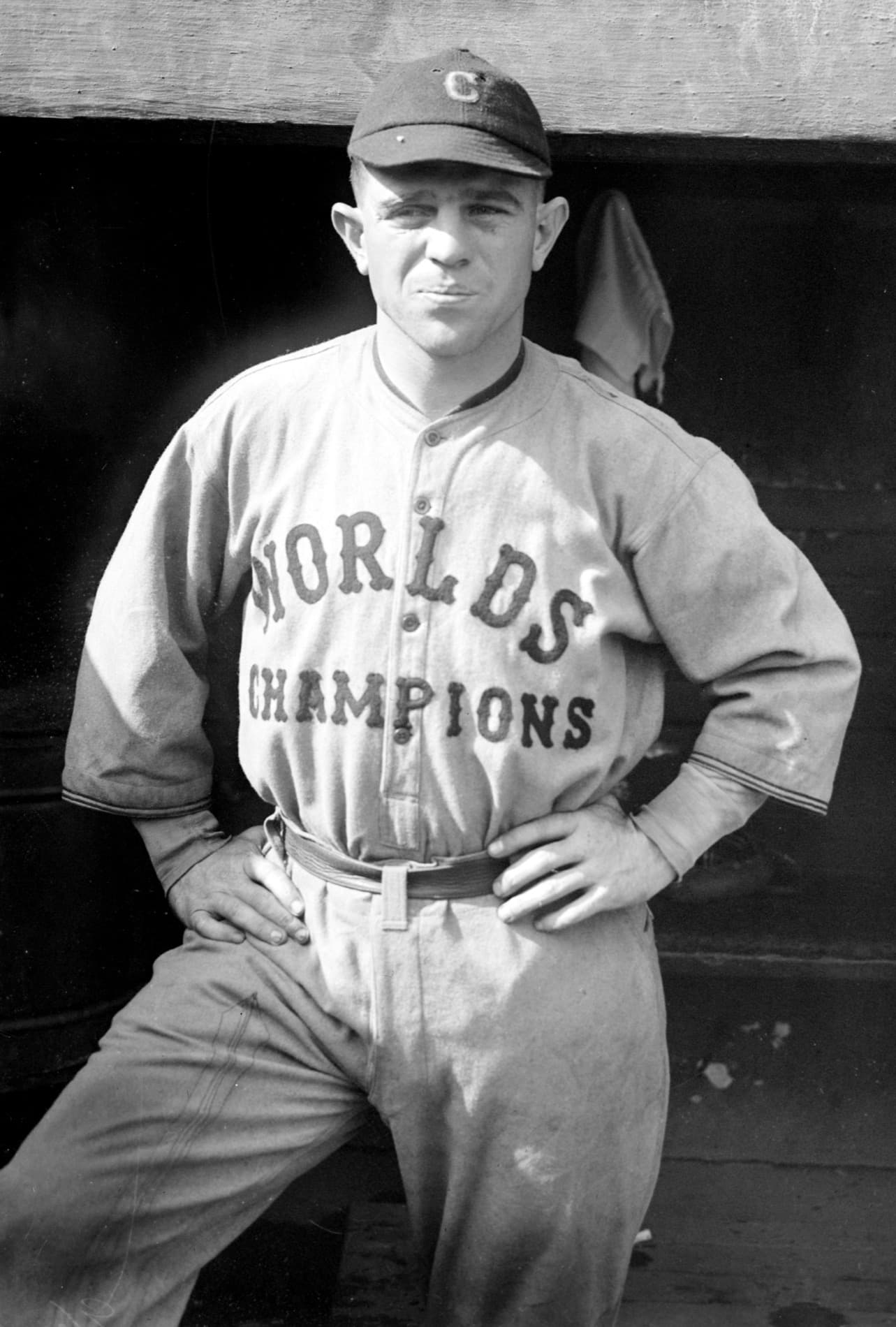
Joe Sewell portrait.
Photo credit: Unknown author via Wikimedia Commons (Public domain)
Joseph Wheeler Sewell struck out 114 times in 14 major league seasons. Not 114 times a year. One hundred and fourteen times total, across 7,132 at-bats, a ratio of one strikeout for every 62.6 trips to the plate that no hitter in major league history has matched. In 1929 he went 115 consecutive games without striking out. In 1932 he struck out three times in 503 at-bats. He credited his hand-eye coordination to a childhood spent throwing rocks at targets and hitting Coca-Cola bottle caps with a broomstick handle. "When I was a boy I'd walk around with a pocket full of rocks," he said, "and I can't remember not being able to hit them with a broom stick handle." The Veterans Committee elected him to the Hall of Fame in 1977.
Titus
Sewell was born on October 9, 1898, in Titus, Alabama. His father Wesley was a country doctor. Baseball ran through the family. His brother Luke played 20 major league seasons with four teams and managed the St. Louis Browns to the 1944 American League pennant. His brother Tommy played one game for the Chicago Cubs in 1927. His cousin Rip Sewell pitched in the majors for 13 years and invented the eephus pitch.
Sewell attended the University of Alabama, where he enrolled in pre-medical studies, lettered in football, and started three years at second base alongside Riggs Stephenson, a future Cubs outfielder who played shortstop at Alabama. Sewell led the school's baseball team to four conference titles and was elected class president by his senior year.
Replacing Chapman
On August 16, 1920, Carl Mays of the New York Yankees hit Cleveland Indians shortstop Ray Chapman in the head with a pitch. Chapman died the following day, the only on-field fatality in major league history. Harry Lunte replaced Chapman but pulled a leg muscle on September 6, and Cleveland purchased Sewell's contract from the New Orleans Pelicans of the Southern Association that same day.
Sewell was 21 years old with 92 minor league games to his name. Sewell made his major league debut on September 10 against the Yankees, went 0-for-2, and then hit .329 over the remaining 22 games of the season. The league waived its September 1 eligibility rule so Sewell could play in the World Series. Cleveland won the championship, and Sewell was in the lineup on October 10 when Bill Wambsganss turned the only unassisted triple play in World Series history.
Cleveland
Sewell became the everyday shortstop in 1921 and hit above .300 in most of his seasons with the Indians. He stood five-six and weighed 155 pounds, and he compensated for his size with an extraordinary ability to put the bat on the ball. His career strikeout totals read like a clerical error. He struck out 20 times in 1922, his career high. Over his final nine seasons, from 1925 through 1933, he never reached double digits in strikeouts. In 1925 he struck out four times. In 1929, four times again. In 1930, three. In 1932, three.
Sewell used a single 40-ounce bat throughout his career, a piece of timber nicknamed "Black Betsy" that George Burns gave him on his first day. Sewell maintained it by rubbing it with a Coca-Cola bottle and seasoning it with chewing tobacco. He never broke it. The bat is now displayed at the Alabama Sports Hall of Fame Museum.
Sewell played 1,103 consecutive games from September 1922 through April 1930, the second-longest streak at the time behind Everett Scott. Sewell led American League shortstops in putouts and assists four times and in fielding percentage three times. Sewell hit .312 for his career with 2,226 hits, 436 doubles, and 1,054 RBI.
New York
Cleveland released Sewell after the 1930 season, and the Yankees signed him on January 24, 1931, to play third base alongside Lou Gehrig and the rest of Joe McCarthy's lineup. Sewell roomed with Gehrig. In 1932 he struck out three times in 503 at-bats, a modern single-season record, and helped the Yankees sweep the World Series against the Cubs. Sewell was in the lineup on the day Babe Ruth hit his famous "called shot" off Charlie Root in Game 3. "I don't care what anybody says," Sewell said. "He did it."
Sewell played his final game on September 24, 1933, at 34. Sewell coached for the Yankees in 1934 and 1935, then returned to Alabama, where he ran a hardware store and worked in public relations for a dairy manufacturer.
Tuscaloosa
Sewell scouted for the Cleveland Indians from 1952 through 1962 and for the New York Mets in 1963. In 1964, at 65, he became the head baseball coach at the University of Alabama, replacing 25-year coach Tilden "Happy" Campbell. He coached for seven seasons, won the 1968 Southeastern Conference championship with a 24-14 record, and retired in 1970 at the mandatory retirement age. Among his players was Ken Stabler, the future NFL quarterback, whom the Yankees drafted in the 10th round in 1966.
Sewell was known in Elmore County for bringing bats, balls, and gloves to local children during the Depression. The University of Alabama renamed its baseball stadium Sewell-Thomas Stadium in his honor in 1978, and the fans call it "The Joe." Sewell died on March 6, 1990, in Mobile, Alabama, at the home of his son James. Sewell was 91 years old and the last surviving member of the 1920 World Series champion Cleveland Indians.