Profile
Johnny Bench
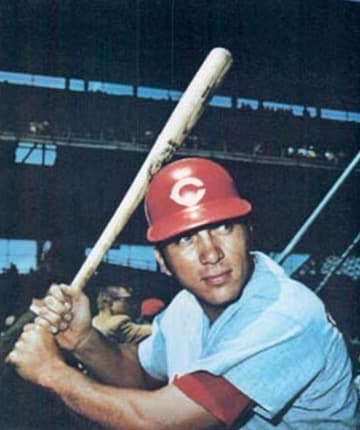
Johnny Bench portrait.
Photo credit: Unknown author via Wikimedia Commons (Public domain)
Johnny Lee Bench grew up in Binger, Oklahoma, a town so small that his graduating class numbered 21, and he told his teacher in the second grade that he would become a major league ballplayer. His father Ted started a boys' team when Johnny was six, and the boy began catching because that was the position nobody else wanted and the position that touched the ball on every pitch. Bench caught for 17 seasons in Cincinnati, won 10 consecutive Gold Gloves, hit 389 home runs, earned the 1970 and 1972 NL MVP awards, anchored the Big Red Machine alongside Joe Morgan, Pete Rose, and Tony Perez through two consecutive World Series championships, and changed the way every catcher who followed him received the ball. Ted Williams signed a baseball for the young Bench during spring training with an inscription that doubled as a prophecy. "To Johnny Bench, a Hall of Famer, for sure." Sparky Anderson, who managed Bench for nine years, refused to diminish the compliment by comparing him to anyone else. "I don't want to embarrass any other catcher by comparing him to Johnny Bench." The BBWAA elected Bench in 1989 on 96.4 percent of the ballot, the third-highest percentage in the history of the vote at the time.
Binger
Bench was born on December 7, 1947, in Oklahoma City, one-eighth Choctaw, and grew up 60 miles west in Binger, where his father drove trucks and his mother Katy raised four children. Bench picked cotton, worked peanut fields, and mowed lawns, and he practiced his autograph before he played a single professional game because he was certain he would need it. His hands were enormous. Photographs show him holding seven baseballs in his throwing hand, a physical trait that made possible the catching revolution he brought to the game.
In 1965, during his senior year, the high school team bus lost its brakes and rolled 50 feet down a ravine. Two of Bench's teammates were killed. Bench was knocked unconscious but survived. He rarely discussed the accident publicly. The Reds drafted him in the second round that June, scout Tony Robello signed him for $6,000 plus college tuition, and Bench dominated the minor leagues at Peninsula and Buffalo, winning league Player of the Year honors and earning The Sporting News Minor League Player of the Year award. The Reds traded their two-time Gold Glove catcher Johnny Edwards to St. Louis to clear the position for a teenager, and Bench debuted on August 28, 1967, at 19, catching 26 games down the stretch. In his first weeks in the majors, the teenage catcher waved veteran shortstop Leo Cardenas to reposition himself during a game, the kind of nerve that would have gotten most rookies benched. Nobody benched Bench.
The Machine
Bench won the 1968 NL Rookie of the Year with a .275 average and 15 home runs, catching 154 games and becoming the first rookie catcher to win a Gold Glove. Jim Maloney, a veteran Reds pitcher, described what it was like to have a 19-year-old call his game. "So help me, this kid coaches me. And I like it. When you're in a big sweat and nervous, he can calm you down more ways than I have ever seen."
In 1970, at 22, Bench hit 45 home runs with 148 RBI and a .293 average and won his first MVP, the youngest NL winner at the time. On July 26, playing left field at the new Riverfront Stadium, he hit three home runs in a single game, all of them off Steve Carlton. Roy Blount Jr. described Bench's throwing arm as "about the size of a good healthy leg" that "works like a recoilless rifle." Harry Dalton, the former Orioles GM, said, "Every time Bench throws, everybody in baseball drools."
Bench led the league in home runs again in 1972 with 40, won his second MVP, and in Game 5 of the NLCS against Pittsburgh, trailing in the bottom of the ninth, led off with a home run off Dave Giusti that tied the game 3-3. The Reds won the pennant minutes later when Bob Moose threw a wild pitch that scored George Foster. In December 1972, doctors discovered a growth on Bench's lung during a routine physical. Surgery on December 9 required a 12-inch incision under his right arm and the extraction of a benign lesion from a fungal spore. He recovered fully by spring training. Frank Cashen of the Orioles summarized the consensus. "The first thing you want in a catcher is the ability to handle the pitchers. Then you want defensive skill, and, of course, the good arm. Last of all, if he can hit with power, well, then you've got a Johnny Bench."
Bench led the league in RBI three consecutive years (1972-1974), driving in 125, 104, and 129 runs, and the Big Red Machine won 108 games in 1975 before defeating the Red Sox in a seven-game World Series that is still regarded as the finest ever played. Bench doubled to start the decisive rally in Game 2 and homered off Rick Wise in Game 3, and the Reds won Game 7 on Joe Morgan's ninth-inning single. The following year the Machine swept the Yankees in four games. Bench struggled through the 1976 regular season with back cramps and a .234 average, then erupted in the postseason, hitting .533 with two home runs in the World Series sweep to win the MVP. He called it a "personal triumph."
Bench popularized catching with one hand, keeping his bare throwing hand tucked behind his back to protect it from foul tips while using a hinged mitt that he controlled with his enormous grip. He adopted the technique after breaking his thumb in the minors, and within a decade every catcher in professional baseball was doing it the same way. The old two-handed style disappeared because Bench proved you could receive, block, and throw without exposing the hand that had to make the relay. "Are there times I wish I hadn't caught?" Bench said. "Sure. But then I wouldn't have been Johnny Bench."
Binger Again
The years behind the plate broke six bones in each of his feet from foul tips, broke his thumb twice, and wore down his back and shoulders until the Reds moved him to first base in 1981 and third base in 1982 before he retired after the 1983 season. He finished with 389 home runs, then the most by any catcher in history, and 14 All-Star selections. Anderson's instruction to the rest of the sport was simple and permanent. "God touched Johnny's mother and said, 'I'm gonna give you the greatest catcher in the history of baseball.'"
ESPN named Bench the greatest catcher in baseball history. A bronze statue of him throwing out a runner was unveiled outside Great American Ball Park on September 17, 2011, and the Johnny Bench Award is given annually to the top collegiate catcher in the country. The teacher in Binger who heard a second-grader say he would play in the major leagues lived long enough to see the prediction come true, along with the one Ted Williams wrote on a baseball before Cooperstown proved him right.