Profile
Pat Gillick
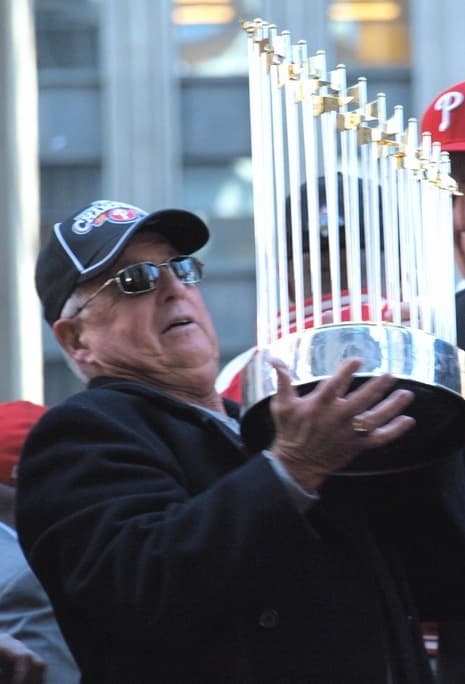
Pat Gillick with the 2008 World Series trophy.
Photo credit: Unknown photographer via Wikimedia Commons
Pat Gillick built winners on four different franchises across more than two decades, an executive with a near-photographic memory and a gift for the deal other clubs were too cautious to make. He turned an expansion team in Toronto into a back-to-back World Series champion, built the Seattle Mariners club that won 116 games, and won a fourth title with the 2008 Phillies. They called him Stand Pat, which was a joke, because he never stood still for long. The Expansion Era Committee elected him to the Hall of Fame in 2011.
Stand Pat and the Yellow Pages
Two nicknames followed Gillick, and both told on him. He earned "Stand Pat" in the 1980s for a supposed reluctance to make a move, a reputation his actual record made a joke of, since he was one of the boldest dealmakers of his time. The other was "Wolley Segap," Yellow Pages spelled backward, hung on him for a memory so complete that colleagues swore he could recite a phone book. "Pat has an exceptional memory, able to memorize flight numbers, phone books," the executive Tal Smith said. "But intelligence can only take you so far. Pat has succeeded because of his perseverance and people skills."
A Pitcher Who Found His Calling in the Office
Gillick was born on August 22, 1937, in Chico, California, the son of a minor league pitcher who later became a county sheriff, and he was raised mostly by his grandparents in the San Fernando Valley. He pitched at Southern California for Rod Dedeaux on a College World Series winner, signed with the Baltimore Orioles, and spent five years as a left-hander in the minor leagues, going 45-32 before he found his real work in a front office. He learned the trade running player development for the Houston organization and then the Yankees, hunting talent in places other clubs ignored, and when Toronto joined the American League as an expansion team he went there to stock it.
Building a Champion in Toronto
Gillick took an expansion roster and made it a contender that stayed one, the Blue Jays winning at least 86 games every year from 1983 through 1993. He mastered the unglamorous tools, plucking George Bell out of the Rule 5 draft and building an academy in the Dominican Republic before most teams bothered with the country. Then he made the trade that won it all. In December 1990 he sent Fred McGriff and Tony Fernández to San Diego for Roberto Alomar and Joe Carter, the deal that turned a good team into the one that won the 1992 and 1993 World Series, the first championships Canada had ever claimed.
The Boldest Dealmaker in the Game
For a man called Stand Pat, Gillick spent prospects without flinching when a title was within reach. He rented David Cone from the Mets in 1992 for a young infielder named Jeff Kent, knowing exactly what he was giving up. "One of the guys probably is a marginal Hall of Famer, Jeff Kent," he said. "We thought David Cone is a guy we think can get us over the hump." The next summer he landed Rickey Henderson at the deadline, and Toronto won again. He described his method as fishing wherever the talent ran. "There are five or six rivers flowing into one river," he said. "Fish in all of them."
Opening the Pacific Rim
When Gillick took over the Seattle Mariners he looked across the ocean for players other general managers could not see. He signed the Japanese closer Kazuhiro Sasaki, and then he brought over Ichiro Suzuki, the first Japanese position player in major league history, a move that changed the way American teams scouted the rest of the world. The signings were of a piece with everything else he did, the same willingness to look where no one else was looking that had filled out his Toronto rosters with Rule 5 picks and Dominican teenagers.
The 116-Win Mariners
Seattle had lost Ken Griffey Jr., Alex Rodriguez, and Randy Johnson in the space of three years, three of the best players alive, and Gillick rebuilt the team around the edges and won anyway. The 2001 Mariners went 116-46, tying the 1906 Cubs for the most wins in a season, with a roster Gillick had stitched together out of free agents and his two imports from Japan. The team fell short of the World Series, the one great club he could not push all the way, but the 116 wins stand as the high mark of his eye for a roster.
A Champion at the End
Gillick had one more title in him. He took over the Philadelphia Phillies in 2006, and in his third year there the team he assembled won the 2008 World Series, the franchise's first championship in 28 years. He retired right after at 71, a winner on the way out. Across 27 years running baseball operations he reached the postseason 11 times and won three World Series across two franchises, one of the few men ever voted into the Hall of Fame for building teams rather than playing for them. The Expansion Era Committee elected him in 2011, where he joined Bert Blyleven and Roberto Alomar, the same Alomar he had traded for 21 years earlier.