Profile
Rod Carew
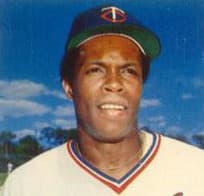
Rod Carew with the Minnesota Twins.
Photo credit: Unknown author via Wikimedia Commons (Public domain)
Rodney Cline Carew was born on a segregated train in the Panama Canal Zone on October 1, 1945. His mother Olga went into labor in the rear cars, where the railroad confined passengers who were not white, and a doctor named Rodney Cline delivered the baby in transit. Olga named her son after the man who brought him into the world. Carew grew up to win seven American League batting titles, collect 3,053 hits with a .328 career average, make 18 consecutive All-Star teams, steal home seven times in a single season, chase .400 through the summer of 1977 until the whole country watched, and receive the transplanted heart and kidney of a young man who met Carew at age 11, idolized him, grew up to play in the NFL, and died at 29 from a burst aneurysm. The BBWAA elected Carew to the Hall of Fame in 1991 on 90.5 percent of the ballot, the first player born in Panama to receive the honor.
Gatun
Carew's father Eric was a sign painter along the Canal who drank and turned violent. "Baseball was the one thing that kept me from killing my father," Carew said. As a boy in Panama he developed his coordination hitting bottle caps with a broomstick, and his uncle Joseph French, a gym teacher, introduced him to organized ball. At 14, Carew moved with siblings to Washington Heights in Manhattan, attended George Washington High School, and played semipro ball for the Bronx Cavaliers because the school did not have a team that suited him. Twins scouts discovered him there, and he signed on June 24, 1964, for $400 a month. He served a six-year commitment in the Marine Corps Reserve as a combat engineer and later said the discipline he learned in the Marines made him the player he became.
Carew won the 1967 AL Rookie of the Year with a .292 average and 19 of 20 first-place votes, and he began an extraordinary run of batting titles that would stretch through most of the next decade. He won four consecutive titles from 1972 through 1975, won a fifth in 1977 and a sixth in 1978, and finished with seven, second only to Ty Cobb in American League history. In 1969, manager Billy Martin coached him in the art of stealing home, and Carew stole it seven times that season, five of them in the first inning, one shy of Cobb's record. Martin later said, "I taught him how to steal home. That's all I ever taught him. As for hitting, he knew how to do that all by himself."
.388
The 1977 season was the closest any hitter came to .400 since Ted Williams reached it in 1941. Carew hit above .400 from late June through mid-July and appeared on the covers of both Sports Illustrated and Time in the same week, the Time cover reading "Baseball's Best Hitter." He finished at .388 with 239 hits, 128 runs, and 100 RBI, won the AL MVP, and earned the Roberto Clemente Award. In 1972 he won the batting title at .318 without hitting a single home run, the first batting champion to go homerless since Zack Wheat in 1918. Gaylord Perry, who faced Carew across a decade and never found a way to solve him, said, "Greaseball, greaseball, greaseball, that's all I throw him, and he still hits them. He's the only player in baseball who consistently hits my grease." Alan Bannister offered the most concise summary. "He's the only guy I know who can go four for three."
Carew played 12 seasons for the Twins before a deteriorating relationship with owner Calvin Griffith, who made racist remarks at a public dinner in 1978, contributed to a trade to the California Angels in February 1979. Carew reached his 3,000th hit on August 4, 1985, singling off Frank Viola at Anaheim Stadium against his former team, the 16th player to reach the milestone.
The Heart
Carew's youngest daughter Michelle was diagnosed with acute myeloid leukemia in September 1995 at 18. Her mixed heritage complicated the bone marrow donor search, and she died on April 17, 1996. Carew turned his grief into public advocacy for bone marrow registries, adding roughly 500,000 donors in the first year of his campaign.
In September 2015 Carew suffered a massive heart attack on a California golf course, was hospitalized for six weeks, and received a mechanical heart pump. On December 15, 2016, he received a transplanted heart and kidney from Konrad Reuland, a former Baltimore Ravens tight end who died at 29 from a burst brain aneurysm three days earlier. The connection between the two men reached deeper than organ donation. Reuland attended middle school with Carew's children, met Carew when he was 11 years old, told his mother he wanted to be a professional athlete just like Carew, and the number 29, Carew's jersey number, became the centerpiece of the organ donation campaign because Reuland was 29 when he died. Carew's wife Rhonda called the coincidences "God winks."
In August 2024, at 78, Carew became a United States citizen, taking the oath at a USCIS office in Santa Ana, California. He said he waited because he wanted children in Panama to see him as a fellow countryman, but the time felt right. "I'm the only one who kind of waited for a very long time."