Profile
Ross Youngs
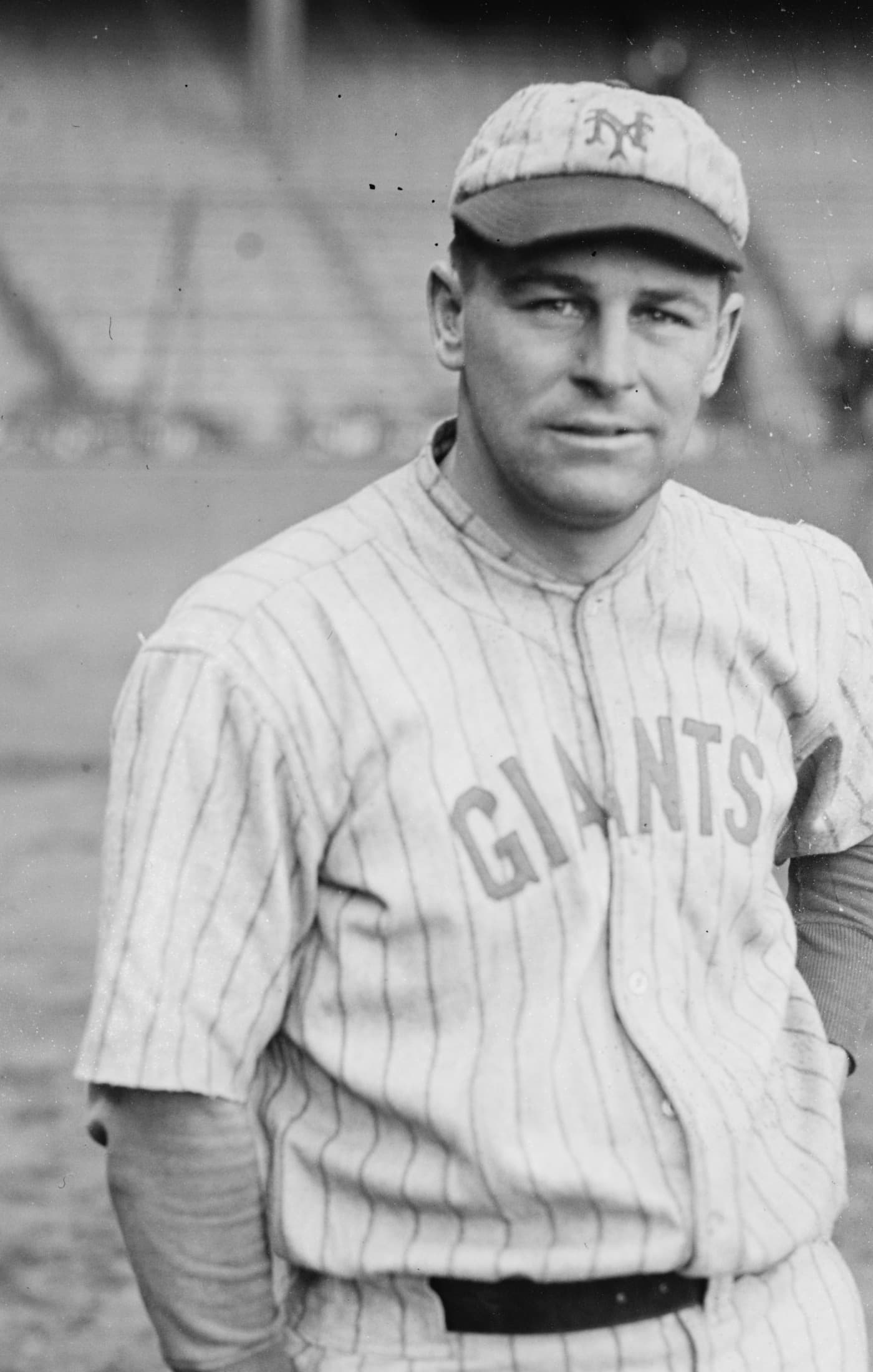
Ross Youngs portrait (New York NL).
Photo credit: Bain News Service / Library of Congress via Wikimedia Commons (Public domain)
John McGraw kept two photographs in his clubhouse office at the Polo Grounds. One was Christy Mathewson. The other was Ross Youngs, a right fielder from Texas who batted .322 over 10 seasons, played on four consecutive pennant winners, and died of kidney disease at 30 years old. McGraw called him "the greatest outfielder I ever saw on a ball field." Rosy Ryan, who pitched alongside him, rated him the best player he ever watched, ahead of Babe Ruth. Frankie Frisch compared him to Enos Slaughter but said Youngs had more ability. Almost nobody outside the game remembers him now, which would have suited him fine. He played with a fury that had nothing to do with reputation and everything to do with winning.
Texas
Ross Middlebrook Youngs was born on April 10, 1897, in Shiner, Texas. He went by Ross his entire life. His father, Stonewall Jackson Youngs, worked as a maintenance supervisor for the San Antonio and Aransas Pass Railroad until a track accident forced him into hotel management with his wife, Henrie. The family moved to San Antonio in 1907 when Ross was 10. His father eventually left the family, and his mother raised three sons alone.
Youngs starred in football and track at West Texas Military Academy, where he ran the 100-yard dash in 9.8 seconds and turned down college football scholarships to play professional baseball. He was 17 when he signed with the Austin Senators of the Texas League in 1914 and batted .145 in 17 games. By 1916, playing for the Sherman Lions of the Western Association, he led the league with a .362 average, 195 hits, and 42 stolen bases. Giants scout Dick Kinsella bought his contract for $2,000 and sent him to Rochester, where he hit .356 in the International League.
The Polo Grounds
McGraw gave him the nickname "Pep" during spring training in 1917 and told Rochester manager Mickey Doolan, "I'm giving you one of the greatest players I've ever seen. Play him in the outfield. If anything happens to him, I'm holding you responsible." Youngs debuted on September 25, 1917, at 20 years old and went 0-for-4 against the Cardinals. He got his first major league hits four days later, a single and a triple against the Reds.
He became the everyday right fielder in 1918 and never relinquished the job. He batted .302 in his first full season, .311 in 1919, and .351 in 1920 with 204 hits, finishing second in the National League batting race behind Rogers Hornsby. On May 11, 1920, he tied a major league record with three triples in one game against the Reds.
McGraw signed him to a three-year contract at $12,000 per year, more than Youngs had asked for. "He is the ideal ballplayer," McGraw said, citing his "spirit and willingness to do anything asked of him." Youngs never caused a minute's trouble, according to McGraw, though he was ferocious on the field. He broke up double plays by throwing cross-body blocks at second basemen. He charged the mound against Pete Donohue in August 1925 after being hit in the elbow, broke his own finger in the fight, and missed nearly a month.
The Giants won four consecutive pennants from 1921 through 1924, and Youngs was at the center of all four. In Game 3 of the 1921 World Series against the Yankees, he doubled and tripled during an eight-run seventh inning, becoming the first player in Series history to record two extra-base hits in a single inning. The Giants won the championship that year in eight games. They swept the Yankees in 1922 (with one tie), and Youngs batted .375 and drove in the winning run in Game 4. In Game 4 of the 1923 Series, he went 4-for-5 with a ninth-inning inside-the-park home run off Herb Pennock, though the Yankees won the championship in six games. The Giants lost again in 1924, falling to Walter Johnson and the Washington Senators in seven.
On April 29, 1922, he hit for the cycle against the Boston Braves, going 5-for-5 with a single, two doubles, a triple, and an inside-the-park home run. Waite Hoyt said of his right-field play at the Polo Grounds, "He played that carom as if he'd majored in billiards."
The Bribery Scandal
Late in the 1924 pennant race, Giants outfielder Jimmy O'Connell offered Phillies shortstop Heinie Sand $500 not to bear down in a game against New York. Commissioner Kenesaw Mountain Landis investigated, and O'Connell implicated Youngs, Frisch, and George Kelly as knowing about the scheme. Landis cleared all three after questioning them. "No court in the country would convict Frisch, Kelly, and Youngs on the evidence furnished me," Landis said. O'Connell and Giants coach Cozy Dolan were banned for life.
Bright's Disease
A streptococcal throat infection in late July 1924 cost Youngs three weeks. He returned and hit .356 for the season, a career high, but something had changed. In 1925 he batted .264, the only time in his career he failed to reach .300. His weight dropped and his energy faded.
By spring 1926, McGraw hired a male nurse to travel with the team. Youngs played 95 games that season and batted .306, but his body was failing. His final game came on August 10, 1926. He checked into Murray Hill Sanitarium afterward. The team told the press it was a severe cold.
He returned to San Antonio that October and entered Physicians and Surgeons Hospital in December. The diagnosis was Bright's disease, a fatal inflammation of the kidneys. No effective treatment existed. He improved briefly in April 1927, enough to go home and express hope of rejoining the Giants, but by early October he was back in the hospital. Dick Kinsella visited him and reported to McGraw, "The hand of fate is heavy upon him."
Youngs died on October 22, 1927, at 30. His body had wasted from roughly 170 pounds to under 100. During his final season he had mentored 17-year-old Mel Ott, teaching him how to play the caroms off the Polo Grounds right-field wall, 258 feet down the line. Ott became his successor.
A two-mile funeral procession wound through San Antonio to Mission Park South Cemetery. His estranged wife Dorothy and their infant daughter Caroline, born in December 1925, traveled from New York. Youngs reportedly never met his daughter because of the separation.
The Photographs
The Giants installed memorial plaques at the Polo Grounds that winter, honoring Youngs alongside Mathewson. Fan donations were capped at one dollar. More than 100 contributions came from opponents, including Ruth. Inmates at Sing Sing Prison sent five dollars. On September 27, 1928, three-year-old Caroline pulled the cord at the unveiling. The plaques disappeared when the Giants moved to San Francisco in 1958.
Youngs was the best golfer in the major leagues by reputation, sometimes betting $100 per hole at San Antonio Country Club. He didn't smoke or drink. He was generous to a fault and owed $16,000 by various debtors at his death, money his family never recovered.
In 10 seasons he accumulated 1,211 games, 1,491 hits, 42 home runs, 592 RBI, 153 stolen bases, and a .322 batting average with a .399 on-base percentage. The Veterans Committee elected him to the Hall of Fame in 1972. He died at the youngest age of any Hall of Famer, and McGraw, who outlived him by more than six years, never took down the photograph.