Profile
Tim Keefe
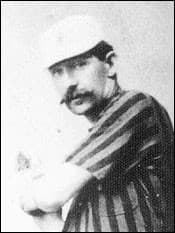
Tim Keefe portrait.
Photo credit: Unknown author via Wikimedia Commons (Public domain)
Timothy John Keefe won 342 games over fourteen seasons, set a record with nineteen consecutive victories in 1888, and pitched in an era when starting pitchers were expected to finish every game they began and start again two or three days later. He was one of the dominant pitchers of the 1880s alongside John Clarkson and Old Hoss Radbourn, a key figure in the first organized players' labor movement, and a man whose career straddled the transition from baseball's amateur origins to its professional maturity. The Veterans Committee elected him to the Hall of Fame posthumously in 1964.
Cambridge
Keefe was born on January 1, 1857, in Cambridge, Massachusetts. He grew up in a working-class Irish American family and took up baseball in the amateur clubs and sandlots of the Boston area during the 1870s, when the sport was evolving rapidly from a gentlemen's recreation into a professional enterprise. He began his professional career in the late 1870s and reached the major leagues with the Troy Trojans of the National League in 1880, going 6-6 in his first season.
He improved rapidly. He won 18 games for Troy in 1881 and showed the fastball and sharp-breaking curve that would make him one of the most dominant pitchers of the decade. When the Troy franchise folded after the 1882 season, Keefe's career moved to New York, where the next phase of his development would unfold.
The Metropolitans and the Giants
Keefe joined the New York Metropolitans of the American Association, a rival league that operated alongside the National League during the 1880s. He won 41 games for the Metropolitans in 1883, an astonishing total that reflected both his talent and the workload expectations of the era. He followed it with a 37-17 record in 1884, leading the Metropolitans to the American Association pennant. His performance made him one of the most valuable pitchers in professional baseball, and his owner, John Day, who controlled both the Metropolitans and the New York Giants of the National League, transferred Keefe to the Giants before the 1885 season to strengthen the flagship franchise.
Keefe remained with the Giants through the 1889 season, and his time there produced his greatest seasons. He paired with Mickey Welch to form one of the most celebrated pitching duos of the nineteenth century, and between them they gave the Giants a rotation that could compete with any club in the league. Keefe won 32 games in 1885, 42 in 1886, 35 in 1888, and 28 in 1889. He threw from overhand, three-quarter, and sidearm angles, and his most celebrated weapon was a change of pace that arrived with the same arm motion as his fastball, leaving batters unable to distinguish one from the other until the ball was past them. His control was exceptional for an era when pitchers were adjusting to increasing distance from the plate.
The 1888 Season
The 1888 season was Keefe's masterwork. He won 35 games and posted a 1.74 ERA, and during one stretch from June through August, he won nineteen consecutive games, a record that stood for more than a century. Rube Marquard tied the streak in 1912 with nineteen consecutive wins of his own, but neither pitcher has been surpassed since. The streak combined dominance and durability in proportions that would be unimaginable in the modern game, when starting pitchers rarely work more than once every five days.
The Giants won the National League pennant that year, and Keefe was the central figure in their postseason success. He won four games in the championship series against the St. Louis Browns of the American Association, the informal predecessor of the modern World Series. The Giants claimed the title, and Keefe's combined regular-season and postseason performance cemented his standing as the best pitcher in baseball that year.
The Brotherhood
Keefe's significance extended beyond the mound. He was a key figure in the Brotherhood of Professional Base Ball Players, the first organized players' labor movement in baseball history, founded and led by his Giants teammate John Montgomery Ward. The Brotherhood sought better treatment for players who were bound to their teams by the reserve clause and had no ability to negotiate for themselves on the open market.
When the Brotherhood launched the Players' League in 1890 as a direct rival to the National League, Keefe joined the revolt and pitched for the New York entry. The Players' League attracted many of the game's best players, but it lacked the financial resources to sustain a prolonged war with the established leagues. The league collapsed after a single season, and the players returned to their former teams under terms that largely preserved the system they had tried to overthrow. Keefe went back to the Giants and then pitched for the Philadelphia Phillies before retiring after the 1893 season.
342 Wins
Keefe finished with a career record of 342-225, a 2.63 ERA, and 554 complete games in 594 career starts. He pitched more than 5,000 innings across fourteen seasons, workloads that reflected the expectations of his era and the durability of his arm. His 342 wins placed him among the highest totals in baseball history at the time of his retirement, a position they continue to hold more than a century later.
After retiring from the field, Keefe worked as an umpire in the National League for a period and then left baseball entirely. He lived quietly in Cambridge for the rest of his life, far from the spotlight that had followed him during his playing days. He died on April 23, 1933, in Cambridge, at age 76. The Veterans Committee elected him to the Hall of Fame in 1964, recognizing a pitcher whose career had preceded the modern game by decades but whose records and contributions to the sport endured.