Profile
Zack Wheat
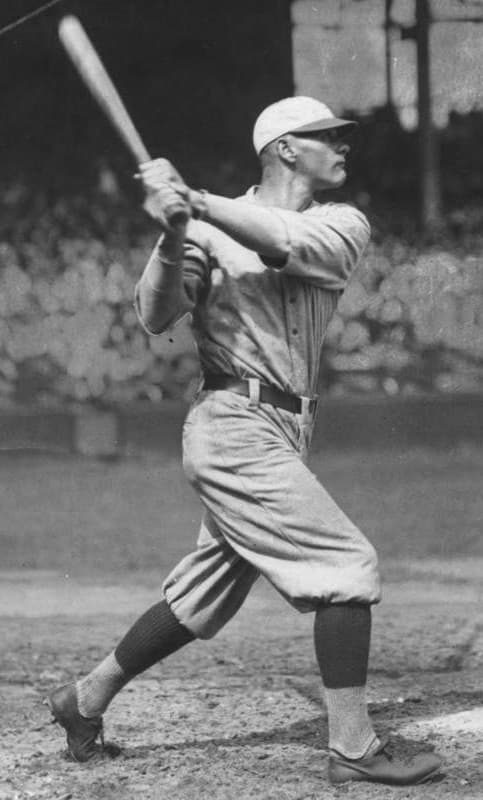
Zack Wheat batting photo (1919).
Photo credit: Charles M. Conlon via Wikimedia Commons (Public domain)
Zachariah Davis Wheat played left field for the Brooklyn club for 18 seasons and hit with a consistency that made him the most popular player in the franchise's history during the first quarter of the twentieth century. He finished with a .317 career batting average, 2,884 hits, and nearly every significant batting record in the Brooklyn record book when he retired. He was not flashy and not temperamental. He showed up, hit line drives, and played the outfield with quiet competence for almost two decades, spending 13 of those seasons under Wilbert Robinson's management. The Veterans Committee elected him to the Hall of Fame in 1959.
Missouri
Wheat was born on May 23, 1888, in Hamilton, Missouri, a small town in the northwestern part of the state. He grew up on a farm and played semipro ball in the region before working his way through the minor leagues. He pitched and played the outfield for Shreveport in the Texas League and then for Mobile in the Southern Association, where his hitting attracted the attention of major league scouts. Brooklyn purchased his contract from Mobile in 1909, and he reached the majors that September. His younger brother Mack also played briefly in the major leagues, though without the sustained success that defined Zack's career.
He became the regular left fielder in 1910 and hit .284 in his first full season. By 1912, he was one of the best hitters in the National League, batting .305 and demonstrating the compact left-handed swing that would carry him through the next 15 years. He drove the ball to all fields, rarely struck out, and possessed the kind of natural hitting ability that coaches described as unteachable.
Brooklyn
Wheat played through the Dead-Ball Era without the power numbers that later generations would produce, but he hit for average year after year with a dependability that Brooklyn fans learned to count on. He batted .301 in 1913, .319 in 1914, .312 in 1916, and .312 in 1917, anchoring Robinson's lineup through seasons that ranged from competitive to mediocre. In 1918, he won the National League batting title with a .335 average in the war-shortened season, and the title confirmed what anyone who had watched him for the previous eight years already knew.
The Brooklyn club won the National League pennant in 1916 and again in 1920, giving Wheat two chances at a championship. The 1916 team lost to the Boston Red Sox in five games. The 1920 team lost to the Cleveland Indians five games to two in a best-of-nine Series, a Series remembered for the extraordinary events of Game 5, which included the first grand slam in World Series history, the first home run by a pitcher, and the only unassisted triple play in Series history, all in a single game. Wheat hit .333 in the 1920 Series but could not lift Brooklyn past a Cleveland team that proved superior across the final three games.
Wheat's best offensive seasons came in the early 1920s, when the transition to the Live-Ball Era raised batting averages across the sport and Wheat's line-drive stroke benefited from the livelier baseball. He hit .320 in 1921, .335 in 1922, .375 in 1923, and .375 again in 1924, four consecutive seasons that ranked among the finest of his career. He and Casey Stengel shared the Brooklyn outfield during Stengel's years with the club, and Burleigh Grimes anchored the pitching staff during the early 1920s, giving Robinson a core of talented players even when the team as a whole fell short of contention.
Wheat was a durable player who missed few games across his career. He played more than 100 games in 16 of his 19 seasons and led the National League in slugging percentage in 1916. His relationship with Brooklyn fans was warm and genuine throughout his tenure. He lived in the community, engaged with supporters, and represented the franchise with a steadiness that matched his performance on the field. He held the Brooklyn records for games played, hits, doubles, triples, and total bases when he left, records that stood for decades until the franchise moved to Los Angeles and a new generation of players eventually surpassed them.
Final Seasons
Brooklyn released Wheat after the 1926 season, ending an 18-year association with the franchise. He played briefly for the Philadelphia Athletics in 1927, hitting .324 in 88 games under Connie Mack before retiring at age 39. He finished with 2,884 hits, 476 doubles, 172 triples, 132 home runs, and a .317 career batting average.
He returned to Missouri after his playing career ended and operated a farm and a bowling alley near Kansas City. He lived quietly and made occasional appearances at old-timers' events. He died on March 11, 1972, in Sedalia, Missouri, at age 83.