Profile
Charlie Bennett
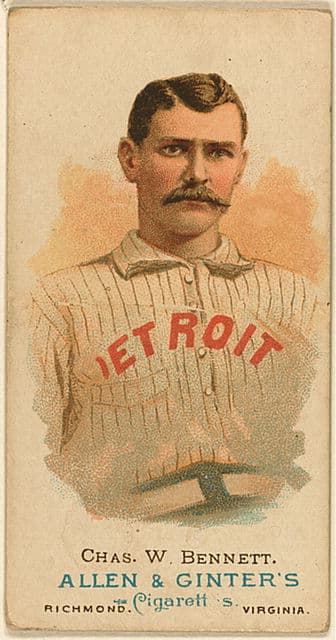
Charlie Bennett baseball card portrait.
Photo credit: Unknown photographer via Wikimedia Commons
Charlie Bennett caught a baseball for fifteen years with nothing on his hands but calluses, and the men who saw him do it called him the best in the world at it. He worked behind the plate through the 1880s before gloves and masks were standard equipment, handling fastballs and foul tips barehanded, leading National League catchers in fielding again and again, and anchoring four pennant winners in Detroit and Boston. A train took both of his legs in January 1894 and ended his career in an instant, and Detroit answered by naming its ballpark for him and asking him to catch the ceremonial first pitch of every home opener for the next three decades. The city loved him as few players have ever been loved, even as Cooperstown enshrined catchers of his era who were not his equal.
The Barehanded Catcher
Bennett was born Charles Wesley Bennett on November 21, 1854, in New Castle, Pennsylvania, and came up in a version of the game that asked its catchers to absorb punishment no equipment softened. He reached the majors with Milwaukee in 1878, spent a season at Worcester, and settled into the work that would define him, crouching behind the plate and taking the full force of the era's hardest throwers on naked hands. By the account passed down through baseball's researchers, he and his wife Alice sewed strips of cork into a vest he wore hidden beneath his uniform, an early and homemade piece of protection in a sport that offered almost none. Catchers in those years split their fingers and broke their thumbs as a matter of routine, and Bennett kept catching through injuries that would have shelved most men. Toughness came first, the price of admission to a position he played better than anyone alive.
The Best Glove of the 1880s
What separated Bennett was the quality of his defense, a combination of hands, arm, and judgment that contemporaries struggled to describe without superlatives. He led National League catchers in fielding percentage seven times, ranked among the league's leaders in defensive value for a decade, and retired holding the record for most career games caught, 954 of them, a staggering total for a barehanded man. Behind the plate he caught Lee Richmond's perfect game at Worcester in 1880, the first perfect game in major league history, and he handled the best pitchers of his day with a steadiness that made them better. Richmond, who threw to him, called him the finest backstop who ever lived, and the praise came from across the sport. The numbers and the testimony point the same way, toward a catcher whose glove was the equal of any the nineteenth century produced.
The Detroit Wolverines
Bennett spent his prime with the Detroit Wolverines, joining in 1881 and staying through 1888, one of only two men to play all eight seasons of the franchise's National League life. He caught for a club that climbed steadily into a power, and in 1887 the Wolverines won their only pennant and then beat the American Association champion St. Louis Browns in a fifteen game traveling series played across ten cities. Detroit's lineup carried the famous Big Four of Dan Brouthers, Deacon White, and Sam Thompson and Hardy Richardson, and Bennett was the man who caught the staff and steadied the whole operation. He drove in nine runs, the most on the team, in the championship series despite a doctor's warning to stay out of the lineup, the sort of stubbornness that defined his career. The Wolverines folded after 1888, and the best years of Detroit's first great team belonged to the catcher the city would never forget.
To Boston
When Detroit disbanded, Bennett moved on to the Boston Beaneaters, where the back half of his career proved as decorated as the front. He caught in Boston from 1889 through 1893, and the Beaneaters won National League pennants in 1891, 1892, and 1893, three more to add to the one he had won in Detroit. Past 35 by then, ancient for a barehanded catcher, he was still good enough to anchor a champion, working with a new generation of Boston pitchers and giving the club the same steadiness he had given the Wolverines. Four pennant winners in two cities marked him as a catcher the best teams wanted behind the plate. His career was rounding toward a graceful close, a long run of winning baseball nearing its natural end.
The Hitting
Bennett never hit the way he caught, but he gave his teams more offense than most catchers of his era could, especially for a man so worn by the position. He finished with a .256 average, 55 home runs, and 533 runs batted in, power numbers that stood out at a position where survival usually came before slugging. During his Detroit years he hit closer to .278 with several seasons above .300, batting in the heart of a strong order rather than at the bottom where catchers often hid. Bennett drew walks, reached base at a healthy clip, and made himself a genuine two way asset in a job that beat most men down to one dimension. His bat was the smaller part of his value, yet it kept him in the middle of pennant races for fifteen years.
The Slip at Wellsville
On January 10, 1894, Bennett's playing career ended at a train stop in Wellsville, Kansas, on a hunting trip he took every winter with his old Boston teammate, the pitcher John Clarkson. He had stepped off the train to greet an old friend, and as the cars began to move he reached for the railing on a rain slicked platform, his foot slipped over the rail, and the wheels ran across both of his legs. Surgeons amputated one leg above the ankle and the other above the knee, and the man who held the record for games caught would never walk unaided again. It was an accident of an instant, a misjudged step on a wet platform, and it took everything the field had given him. He was 39 years old, and his career was simply over.
Bennett Park
Detroit refused to let Bennett fade, and in 1896 the city opened a new ballpark at Michigan and Trumbull and named it Bennett Park in his honor. The Tigers played there from 1896 through 1911, when the wooden grounds gave way to the steel and concrete of Navin Field, later Briggs Stadium and then Tiger Stadium, all of it rising from the same corner that had carried his name. Every year from 1896 until 1926, the season before he died, Bennett took the ceremonial first pitch of the Detroit home opener, lowering himself behind the plate on his prosthetics to catch one more throw before the crowd that still adored him. Bennett made his living running a cigar store on Woodward Avenue, took up china painting, and stayed a fixture of Detroit baseball to the end. He died on February 24, 1927, and the city that had built him a monument out of a ballpark mourned the catcher it had honored every spring for thirty years.