Profile
Sam Thompson
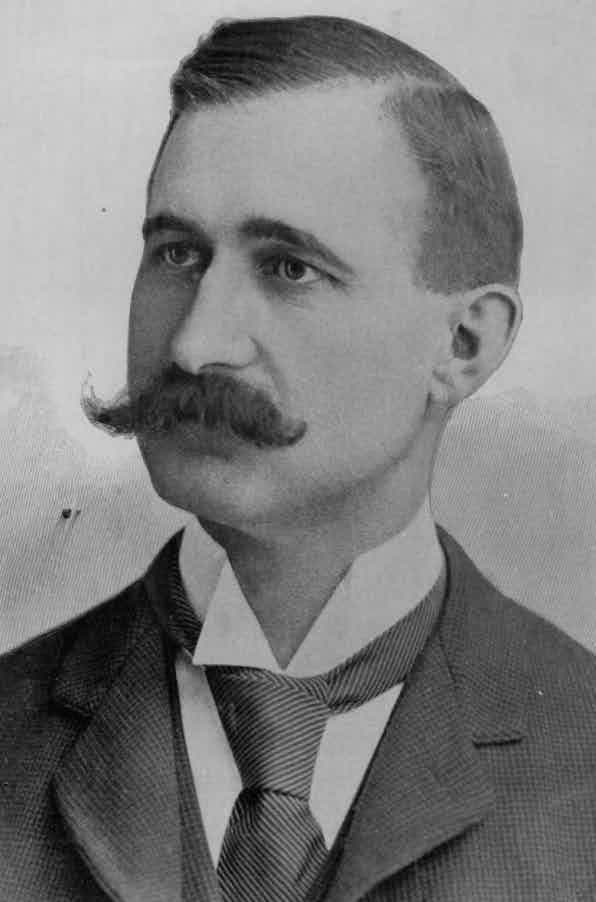
Sam Thompson portrait, 1885.
Photo credit: Unknown author via Wikimedia Commons (Public domain)
Samuel Luther Thompson was discovered on a roof in Stinesville, Indiana, where he was working as a carpenter, and the scout who found him paid him $2.50 to play in an exhibition game. He split his pants on his first at-bat in the major leagues, drove in 166 runs in 127 games before the pitching mound existed at its current distance, hit .407 in a season when his two outfield partners did the same, and came back at 46 to play alongside Ty Cobb. His career RBI-per-game ratio of .923 remains the highest in baseball history, ahead of Lou Gehrig, Hank Greenberg, Joe DiMaggio, and Babe Ruth. When he died in 1922, the courts and factories of Detroit shut down for his funeral.
Danville
Thompson was born on March 5, 1860, in Danville, Indiana. His father Jesse had served with Indiana's 63rd Infantry during the Civil War, guarding Confederate prisoners at Camp Morton, and after returning to Danville he introduced baseball to the community. His mother Rebecca's grandfather had served in the Revolutionary War. Thompson was the fifth of eleven children. Six sons and three daughters survived infancy, and all six brothers exceeded six feet and weighed over 200 pounds. They played together for the local Danville Browns and drew crowds near a thousand.
Thompson attended the Danville Graded School and became a carpenter. In July 1884, scout Dan O'Leary spotted him on a rooftop in Stinesville and paid him $2.50 to play in an exhibition. His team won 9-0. O'Leary signed him with Evansville of the Northwestern League, where Thompson hit .391 in five games before the league folded in August. He moved to the Indianapolis Hoosiers of the Western League in 1885 and batted .321 in roughly 30 games before that team disbanded as well.
The Wolverines
When Indianapolis folded in June 1885, Detroit representatives kept Thompson and his teammates aboard the steamship Annette for 10 days on the river, playing poker and fishing and eating well, to prevent rival clubs from signing them. "We were prisoners," Thompson recalled, "but well cared-for prisoners." He was brought ashore at midnight on the tenth day and delivered to the Detroit Wolverines.
He made his major league debut on July 2, 1885. Detroit had no uniform large enough for him, and on his first at-bat he doubled off Hall of Famer Tim Keefe and split his pants running to second base. He hit .303 in 63 games that half-season, finished third in the National League with seven home runs, and recorded 24 outfield assists.
His breakout came in 1887, when he won the NL batting title with a .372 average and became the first player in major league history to collect 200 hits in a season, finishing with 203. He drove in 166 runs in 127 games, a record that stood for 34 years until Ruth surpassed it in 1921 while playing 25 more games. Thompson's total was 62 more than the second-place finisher that year. He led the league in hits, triples (23), slugging (.565), and total bases (308), and on May 7 became the first player to hit two bases-loaded triples in the same game. The Wolverines won the pennant and defeated the St. Louis Browns 10 games to 5 in the 15-game World Series. Thompson hit .362 with two home runs and seven RBI.
The 1887 Wolverines featured four future Hall of Famers: Thompson, Dan Brouthers, Deacon White, and Ned Hanlon. A sore arm limited Thompson to 56 games in 1888, and Detroit finished fifth. The franchise folded in October.
Philadelphia
Philadelphia purchased Thompson's contract on October 16, 1888, for $5,000. He spent the next decade there and put up numbers that still sit near the top of the record books. In 1889 he hit 20 home runs and stole 24 bases, becoming the first player to reach 20 in both categories in the same season. He led the league in hits in 1890 and again in 1893, when he batted .370 with 222 hits after the pitching distance moved from 50 feet to 60 feet 6 inches.
In 1894, Thompson batted .407 with a .696 slugging percentage, 147 RBI, and 28 triples in 102 games. His ratio of 1.44 RBI per game that season remains the single-season record. He drove in 61 runs in August alone. On August 17 he hit for the cycle. All of this came after surgeons amputated portions of the little finger on his left hand in mid-May to remove dead bone, an old injury.
His left fielder Ed Delahanty also hit .407 that year. Their center fielder Billy Hamilton hit .404. A fourth outfielder, Tuck Turner, batted .416 in part-time duty. No other outfield in major league history has produced three .400 hitters in the same season.
Thompson hit .392 with 211 hits, 18 home runs, and 165 RBI in 1895, his second season driving in more than 150 runs. He was the only nineteenth-century player to do it once, and he did it twice. By 1896, at 36, he was slowing down, though he still drove in 100 runs. Chronic back pain and tension with new manager George Stallings limited him to three games in 1897 and 14 in 1898. He batted .349 in that final handful of games and walked away.
The Comeback
Eight years later, in 1906, the Detroit Tigers lost Ty Cobb and Davy Jones to injuries and persuaded Thompson out of retirement. He was 46 years old. He played eight games, collected seven hits including a triple, and could still throw from deep right field on a line. For a few weeks the Tigers outfield consisted of Thompson, Sam Crawford, and Cobb, three future Hall of Famers spanning three generations of the game. "Special Thompson delegations" packed the stands. When Matty McIntyre returned to the team in early September, Thompson retired for good.
After the Game
Thompson invested in Detroit real estate and lived comfortably in retirement. He served as a United States Deputy Marshal and later as courtroom crier in the chambers of U.S. District Court Judge Arthur J. Tuttle, where he was a familiar presence at the federal building. He and his old teammate Charlie Bennett, who had lost both legs in a railroad accident, made regular appearances on evangelist Billy Sunday's revival circuit. At Detroit Tigers home games, Bennett would throw the first pitch and Thompson would catch it.
He died on November 7, 1922, at 62, after suffering a heart attack while serving as an election inspector at a polling place. He was taken home, where a second heart attack killed him. The funeral drew Michigan's foremost citizens. Courts adjourned, factories paused, and the neighborhood filled with expensive automobiles alongside the laborers who had cheered Thompson decades earlier. A Methodist minister and a Catholic priest co-officiated the service. He was buried at Elmwood Cemetery in Detroit.
The Veterans Committee elected him to the Hall of Fame in 1974, 52 years after his death. His nephew Lawrence W. Thompson, the only surviving family member who had known Sam personally, accepted the plaque. In 1,410 games he accumulated 1,988 hits, 126 home runs, 1,308 RBI, and a .331 batting average. Bill Watkins, his old Detroit manager, said upon learning of his death: "Not only a great baseball player, but one of the finest gentlemen I ever knew."