Profile
Curt Schilling
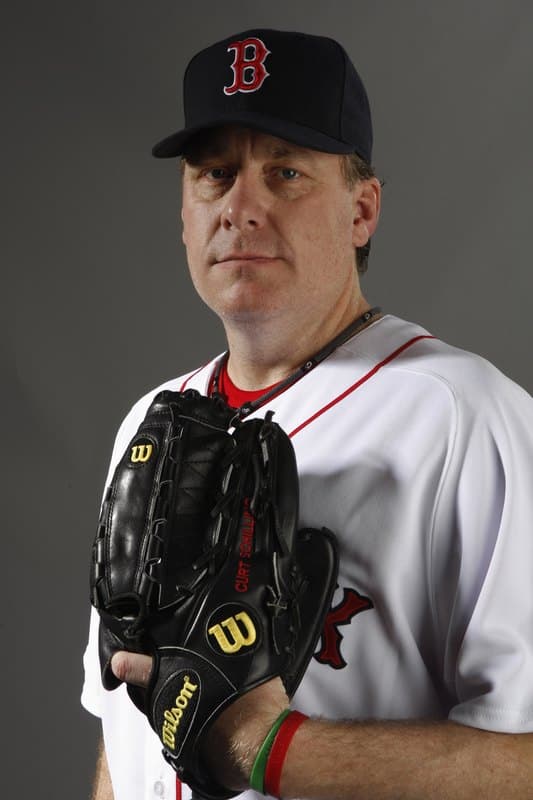
Curt Schilling portrait in Boston Red Sox uniform.
Photo credit: Listal user upload via Listal
Curtis Montague Schilling won 216 games, struck out 3,116 batters, posted a career 4.38 strikeout-to-walk ratio (the best since 1900 among pitchers with 1,000 or more strikeouts), won three World Series rings, and compiled an 11-2 postseason record that ranks among the finest in baseball history. He struck out the first five batters he faced in the 1993 NLCS and won the series MVP. He shared the 2001 World Series MVP with Randy Johnson after the two of them carried Arizona past the Yankees. He pitched the most famous game of the 2004 postseason with a dislocated ankle tendon sutured to deep tissue, blood soaking through his white sock on national television, and helped end an 86-year championship drought in Boston. He never won a Cy Young Award. He never made the Hall of Fame. The gap between what he did on the mound and what happened everywhere else is one of the stranger stories in modern baseball.
Anchorage to Philadelphia
Schilling was born on November 14, 1966, at Elmendorf Air Force Base in Anchorage, Alaska. His father, Cliff, was a master sergeant in the 101st Airborne Division. The family moved to Phoenix, where Schilling attended Shadow Mountain High School and played baseball at Yavapai Junior College in Prescott. The Boston Red Sox drafted him in the second round in January 1986, the last January draft in major league history. He spent two and a half years in the minor leagues before the Red Sox traded him to the Baltimore Orioles in July 1988, along with Brady Anderson, for Mike Boddicker.
Schilling made his major league debut on September 7, 1988, against the team that drafted him. Frank Robinson, managing Baltimore, said afterward, "He showed he doesn't get rattled out there." But Schilling couldn't find a consistent role with the Orioles. Baltimore traded him to Houston in January 1991 in a package that included Steve Finley and Pete Harnisch. The Astros used him in the bullpen for 56 games in 1991, and then traded him to the Philadelphia Phillies in April 1992 for Jason Grimsley.
Philadelphia is where Schilling became Schilling. He moved into the rotation, went 14-11 with a 2.35 ERA in 1992, led the National League in complete games in 1996, 1998, 2000, and 2001, and struck out 300 or more batters in three seasons (319 in 1997, 300 in 1998, 316 in 2002 with Arizona). He threw a four-seam fastball in the mid-90s, a split-finger fastball that was his primary out pitch, a changeup, and a slider, and he located all of them with a precision that set him apart from most power pitchers of his era. He kept detailed notebooks on opposing hitters and studied video the way other pitchers studied the sports page.
The 1993 Phillies reached the World Series, and Schilling was the reason they survived the NLCS against the Braves. He struck out the first five Atlanta hitters in Game 1, setting an NLCS record, and won the series MVP with a 1.69 ERA across two appearances and 19 strikeouts. In the World Series against Toronto, he pitched a five-hit shutout in Game 5 but the Phillies lost the series in six when Mitch Williams surrendered Joe Carter's walk-off home run.
Schilling stayed in Philadelphia through 2000, winning the Lou Gehrig Memorial Award in 1995 and making three consecutive All-Star teams from 1997 to 1999. His strikeout-to-walk ratio led the league five times. On April 7, 2002, now pitching for Arizona, he struck out 17 Milwaukee Brewers while allowing one hit. On June 7, 2007, pitching for Boston at 40, he carried a no-hitter into the ninth inning against Oakland before Shannon Stewart lined a two-out single to right field off a 95-mph fastball. It was the only hit he allowed.
Arizona
The Phillies traded Schilling to the Arizona Diamondbacks in July 2000, and he paired with Randy Johnson to form the most dominant pitching tandem in postseason history. In 2001, Schilling went 22-6 with a 2.98 ERA and 293 strikeouts, finished second in Cy Young voting, and then dominated the postseason. He shut out the Cardinals in the NLDS opener, pitched a complete game in the clinching Game 5, and threw another complete game in the NLCS. In the World Series against the Yankees, he struck out 26 batters in 21 innings, won his start in Game 1, and pitched 7.1 innings in Game 7 before Johnson came out of the bullpen to finish the job. Arizona won the franchise's first championship on a Luis Gonzalez single off Mariano Rivera in the bottom of the ninth. Schilling and Johnson shared the World Series MVP.
Schilling went 23-7 with a 3.23 ERA and 316 strikeouts in 2002, finished second in Cy Young voting again, and from May 13 to June 8 of that season struck out 56 consecutive batters without issuing a walk, a record dating to at least 1946. He was one of four pitchers to reach 3,000 strikeouts before 1,000 walks, alongside Ferguson Jenkins, Greg Maddux, and Pedro Martinez. He recorded his 3,000th strikeout on August 30, 2006, in Oakland.
The Bloody Sock
The Diamondbacks traded Schilling to the Red Sox in November 2003. He went 21-6 with a 3.26 ERA in the 2004 regular season and led the American League in wins. Then his right ankle gave out. During Game 1 of the ALDS against Anaheim, Schilling tore the tendon sheath in his ankle, and the peroneal tendon began dislocating with every push off the mound. He pitched poorly in Game 1 of the ALCS against the Yankees, lasting three innings and giving up six runs. The Red Sox fell behind three games to none.
Before Game 6, Red Sox team physician Dr. Bill Morgan performed an experimental procedure, suturing the dislocating tendon to deep tissue to stabilize it. Nobody had attempted it on a pitcher about to take the mound in an elimination game. Schilling pitched seven innings, allowed one run on four hits, and the Red Sox won 4-2 to force a Game 7. By the end of the game, blood from the sutured tendon had soaked through his white sock in full view of the television cameras. The Red Sox won Game 7 and became the first team in baseball history to overcome a 3-0 deficit in a postseason series.
In the World Series against the Cardinals, Dr. Morgan repeated the procedure before Game 2. Schilling pitched six innings and allowed one unearned run, with "K ALS" written on his cleat in reference to his longtime charitable partnership with ALS research. The sock was bloodied again. The Red Sox swept St. Louis in four games to win their first championship since 1918. Schilling became the only pitcher in history to win World Series games for three different franchises (Philadelphia in 1993, Arizona in 2001, Boston in 2004). The second bloody sock went to the Baseball Hall of Fame. The first sold at auction in February 2013 for $92,613.
Schilling won a third ring in 2007, pitching effectively in the ALDS, ALCS, and World Series at age 40. His postseason career ended at 11-2 with a 2.23 ERA, the highest winning percentage among pitchers with 10 or more postseason decisions. In five elimination games he went 5-0 with a 1.37 ERA. In three clinching games he went 3-0 with a 1.16 ERA.
After the Mound
Schilling missed the entire 2008 season with a shoulder injury that required surgery. He announced his retirement on March 23, 2009, at 42.
He founded a video game company, 38 Studios, in 2006, hiring comic artist Todd McFarlane and novelist R.A. Salvatore for the creative team. The company released "Kingdoms of Amalur: Reckoning" in February 2012, but the ambitious MMO project it was building alongside the single-player game consumed far more money than Amalur generated. In July 2010, Rhode Island's Economic Development Corporation had guaranteed a $75 million loan to attract the company from Massachusetts. Schilling moved operations to Providence and promised 450 jobs. In May 2012, 38 Studios defaulted on the loan and laid off its entire staff by mass email on May 24. Schilling reported losing more than $50 million of his own money. Rhode Island sued him and other executives, and the parties settled for $61 million.
In February 2014, Schilling disclosed that he had been diagnosed with squamous cell carcinoma of the mouth and throat, which he attributed to 30 years of using smokeless tobacco. He underwent radiation and chemotherapy, lost 75 pounds, battled pneumonia twice, and announced in June 2014 that the cancer was in remission.
Schilling first appeared on the BBWAA Hall of Fame ballot in 2013, receiving 38.8% of the vote. His support climbed to 71.1% in 2021, 16 votes short of the 75% threshold. Schilling was outspoken on politics and social media throughout his post-playing career, and ESPN fired him in April 2016 after he shared a post the network deemed unacceptable. In January 2021 he asked the Hall of Fame to remove his name from the ballot, saying he did not want to be judged by writers he viewed as politically hostile. The Hall declined the request. His final vote in 2022 was 58.6%. He became eligible for the Contemporary Baseball Era Players Committee in December 2022 but did not receive enough votes.
Schilling finished with 216 wins, 3,116 strikeouts, an 80.5 career WAR, an 11-2 postseason record, three rings, and a K/BB ratio that no pitcher with comparable innings had matched in more than a century. The character clause in the Hall of Fame's voting criteria, which instructs voters to consider "integrity, sportsmanship, character, and contributions to the team(s) on which the player played," gave some voters a reason to leave him off the ballot despite the statistical credentials. Whether the clause was applied fairly to Schilling is a question the BBWAA's voting record will carry forward.
Schilling finished with 216 wins, 146 losses, 83 complete games, 20 shutouts, a 3.46 ERA, and 3,116 strikeouts across 3,261 innings. He won the 1993 NLCS MVP, shared the 2001 World Series MVP, earned the Roberto Clemente Award in 2001 for community service, raised more than $10 million for ALS research through his "Curt's Pitch for ALS" program, and pitched two of the most important games in Red Sox history with a tendon held in place by stitches. Whatever else followed, the bloody sock was real.