Profile
Enos Slaughter
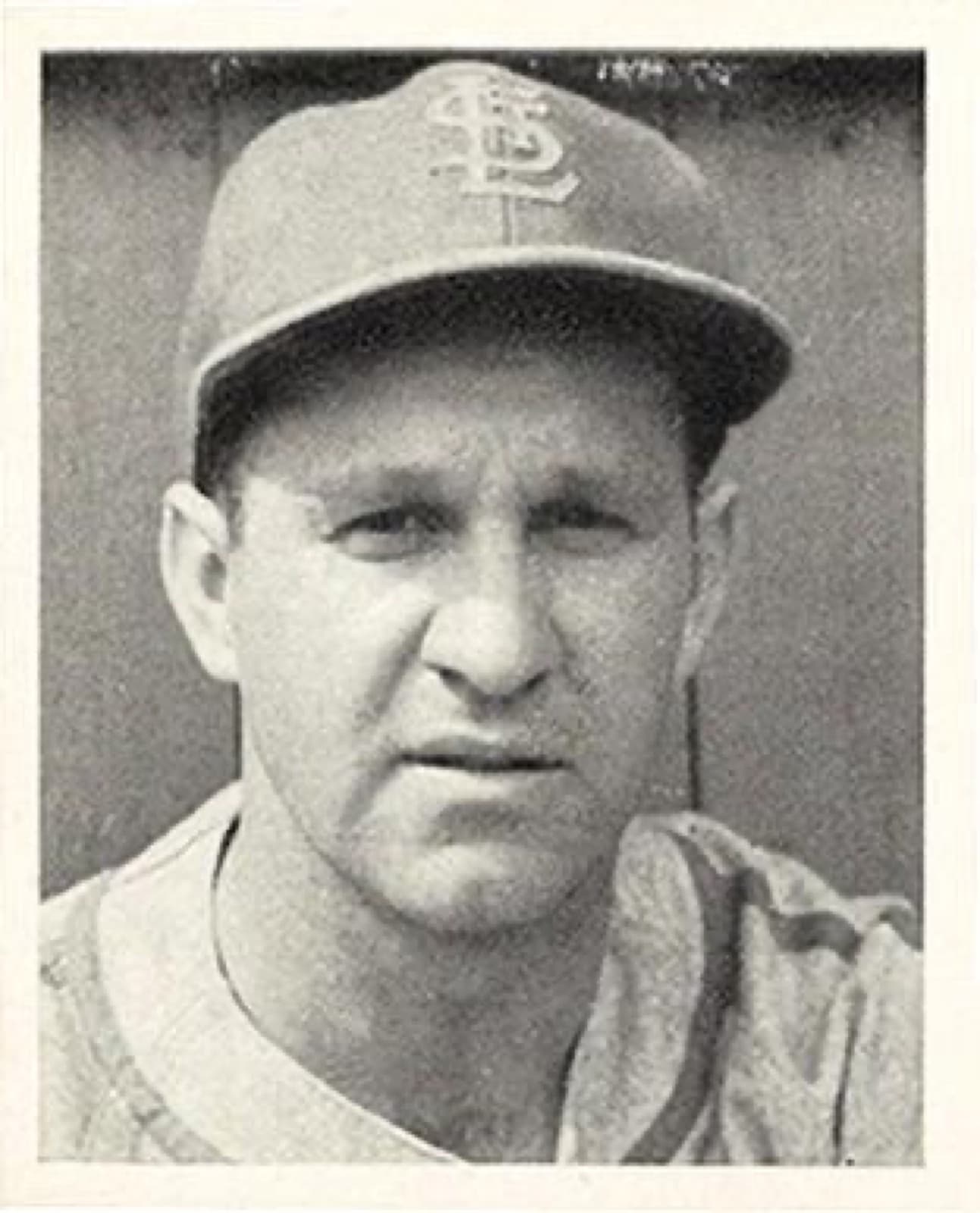
Enos Slaughter portrait with the Cardinals.
Photo credit: St. Louis Cardinals - 1941 Team Issue via Wikimedia Commons (Public domain)
Enos Bradsher Slaughter ran to first base on walks, ran to his position between innings, and ran from first to home on a hit to left center in Game 7 of the 1946 World Series while the relay man held the ball, scoring the run that won the championship and producing one of the five or six plays that baseball will never stop arguing about. Slaughter batted .300 with 2,383 hits across 19 seasons, lost three prime years to military service, earned 10 All-Star selections, and played with a fury that Frankie Frisch summarized in five words. "The most hustling so-and-so in the game today." Casey Stengel called him "one of the greatest. He will do anything to beat you." Pete Rose, who as a boy in Cincinnati watched Slaughter draw a walk on television and sprint to first base, decided then that he would play the game the same way for the rest of his life. The Veterans Committee elected Slaughter to the Hall of Fame in 1985.
Roxboro
Slaughter was born on April 27, 1916, in Roxboro, North Carolina, the third of six children raised on a 90-acre farm in nearby Allensville. His parents Zadok and Lonie grew tobacco, and Slaughter picked it alongside them. Manager Burt Shotton gave him the nickname "Country" during his minor league days in 1937 because Slaughter looked like he had just walked off the farm, which he had. The lesson that defined his career came in the minors, when manager Eddie Dyer caught him jogging toward the dugout after a fly ball. "Son, if you're tired, we'll try to get you some help," Dyer said. Slaughter never loafed again.
Slaughter reached the Cardinals in 1938 and joined a franchise still carrying the spirit of the Gas House Gang, though the original members had moved on. In 1942 the Cardinals trailed the Dodgers by 10 games in early August, then won 43 of their last 51 to take the pennant, and Slaughter led the league with 188 hits, 17 triples, and 292 total bases. The Cardinals beat the Yankees in the World Series, and in Game 5 Slaughter was hit on the elbow by a pitch, then stole second base to show he didn't care. He entered the Army Air Corps after the 1942 season and missed three full years.
The Mad Dash
Slaughter returned from the military in March 1946 and picked up where he left off, batting .300 and helping the Cardinals win the pennant. The 1946 World Series against the Red Sox went to a seventh game at Sportsman's Park on October 15, with the score tied 3-3 in the bottom of the eighth. Slaughter singled off reliever Bob Klinger, and after two outs, manager Eddie Dyer called for a hit and run with Harry Walker at the plate. Walker lined a ball into left center field, and Slaughter, who was already running at full speed, never stopped. Leon Culberson, a defensive replacement for Dom DiMaggio (who had pulled his hamstring tying the game earlier that inning), fielded the ball and relayed to shortstop Johnny Pesky. Pesky hesitated. Slaughter slid across the plate well ahead of the throw.
Pesky carried the blame for the rest of his life, saying, "I'm the goat. I never expected he'd try to score." Slaughter said he never would have tried it if DiMaggio had still been in center field, because DiMaggio's arm would have cut him down. "It was a gutsy play," Slaughter said. "But, you know, two men out and the winning run. You can't let the grass grow under your feet." The Associated Press compared the dash to Paul Revere's ride.
The Trade
Slaughter spent 13 seasons with the Cardinals and expected to finish his career in St. Louis. Two days before Opening Day 1954, the Cardinals traded him to the Yankees for Bill Virdon, Mel Wright, and a minor leaguer. The club wanted to get younger and handed right field to rookie Wally Moon. Slaughter wept openly, and his teammate Stan Musial did too. "This is the biggest shock of my life," Slaughter said. "I've given my life to this organization, and they let you go when they think you're getting old."
With the Yankees, Slaughter won two more World Series rings, in 1956 and 1958. In Game 3 of the 1956 World Series against the Dodgers, Slaughter hit a three-run home run off Roger Craig at 40 years old. He played his final games with the Milwaukee Braves in 1959.
On August 20, 1947, during a game against the Brooklyn Dodgers at Ebbets Field, Slaughter's spikes tore into Jackie Robinson's leg at first base, gashing Robinson's leg. Robinson said Slaughter did it deliberately. Slaughter denied it for the rest of his life, saying he never intentionally spiked anyone. The incident, combined with allegations that he helped organize a player strike against Robinson's promotion, shadowed Slaughter's candidacy with New York-based BBWAA writers and contributed to the Veterans Committee, rather than the writers, eventually electing him.
Roxboro Again
Slaughter retired to a 240-acre farm near Roxboro, where he grew tobacco, watermelons, and vegetables. He coached baseball at Duke University from 1971 to 1977, compiling a 68-120 record, and published his autobiography, "Country Hardball," in 1991. The Cardinals retired his number 9 on September 6, 1996. Lou Brock spoke at Slaughter's funeral and said, "History finds us together. The name of Enos Slaughter will be spoken for generations to come." Slaughter died of non-Hodgkin's lymphoma on August 12, 2002, at Duke University Medical Center, at 86.