Profile
Hank O'Day
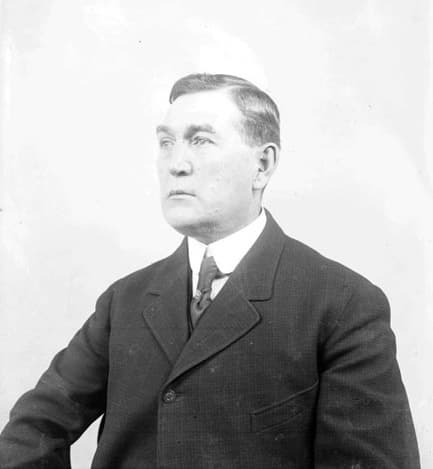
Hank O'Day portrait, 1907.
Photo credit: Unknown photographer via Wikimedia Commons (Public domain)
Hank O'Day pitched in the major leagues, managed two clubs, and then spent 30 years as a National League umpire, the only man ever to do all three for full seasons in the league. He worked 10 World Series and made the most argued call of the dead-ball era, ruling Fred Merkle out in 1908 in a decision that cost the New York Giants a pennant and handed it to the Chicago Cubs. A solitary, unsmiling man they called the Reverend, he lived alone in hotel rooms and gave the game everything he had. The Pre-Integration Era Committee elected him to the Hall of Fame in 2013.
A Pitcher and a Wandering Career
O'Day was born on July 8, 1859, in Chicago, the son of deaf Irish immigrants, and he grew up fluent in sign language. He came up as a pitcher in 1884 and bounced through bad teams for years until the pennant-chasing Giants bought him in the middle of the 1889 season, and he won nine games down the stretch to carry New York to the pennant. In the 1889 World Series against Brooklyn he was the hero, winning two games, one of them a 2-1 victory in 11 innings, with a 1.17 earned run average. He finished his pitching days with a losing record on weak teams, threw one strong season in the Players' League, and found his real calling once his arm gave out.
The Best Umpire of the Dead-Ball Era
O'Day became a National League umpire in 1895 and worked the job for more than 30 years, nearly 4,000 games, trusted with more of the league's biggest moments than anyone but Bill Klem. He knew the rulebook cold, an executive once calling him an encyclopedia of the game, and he wrote the foul-strike rule that still stands. He was feared and incorruptible in equal measure. "It is as dangerous to argue with him," Christy Mathewson said, "as it is to try to ascertain how much gasoline is in the tank of an automobile by sticking down the lighted end of a cigar." O'Day gave his own creed plainly. "I know no friends nor enemies on the field," he said.
The Warren Gill Game
Three weeks before the call that made him famous, O'Day got a dress rehearsal. On September 4, 1908, in Pittsburgh, a Pirates runner scored the apparent winning run from third while the runner on first, seeing the run cross, turned for the clubhouse without touching second. Johnny Evers of the Cubs called for the ball, stepped on the bag, and demanded a force out. O'Day refused, because he had not seen whether the runner touched the base, and the run stood. The league president upheld the decision, but only because O'Day had not watched the play, which left the rule itself alive. O'Day filed the lesson away.
Merkle's Boner
On September 23, 1908, at the Polo Grounds, with the Giants and Cubs all but tied for first, the same play happened again. Two out in the ninth, the score 1-1, Al Bridwell singled home what looked like the winning run, and the Giants' rookie Fred Merkle, on first, broke for the clubhouse without touching second. Evers screamed for the ball in the chaos of fans pouring onto the field. This time O'Day, working the plate, had been watching the runner on purpose. He conferred with his base umpire, confirmed that Merkle never touched second, called the force out, wiped the run off the board, and ruled the game a tie. The crowd swarmed him, and the police had to carry him off the field.
The Call That Decided a Pennant
The ruling held, and the league president backed O'Day through a storm of fury, the Giants and Cubs finished the season tied, and the Cubs won the October replay and the pennant, then the 1908 World Series, the last they would win for 108 years. John McGraw never forgave O'Day, and neither did New York, but the umpire had the rule on his side and never wavered. Even Bill Klem, who called it the worst decision in the history of baseball, conceded in the same breath that Evers had talked a great umpire into it.
The Reverend
Off the field O'Day lived like a hermit. He never married, never owned a home, lived his whole career alone in hotel rooms, and ate alone, a dour man with few friends and no use for parties or company. They called him the Reverend for a face that was never seen to smile. "It is a National League tradition," one magazine wrote, "that Henry has never yet been known to smile." He had understood sign language from boyhood, and when a deaf pitcher once cursed him in signs, O'Day, reading every word, ejected and fined him. His idea of an evening was an hour of silence on a fellow umpire's porch.
The Only Man to Play, Manage, and Umpire
Twice O'Day left the field to manage, and twice he came back to it. He ran the Cincinnati Reds to a fourth-place finish in 1912 and the Chicago Cubs to fourth in 1914, and both times he returned to umpiring, the work that suited his solitary, exacting temperament far better than handling a clubhouse of men. No one else ever served full National League seasons as a player, a manager, and an umpire. He worked 10 World Series, starting with the first modern one in 1903, and stayed on the field until 1927, when he was nearly 70, the oldest umpire the major leagues had ever had.
Forgotten, Then Remembered
O'Day died in Chicago in 1935, a bachelor with no children, remembered mostly for one call against a rookie. The Hall of Fame opened the next year and ignored the umpires for decades, and when it finally took two, in 1953, it chose Tom Connolly over O'Day. He waited 78 more years. The Pre-Integration Era Committee elected him in 2013, the tenth umpire in the Hall, and his grandnephew, a retired Chicago policeman, spoke for the family. "The lesson of Hank O'Day," he said, "is do your best with honesty and integrity."