Profile
Jacob Ruppert
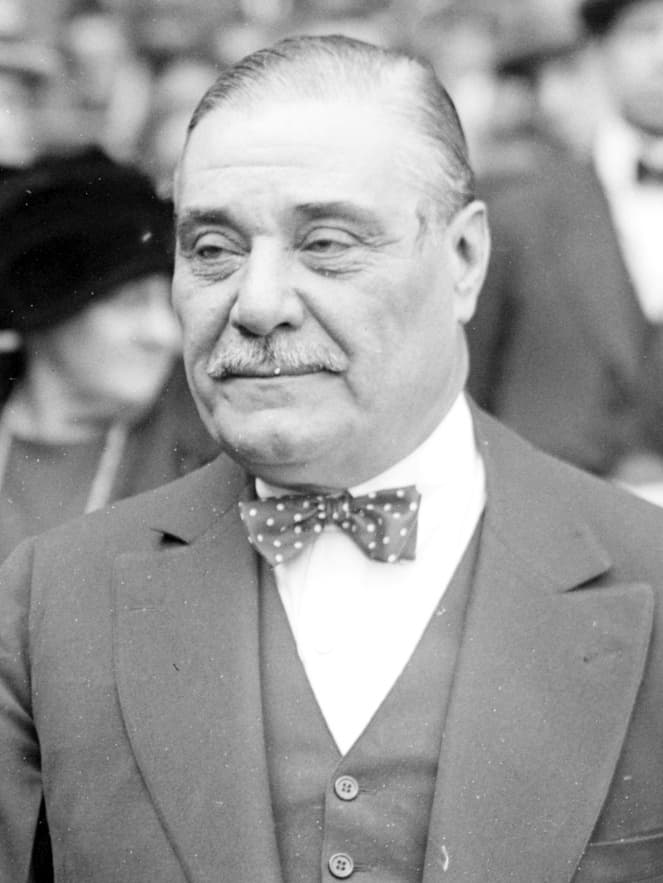
Jacob Ruppert portrait, circa 1923.
Photo credit: Bain News Service via Wikimedia Commons (Public domain)
Jacob Ruppert was a beer baron, a four-term congressman, and a National Guard colonel who never saw combat, and he spent his brewery fortune turning the New York Yankees from an afterthought into the most powerful team in American sports. He bought a losing club in 1915, paid a record price for Babe Ruth, built Yankee Stadium, and won 10 pennants and seven World Series before he died. He liked his wins lopsided and his ballpark full, and he insisted on being called Colonel. The Pre-Integration Era Committee elected him to the Hall of Fame in 2013, almost 75 years after his death.
The Beer Baron and the Colonel
Ruppert was born on August 5, 1867, in New York City, into a German-American brewing family, and he started at the bottom of the family business washing barrels before he built the Jacob Ruppert Brewery into one of the largest in the country, a two-million-barrel operation in Yorkville with a thousand men on the payroll. He served four terms in Congress as a Tammany Hall Democrat from 1899 to 1907, held an honorary colonel's commission as aide-de-camp to the governor, and carried the title for the rest of his life. When Prohibition arrived in 1920 it cut the brewery's output by most of a million barrels a year, and the Yankees became the thing he poured himself into.
Buying Baseball's Orphan
The team Ruppert bought in 1915 was a sorry one, a New York franchise called the Highlanders that had spent a decade going nowhere under a gambler and a former police official, renting space in the Giants' Polo Grounds, and the American League president Ban Johnson wanted respectable money behind his New York club. He steered Ruppert to it. Ruppert and a partner, the engineer Tillinghast Huston, bought the team for about $460,000, and Ruppert later summed up the purchase without affection. They had bought, he said, "an orphan ball club, without a home of its own, without players of outstanding ability, without prestige."
The Feud with Huston
Ruppert and Huston did not get along. The deepest rift was over the manager, with Huston backing Wilbert Robinson and Ruppert hiring Miller Huggins in 1917 without telling his partner, and it festered for years. After a World Series loss in 1922, Huston declared that Huggins had managed his last Yankee game. Ruppert refused to do it. "I won't fire a man who has just brought the Yankees two pennants," he said, and instead he bought Huston out, paying more than a million dollars to run the team alone. The buyout closed in 1923, the year everything came together.
The $100,000 Player
The move that remade the franchise came after the 1919 season, when Ruppert paid the cash-strapped Boston owner Harry Frazee $100,000 for Babe Ruth and lent him another $300,000 against a mortgage on Fenway Park. It was the highest price ever paid for a player, and it was a bargain. Ruth hit 54 home runs in his first New York season, almost double the record he had set the year before, the Yankees jumped from also-rans to a 95-win team, and nearly 1.3 million fans came through the gates to watch him. Ruppert had bought the biggest draw the sport had ever known.
The House That Ruth Built
Ruth drew so well that the Giants, tired of being upstaged by their tenants, pushed the Yankees out of the Polo Grounds. Ruppert built his own ballpark across the Harlem River in the Bronx, a triple-decked structure so grand the writers reached for a new word and called it a stadium. Yankee Stadium opened on April 18, 1923, cost a little over two million dollars, and was soon christened the House That Ruth Built. Ruppert enjoyed the role reversal. "Yankee Stadium is a mistake," he liked to say. "Not mine, but the Giants'." The Yankees won the World Series there that fall, the first championship in franchise history.
A Dynasty and a Taste for Lopsided Wins
Ruppert spent what it took and trusted the men he hired. He brought in Ed Barrow to run baseball operations, and Barrow built a front office and, with George Weiss, a farm system that kept the talent coming, from the Murderers' Row team of 1927 through the three straight titles of 1936 to 1938 behind Joe DiMaggio and Lou Gehrig. Ten pennants and seven World Series came in Ruppert's 24 years, and he wanted every one of them to be a rout. "He wanted them to win every game by a top-heavy score," Barrow remembered. Ruppert described his idea of a perfect afternoon as the Yankees scoring eight runs in the first inning and slowly pulling away.
The Bachelor and His St. Bernards
Away from the ballpark Ruppert lived like a man with more money than he could spend. He bred champion St. Bernards, kept monkeys and exotic birds at his estate up the Hudson at Garrison, and filled his homes with jade, porcelain, and oil paintings. He never married, a fastidious bachelor whose one unfilled want was a winner he could call his own, and the Yankees gave it to him so completely that the question of why he stayed single mostly went unasked. Estimates of his fortune ran as high as forty million dollars, though the figure that cleared probate was closer to six and a half.
The Deathbed and Cooperstown
Ruppert died on January 13, 1939, at 71, drifting in and out of a coma in his final days. Ed Barrow stood at the bedside when he surfaced once and asked whether the Yankees would win the pennant again. "We'll win again, Colonel," Barrow told him. Babe Ruth, long gone from the team and never close to the buttoned-up old man who had paid him, came too, and Ruppert reached out and said one word, "Babe." Ruth said it was the only time in his life the Colonel called him that to his face. The Yankees won a fourth straight title that fall, and the Pre-Integration Era Committee, decades late for the man who built the greatest dynasty in the game, elected him to the Hall of Fame in 2013.